







Question: Gambler's Ruin. any help will be appreciated 1 Problem As mentioned in class the Gambler Ruin problem can be formulated as follows: Two players A
Gambler's Ruin. any help will be appreciated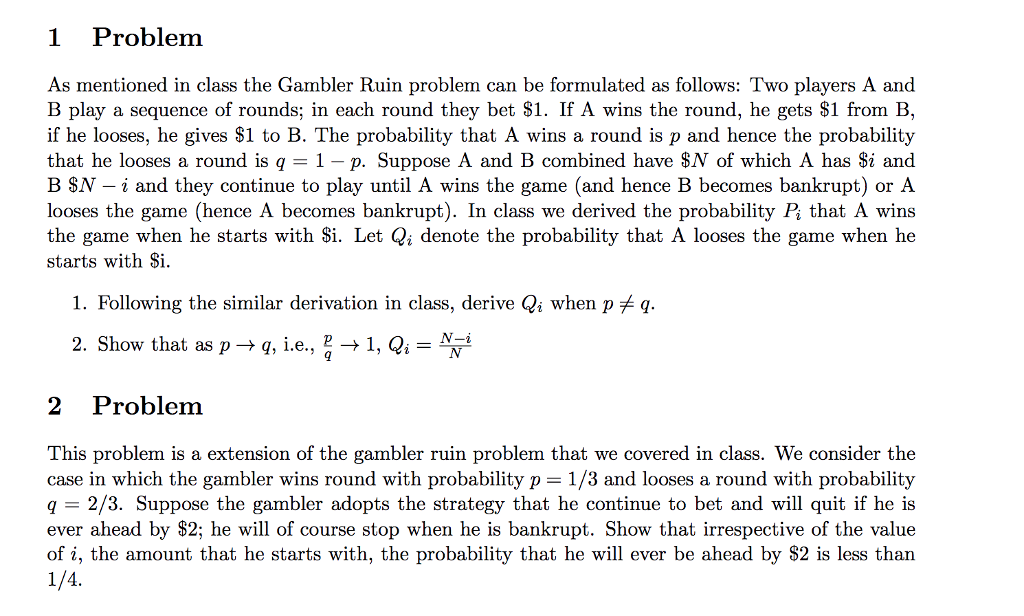
1 Problem As mentioned in class the Gambler Ruin problem can be formulated as follows: Two players A and B play a sequence of rounds; in each round they bet $1. If A wins the round, he gets $1 from B, if he looses, he gives $1 to B. The probability that A wins a round is p and hence the probability that he looses a round is q = 1 - p. Suppose A and B combined have $N of which A has $i and B $N i and they continue to play until A wins the game (and hence B becomes bankrupt) or A looses the game (hence A becomes bankrupt). In class we derived the probability P? that A wins the game when he starts with $i. Let Qi denote the probability that A looses the game when he starts with $i. 1. Following the similar derivation in class, derive Qi when p = a. 2. Show that as p q, i.e., 4 1, Qi = Na i 2 Problem This problem is a extension of the gambler ruin problem that we covered in class. We consider the case in which the gambler wins round with probability p= 1/3 and looses a round with probability q = 2/3. Suppose the gambler adopts the strategy that he continue to bet and will quit if he is ever ahead by $2; he will of course stop when he is bankrupt. Show that irrespective of the value of i, the amount that he starts with, the probability that he will ever be ahead by $2 is less than 1/4. 1 Problem As mentioned in class the Gambler Ruin problem can be formulated as follows: Two players A and B play a sequence of rounds; in each round they bet $1. If A wins the round, he gets $1 from B, if he looses, he gives $1 to B. The probability that A wins a round is p and hence the probability that he looses a round is q = 1 - p. Suppose A and B combined have $N of which A has $i and B $N i and they continue to play until A wins the game (and hence B becomes bankrupt) or A looses the game (hence A becomes bankrupt). In class we derived the probability P? that A wins the game when he starts with $i. Let Qi denote the probability that A looses the game when he starts with $i. 1. Following the similar derivation in class, derive Qi when p = a. 2. Show that as p q, i.e., 4 1, Qi = Na i 2 Problem This problem is a extension of the gambler ruin problem that we covered in class. We consider the case in which the gambler wins round with probability p= 1/3 and looses a round with probability q = 2/3. Suppose the gambler adopts the strategy that he continue to bet and will quit if he is ever ahead by $2; he will of course stop when he is bankrupt. Show that irrespective of the value of i, the amount that he starts with, the probability that he will ever be ahead by $2 is less than 1/4
Step by Step Solution
There are 3 Steps involved in it

Get step-by-step solutions from verified subject matter experts
 Study Help