







Question: Geidelines for Article summaries docx During weeks two and three of MGMT 4853, students will synthesize and summarize the information contained in each of eight
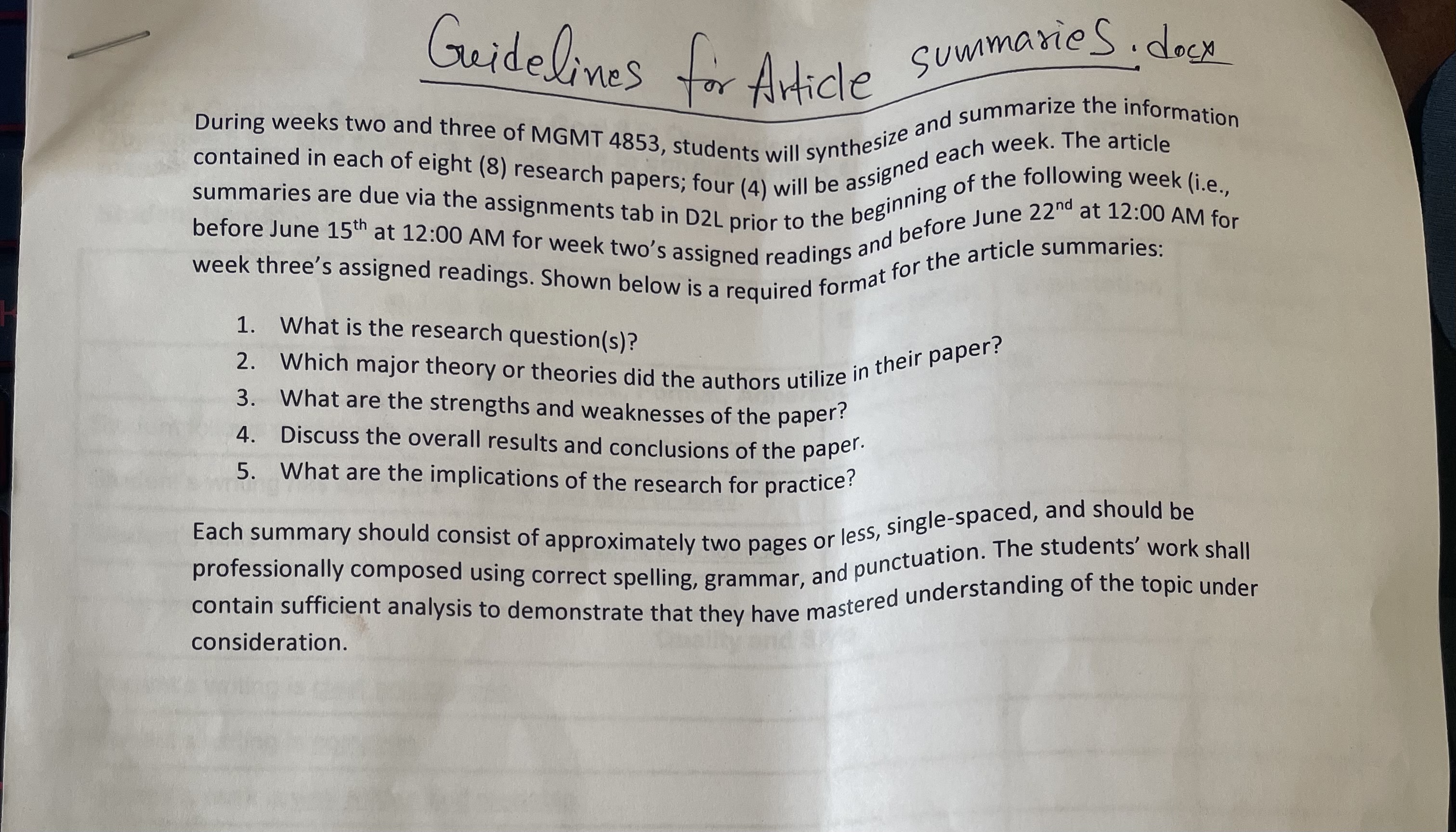
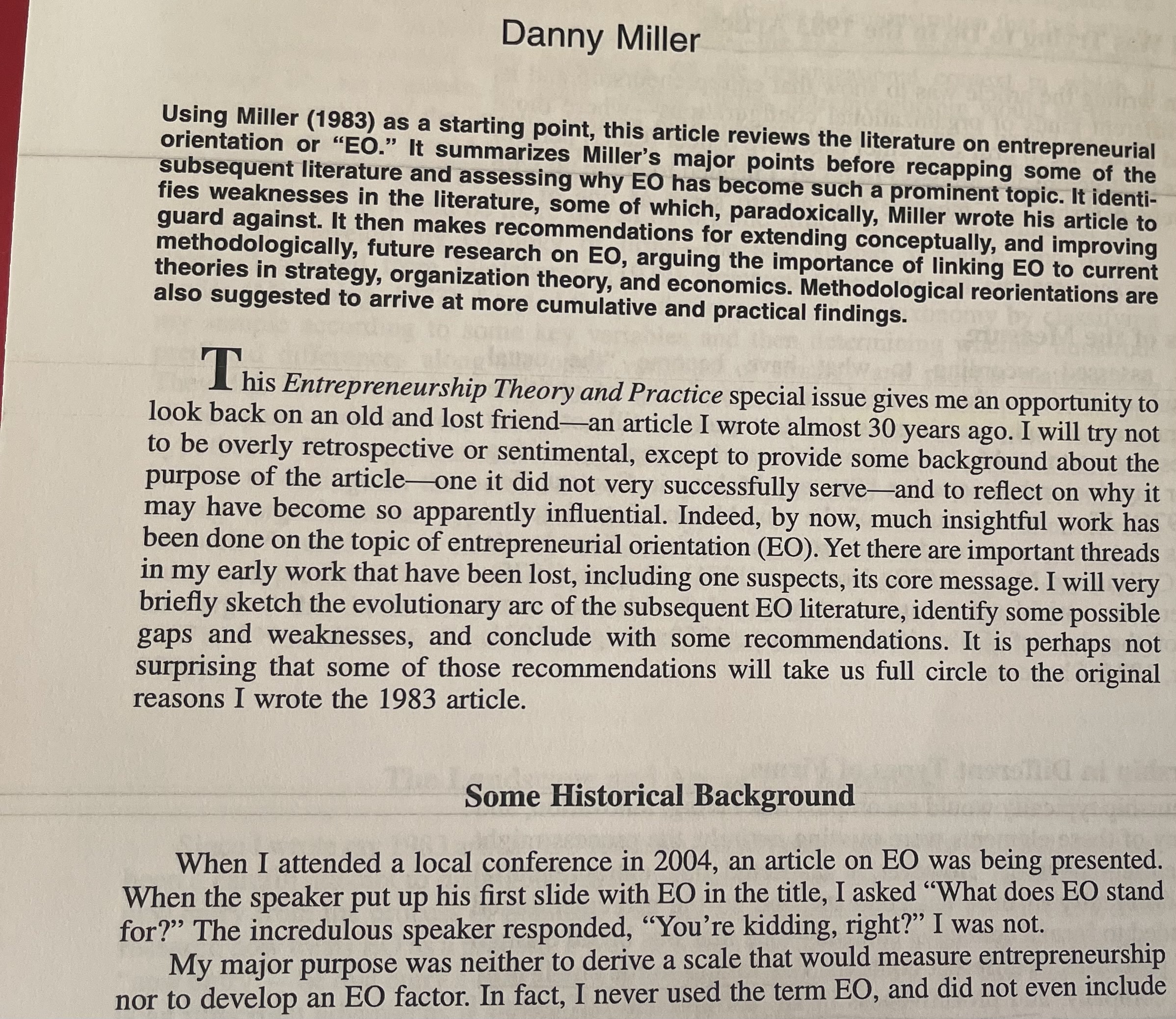
Geidelines for Article summaries docx During weeks two and three of MGMT 4853, students will synthesize and summarize the information contained in each of eight (8) research papers; four (4) will be assigned each week. The article summaries are due via the assignments tab in D2 2 prior to the beginning of the following week (i.e., before June 15th at 12:00 AM for week two's assigned readings and before June 22nd at 12:00 AM for week three's assigned readings. Shown below is a required format for the article summaries: 1. What is the research question(s)? 2. Which major theory or theories did the authors utilize in their paper? 3. What are the strengths and weaknesses of the paper? 4. Discuss the overall results and conclusions of the paper. 5. What are the implications of the research for practice? Each summary should consist of approximately two pages or less, single-spaced, and should be professionally composed using correct spelling, grammar, and punctuation. The students' work shall contain sufficient analysis to demonstrate that they have mastered understanding of the topic under consideration. Using Miller (1983) as a starting point, this article reviews the literature on entrepreneurial orientation or "EO." It summarizes Miller's major points before recapping some of the subsequent literature and assessing why EO has become such a prominent topic. It identifies weaknesses in the literature, some of which, paradoxically, Miller wrote his article to guard against. It then makes recommendations for extending conceptually, and improving methodologically, future research on EO, arguing the importance of linking EO to current theories in strategy, organization theory, and economics. Methodological reorientations are also suggested to arrive at more cumulative and practical findings. This Entrepreneurship Theory and Practice special issue gives me an opportunity to look back on an old and lost friend-an article I wrote almost 30 years ago. I will try not to be overly retrospective or sentimental, except to provide some background about the purpose of the article-one it did not very successfully serve-and to reflect on why it may have become so apparently influential. Indeed, by now, much insightful work has been done on the topic of entrepreneurial orientation (EO). Yet there are important threads in my early work that have been lost, including one suspects, its core message. I will very briefly sketch the evolutionary arc of the subsequent EO literature, identify some possible gaps and weaknesses, and conclude with some recommendations. It is perhaps not surprising that some of those recommendations will take us full circle to the original reasons I wrote the 1983 article. Some Historical Background When I attended a local conference in 2004, an article on EO was being presented. When the speaker put up his first slide with EO in the title, I asked "What does EO stand for?" The incredulous speaker responded, "You're kidding, right?" I was not. My major purpose was neither to derive a scale that would measure entrepreneurship nor to develop an EO factor. In fact, I never used the term EO, and did not even include
Step by Step Solution
There are 3 Steps involved in it

Get step-by-step solutions from verified subject matter experts
 Study Help