







Question: gen physics 2 Example: (a) What is the value of the peak voltage for 120-V AC power? (b) What is the peak +V. power consumption
gen physics 2
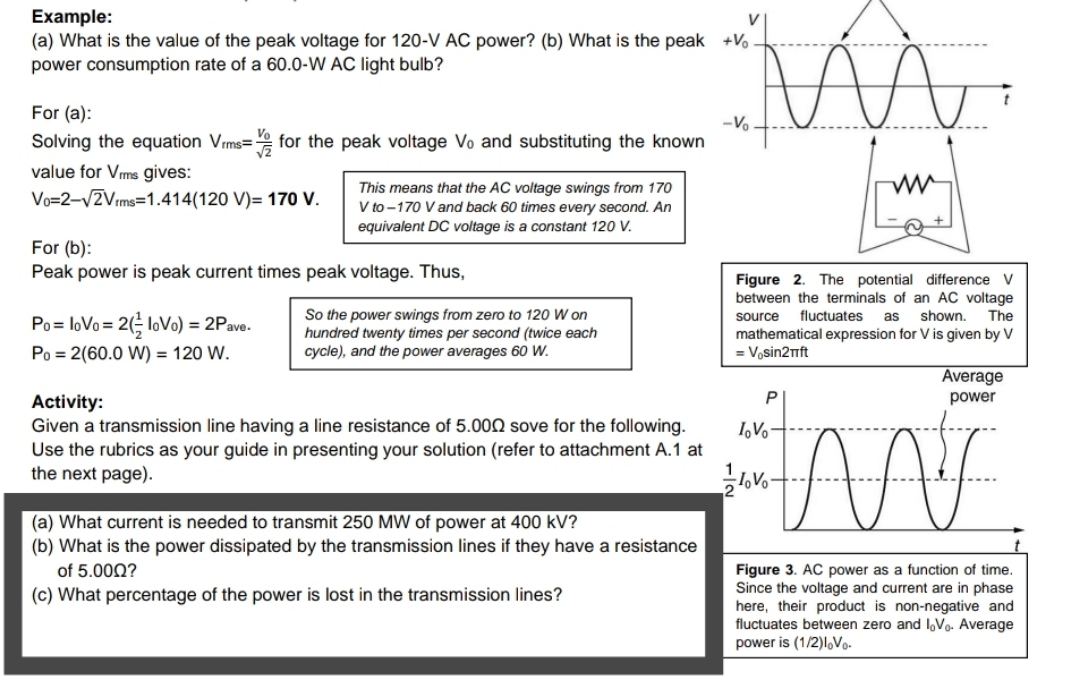
Example: (a) What is the value of the peak voltage for 120-V AC power? (b) What is the peak +V. power consumption rate of a 60.0-W AC light bulb? For (a): -Vo Solving the equation Vims= - for the peak voltage Vo and substituting the known value for Vims gives: Vo=2-V2Vrms=1.414(120 V)= 170 V. This means that the AC voltage swings from 170 V to-170 V and back 60 times every second. An equivalent DC voltage is a constant 120 V. For (b): Peak power is peak current times peak voltage. Thus, Figure 2. The potential difference V between the terminals of an AC voltage Po= loVo= 2( loVo) = 2Pave. So the power swings from zero to 120 W on source fluctuates as shown. The hundred twenty times per second (twice each mathematical expression for V is given by V Po = 2(60.0 W) = 120 W. cycle), and the power averages 60 W. = Vosin2rift Average Activity: Given a transmission line having a line resistance of 5.000 sove for the following. Use the rubrics as your guide in presenting your solution (refer to attachment A.1 at the next page). (a) What current is needed to transmit 250 MW of power at 400 kV? (b) What is the power dissipated by the transmission lines if they have a resistance of 5.000? Figure 3. AC power as a function of time. (c) What percentage of the power is lost in the transmission lines? Since the voltage and current are in phase here, their product is non-negative and fluctuates between zero and loVo- Average power is (1/2)loVo
Step by Step Solution
There are 3 Steps involved in it

Get step-by-step solutions from verified subject matter experts
 Study Help