General Comments on the Deaver Brown Case:
The Deaver Brown case involves making a 10-minute verbal sales presentation to the buyer. Three or four students have been asked to make the verbal presentation. The rest of the class is to write a presentation just as if they were going to do it verbally. This will involve guessing what the buyer will ask and answering the questions. I'd suggest preparing what you would say going through the steps of a sales presentation as described in the assigned reading in the 4th Edition of our text Entrepreneurial Small Business, pages 332-334 (In the 3rd Edition the pages are 319-322). Remember that you have only 10 minutes and that is too short to go through a lot of questions of the buyer. You should know his company and should know what would likely be of interest to him before you get to his office. It would be good to know what your deal is that you are proposing and get on with telling him about your product, how it will be good for him and for his customers, what your deal is that you are proposing and make some trial closes. Remember that it is only 10 minutes - not as formal as a PowerPoint presentation. Just person-to-person selling with no sales aids.
Points to remember
- Put yourself in the shoes of the buyer
- How the stroller and its package make it easy to store, display and carry
- What the buyer's personal situation is (tenure, pending retirement, etc.)
- Remember, this is a 10-minute sales call - no time for small talk or unnecessary questions
- Understand the balance of power
- They don't need you. You need them
- Know what you want out of the sales call
- A big order or just any order?
- Master the details
- Read the case several times and know the facts cold
- Be prepared to shoot from the hip. The buyer will ask questions for which the answers are not in the case. Answer what you think you can do as the president of the company. "I'll have to check and get back to you" is a weak answer as president - you can make it happen if it is a reasonable request!
GET THE ORDER!
Additional Description of Umbroller
- Collapsible for travel and storage
- Adjustable reclining seat
- Sleek and aerodynamic design
- Easy no-tool assembly
- Light weight and easy to fold
- Six-month warranty
- Adjustable safety harness
- Four storage pockets
- Multiple canopy with screen side to let the air in
- Bicycle style hand brakes
- Adjustable angle back seat
- Foot operated parking brake
- Four color presentation box for floor display
Prepare: Deaver Brown & Cross River Case (Canvas) A written word-for-word ten-minute sales presentation to the buyer and a grading sheet showing four criteria (hint: read The Process of Personal Selling pages 319-322 ESB) to grade the presentations that three selected students will give in class. Each student including those who will give their presentations in class must submit a written ten-minute narrative and the four-point grading sheet. If your surname begins with A through K prepare your presentation for the K-Mart buyer. If you surname begins with L through Z prepare your presentation for the Macys buyer. A buyer guest will be in class for students selected in advance to give their presentations. Note: Use the General Comments on the Deaver Brown Case - as an aid in preparing the sales presentation write-up.
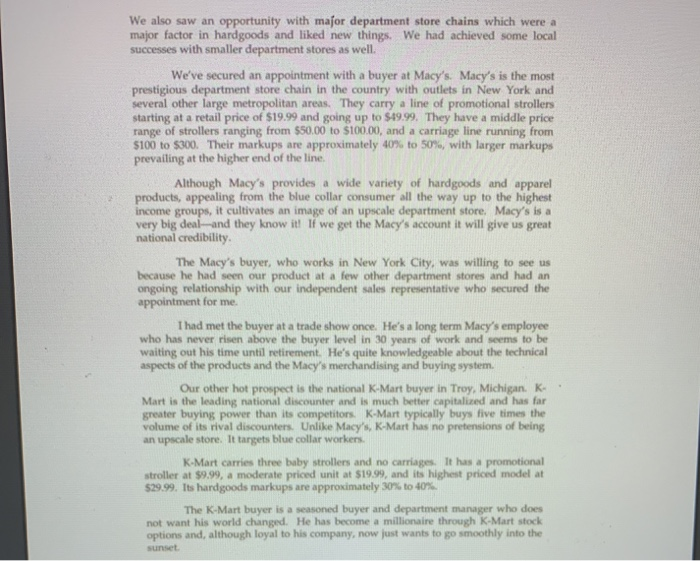
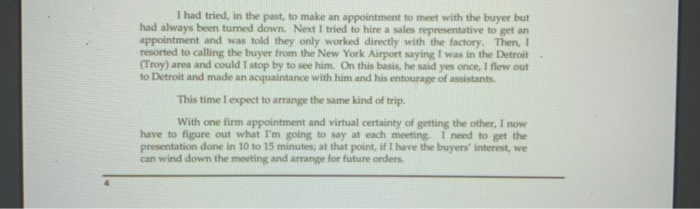
Deaver Brown and Cross River Inc. Deaver Brown, co-founder and CEO of Cross River Inc., had finally connected with the buyers of K-Mart and Macy's. Deaver and his partner, Alex Goodwin, had started Cross River in 1970 to manufacture, market, and sell baby strollers. A year later, the company was selling approximately 2,000 units a month almost entirely through small stores. Deaver and Alex believed that Cross River now had to sell through higher volume channels such as discount stores and department store chains; otherwise, their company would struggle along going nowhere and eventually disappear. Therefore, Deaver felt, his presentation to the K-Mart and Macy buyers could determine the future of their company. Background After graduating from Harvard Business School in 1968, Deaver had joined General Foods. A year later, he began investigating opportunities to start his own business Deaver recalled: I had worked at General Foods on one highly advertised, differentiated brand, Cool Whip, and on one commodity oriented product line, Birds Eye Vegetables I had found that the Vegetable business was more fun than Cool Whip because no one cared much about it. They left it to me trusted me with the decisions, appreciated my successes and were not overly concerned with my failures. It seemed as if I was running my own little backwater business. It was fun and I learned a lot as I won a few and lost a few battles along the way. The clear feedback was probably the most satisfying element of the job succes were mine failures were mine. No excuses were available! This helped me define my thinking about a new business to pursue on my own Essentially, I decided to pursue backwater businesses that had a steady customer stream in the consumer product area. After many investigations and false starts, I teamed up with an old friend, Alex Goodwin, to make an innovative baby Stroller Alex had found a light weight folding stroller, invented by an Englishman The inventor had tried to license the product but all of the American companies in the industry turned it down because the conventional wisdom said it was not heavy 354-642 Deaver Brown and Cross River Inc. and durable enough for the American consumer. Alex had found the easy-to-carry stroller perfect for his mobile lifestyle and suggested that we get the license We checked out the market facts about strollers. We found that 1400,000 baby strollers and 300,000 carriages were sold at wholesale in 1969. Total wholesale sales of baby strollers were $24.500.000 and total sales of carriages were $14.000.000 Despite the visibility of these products one often sees strollers rolling down streets the category was very small. The birth rate was in decline: parenting was out of favor. Only about 5% of the population at any time had a use for a baby stroller either for personal or family use or as a gift. The market was divided among about 20 manufacturers. The primary methods of distribution were general mass merchants such as Sears, Wards, Penney. department stores such as Macy's small juvenile fumiture shops, especially in large cities such as New York, and emerging retail classifications such as discounters, mail order, and catalog showrooms. I checked out the production facts and found the product that I dubbed the Umbroller, contraction of the words umbrella and stroller would cost approximately $8.00 to make in reasonable volumes and $6.50 in 100.000's of units. The assembly process would be reasonably complex with 12 rivets, a frame consisting of 12 pieces of tube, one sent, 12 steel brackets, and plastic handles. A lot of work! The fragmentation of competition, among 20 plus companies, coupled with the fragmentation of distribution, meant that getting started would not be too difficult because no dominant players existed. The problem, however, was that though our company might get launched and even survive the odds of becoming a lange, dominant player were small. Distribution channels, for example, were extremely fragmented and no single success would have a large payback. In sum, successful launch might not bring much return other than a company in what I called "The Land of the Living Dead. The First Year I left General Foods, and we invested about $30.000 from a combination of personal savings and a bank loan backed by personal guarantees to launch Cross River. We had expected to license the product after launch and we offered big money for the rights, but we were turned down. We decided to go ahead anyway we had studied the patient and Alex thought we could beat it in court. We were subsequently sued, and the matter is now pending We made prototypes and tried a test market in Buffalo but no retailer would buy it. Nevertheless we took our product to a trade show to see if we could get orders, Alex and I had sold various things together in high school. They ranged from products for teenagers to a niche Maine record called "Bert and L" with Maine humor, to record stores. We sold the records through hustle and salesmanship. Alex and I were back to hustle and salesmanship Denver Brown Cross Riverine At the trade show, Alex and I were pretty good at button-holing small dealers penting penal to peper, and petting the orders. But dealing with salaried buyers from the chain wakening in We got nowhere We did buttonhole a buyer from Belees who bought our argument about and t he then later, we found out the buyer had with Bradloes to start his own business. We had not been good to this guy we had been lucky. We had to eves trying to get out of the company world My MBA training and GF work experience coupled with Alex's flair for sales and marketing helped us put together a solid marketing foundation. We had the first four color self-service carton; we advertised in the one niche periodical, American Baby, a small consistent ad; we advertised in two trade journals we put together a solid sales literature package. We hired about 20 reps who worked for the company on a commission only basis. Small business economics are very simple, though unforgiving We needed to sell 2,000 strollers per month to break-even: We received $13.50 per unit from the retailers (who then sold it with a mark-up! for about $25). Our variable cost per unit was $9.35: $8.00 of product cost plus 5% commission of $.675 plus 5% miscellaneous variable expense of discounts, returns, and the like of $.675. So Cross River netted $4.15 per stroller Our fixed costs ran at $5.300 per month. We paid ourselves $2,500 (51,250 each) Our monthly ads in American Baby, Small World, and Juvenile Merchandising cost $1,935. The rest was spent on travel expenses, phones, promotional material, professional fees, and the like We had achieved break-even through November 1971 on a month to month basis. But we hadn't shipped product for the orders we had written in October 1970 until January 1971 and we ate up our capital during this period. Landing a major account We had to do more than break even. In fading up to our problems of mediocrity, we determined the problem was bugging a major account or two that could take us up to the level of 4,000 to 6,000 units per month and propel us to a higher level of success We eliminated the mass merchants: this was an old boy network, we were unlikely to crack it and a major effort would be required. National discounters were a more likely group. Compared to the established mass merchants, these were the Young Turks, more anxious to do things and try things We had already achieved some success with small local discounters. However, the discounters were blue collar oriented. They wanted a lower price than we felt we could give them R eseally referred to make as a percentage of the price We also saw an opportunity with major department store chains which were a major factor in hardgoods and liked new things. We had achieved some local successes with smaller department stores as well. We've secured an appointment with a buyer at Macy's. Macy's is the most prestigious department store chain in the country with outlets in New York and several other large metropolitan areas. They carry a line of promotional strollers starting at a retail price of $19.99 and going up to $49.99. They have a middle price range of strollers ranging from $50.00 to $100.00, and a carriage line running from $100 to $300. Their markups are approximately 40% to 50%, with larger markups prevailing at the higher end of the line Although Macy's provides a wide variety of hard goods and apparel products, appealing from the blue collar consumer all the way up to the highest income groups, it cultivates an image of an upscale department store. Macy's is a very big deal and they know it! If we get the Macy's account it will give us great national credibility The Macy's buyer, who works in New York City, was willing to see us because he had seen our product at a few other department stores and had an ongoing relationship with our independent sales representative who secured the appointment for me. I had met the buyer at a trade show once. He's a long term Macy's employee who has never rien above the buyer level in 30 years of work and seems to be waiting out his time until retirement. He's quite knowledgeable about the technical aspects of the products and the Macy's merchandising and buying system. Our other hot prospect is the national K-Mart buyer in Troy, Michigan. K Mart is the leading national discounter and is much better capitalized and has far greater buying power than its competitors. K.Mart typically buys five times the volume of its rival discounters. Unlike Macy's, K-Mart has no pretensions of being an upscale store. It targets blue collar workers. K.Mart carries three baby strollers and no carriages. It has a promotional stroller at $9.99, a moderate priced unit at $19.99, and its highest priced model at $29.99. Its hard goods markups are approximately 30% to 40% The K-Mart buyer is a seasoned buyer and department manager who does not want his world changed. He has become a millionaire through K-Mart stock options and, although loyal to his company, now just wants to go smoothly into the sunset I had tried, in the past, to make an appointment to meet with the buyer but had always been turned down. Next I tried to hire a sales representative to get an appointment and was told they only worked directly with the factory. Then, resorted to calling the buyer from the New York Airport saying I was in the Detroit (Troy) area and could I stop by to see him. On this basis, he said yes once, I flew out to Detroit and made an acquaintance with him and his entourage of assistants This time I expect to arrange the same kind of trip With one firm appointment and virtual certainty of getting the other, I now have to figure out what I'm going to say at each meeting need to get the presentation done in 10 to 15 minutes at that point, if I have the buyers interest, we can wind down the meeting and arrange for future orders Deaver Brown and Cross River Inc. Deaver Brown, co-founder and CEO of Cross River Inc., had finally connected with the buyers of K-Mart and Macy's. Deaver and his partner, Alex Goodwin, had started Cross River in 1970 to manufacture, market, and sell baby strollers. A year later, the company was selling approximately 2,000 units a month almost entirely through small stores. Deaver and Alex believed that Cross River now had to sell through higher volume channels such as discount stores and department store chains; otherwise, their company would struggle along going nowhere and eventually disappear. Therefore, Deaver felt, his presentation to the K-Mart and Macy buyers could determine the future of their company. Background After graduating from Harvard Business School in 1968, Deaver had joined General Foods. A year later, he began investigating opportunities to start his own business Deaver recalled: I had worked at General Foods on one highly advertised, differentiated brand, Cool Whip, and on one commodity oriented product line, Birds Eye Vegetables I had found that the Vegetable business was more fun than Cool Whip because no one cared much about it. They left it to me trusted me with the decisions, appreciated my successes and were not overly concerned with my failures. It seemed as if I was running my own little backwater business. It was fun and I learned a lot as I won a few and lost a few battles along the way. The clear feedback was probably the most satisfying element of the job succes were mine failures were mine. No excuses were available! This helped me define my thinking about a new business to pursue on my own Essentially, I decided to pursue backwater businesses that had a steady customer stream in the consumer product area. After many investigations and false starts, I teamed up with an old friend, Alex Goodwin, to make an innovative baby Stroller Alex had found a light weight folding stroller, invented by an Englishman The inventor had tried to license the product but all of the American companies in the industry turned it down because the conventional wisdom said it was not heavy 354-642 Deaver Brown and Cross River Inc. and durable enough for the American consumer. Alex had found the easy-to-carry stroller perfect for his mobile lifestyle and suggested that we get the license We checked out the market facts about strollers. We found that 1400,000 baby strollers and 300,000 carriages were sold at wholesale in 1969. Total wholesale sales of baby strollers were $24.500.000 and total sales of carriages were $14.000.000 Despite the visibility of these products one often sees strollers rolling down streets the category was very small. The birth rate was in decline: parenting was out of favor. Only about 5% of the population at any time had a use for a baby stroller either for personal or family use or as a gift. The market was divided among about 20 manufacturers. The primary methods of distribution were general mass merchants such as Sears, Wards, Penney. department stores such as Macy's small juvenile fumiture shops, especially in large cities such as New York, and emerging retail classifications such as discounters, mail order, and catalog showrooms. I checked out the production facts and found the product that I dubbed the Umbroller, contraction of the words umbrella and stroller would cost approximately $8.00 to make in reasonable volumes and $6.50 in 100.000's of units. The assembly process would be reasonably complex with 12 rivets, a frame consisting of 12 pieces of tube, one sent, 12 steel brackets, and plastic handles. A lot of work! The fragmentation of competition, among 20 plus companies, coupled with the fragmentation of distribution, meant that getting started would not be too difficult because no dominant players existed. The problem, however, was that though our company might get launched and even survive the odds of becoming a lange, dominant player were small. Distribution channels, for example, were extremely fragmented and no single success would have a large payback. In sum, successful launch might not bring much return other than a company in what I called "The Land of the Living Dead. The First Year I left General Foods, and we invested about $30.000 from a combination of personal savings and a bank loan backed by personal guarantees to launch Cross River. We had expected to license the product after launch and we offered big money for the rights, but we were turned down. We decided to go ahead anyway we had studied the patient and Alex thought we could beat it in court. We were subsequently sued, and the matter is now pending We made prototypes and tried a test market in Buffalo but no retailer would buy it. Nevertheless we took our product to a trade show to see if we could get orders, Alex and I had sold various things together in high school. They ranged from products for teenagers to a niche Maine record called "Bert and L" with Maine humor, to record stores. We sold the records through hustle and salesmanship. Alex and I were back to hustle and salesmanship Denver Brown Cross Riverine At the trade show, Alex and I were pretty good at button-holing small dealers penting penal to peper, and petting the orders. But dealing with salaried buyers from the chain wakening in We got nowhere We did buttonhole a buyer from Belees who bought our argument about and t he then later, we found out the buyer had with Bradloes to start his own business. We had not been good to this guy we had been lucky. We had to eves trying to get out of the company world My MBA training and GF work experience coupled with Alex's flair for sales and marketing helped us put together a solid marketing foundation. We had the first four color self-service carton; we advertised in the one niche periodical, American Baby, a small consistent ad; we advertised in two trade journals we put together a solid sales literature package. We hired about 20 reps who worked for the company on a commission only basis. Small business economics are very simple, though unforgiving We needed to sell 2,000 strollers per month to break-even: We received $13.50 per unit from the retailers (who then sold it with a mark-up! for about $25). Our variable cost per unit was $9.35: $8.00 of product cost plus 5% commission of $.675 plus 5% miscellaneous variable expense of discounts, returns, and the like of $.675. So Cross River netted $4.15 per stroller Our fixed costs ran at $5.300 per month. We paid ourselves $2,500 (51,250 each) Our monthly ads in American Baby, Small World, and Juvenile Merchandising cost $1,935. The rest was spent on travel expenses, phones, promotional material, professional fees, and the like We had achieved break-even through November 1971 on a month to month basis. But we hadn't shipped product for the orders we had written in October 1970 until January 1971 and we ate up our capital during this period. Landing a major account We had to do more than break even. In fading up to our problems of mediocrity, we determined the problem was bugging a major account or two that could take us up to the level of 4,000 to 6,000 units per month and propel us to a higher level of success We eliminated the mass merchants: this was an old boy network, we were unlikely to crack it and a major effort would be required. National discounters were a more likely group. Compared to the established mass merchants, these were the Young Turks, more anxious to do things and try things We had already achieved some success with small local discounters. However, the discounters were blue collar oriented. They wanted a lower price than we felt we could give them R eseally referred to make as a percentage of the price We also saw an opportunity with major department store chains which were a major factor in hardgoods and liked new things. We had achieved some local successes with smaller department stores as well. We've secured an appointment with a buyer at Macy's. Macy's is the most prestigious department store chain in the country with outlets in New York and several other large metropolitan areas. They carry a line of promotional strollers starting at a retail price of $19.99 and going up to $49.99. They have a middle price range of strollers ranging from $50.00 to $100.00, and a carriage line running from $100 to $300. Their markups are approximately 40% to 50%, with larger markups prevailing at the higher end of the line Although Macy's provides a wide variety of hard goods and apparel products, appealing from the blue collar consumer all the way up to the highest income groups, it cultivates an image of an upscale department store. Macy's is a very big deal and they know it! If we get the Macy's account it will give us great national credibility The Macy's buyer, who works in New York City, was willing to see us because he had seen our product at a few other department stores and had an ongoing relationship with our independent sales representative who secured the appointment for me. I had met the buyer at a trade show once. He's a long term Macy's employee who has never rien above the buyer level in 30 years of work and seems to be waiting out his time until retirement. He's quite knowledgeable about the technical aspects of the products and the Macy's merchandising and buying system. Our other hot prospect is the national K-Mart buyer in Troy, Michigan. K Mart is the leading national discounter and is much better capitalized and has far greater buying power than its competitors. K.Mart typically buys five times the volume of its rival discounters. Unlike Macy's, K-Mart has no pretensions of being an upscale store. It targets blue collar workers. K.Mart carries three baby strollers and no carriages. It has a promotional stroller at $9.99, a moderate priced unit at $19.99, and its highest priced model at $29.99. Its hard goods markups are approximately 30% to 40% The K-Mart buyer is a seasoned buyer and department manager who does not want his world changed. He has become a millionaire through K-Mart stock options and, although loyal to his company, now just wants to go smoothly into the sunset I had tried, in the past, to make an appointment to meet with the buyer but had always been turned down. Next I tried to hire a sales representative to get an appointment and was told they only worked directly with the factory. Then, resorted to calling the buyer from the New York Airport saying I was in the Detroit (Troy) area and could I stop by to see him. On this basis, he said yes once, I flew out to Detroit and made an acquaintance with him and his entourage of assistants This time I expect to arrange the same kind of trip With one firm appointment and virtual certainty of getting the other, I now have to figure out what I'm going to say at each meeting need to get the presentation done in 10 to 15 minutes at that point, if I have the buyers interest, we can wind down the meeting and arrange for future orders