







Question: General Guidelines for Design Exercises (Problem 3-4) - Design a steady-state continuous process. - Assume liquid-gas separations are perfect if boiling points differ by more
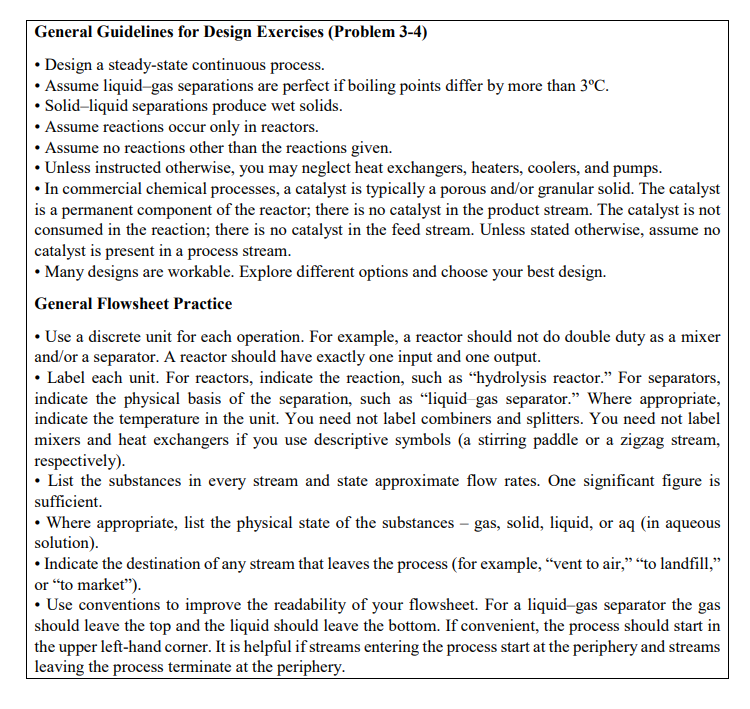
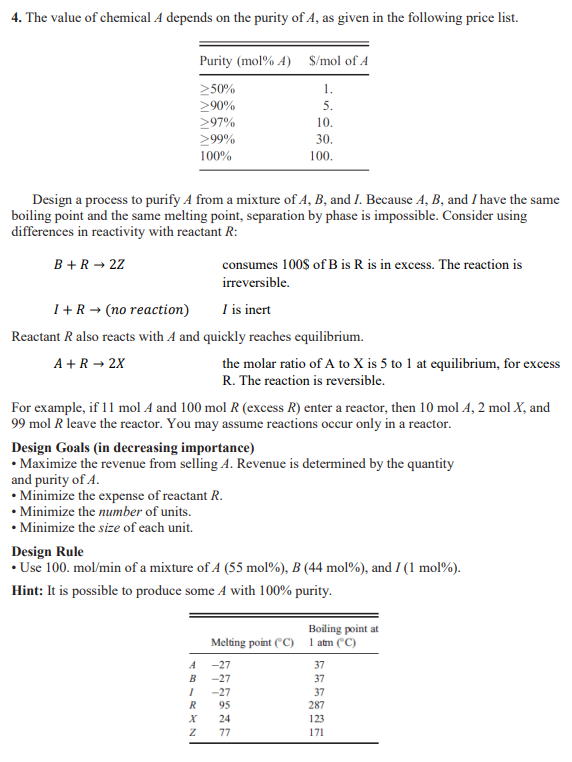
General Guidelines for Design Exercises (Problem 3-4) - Design a steady-state continuous process. - Assume liquid-gas separations are perfect if boiling points differ by more than 3C. - Solid-liquid separations produce wet solids. - Assume reactions occur only in reactors. - Assume no reactions other than the reactions given. - Unless instructed otherwise, you may neglect heat exchangers, heaters, coolers, and pumps. - In commercial chemical processes, a catalyst is typically a porous and/or granular solid. The catalyst is a permanent component of the reactor; there is no catalyst in the product stream. The catalyst is not consumed in the reaction; there is no catalyst in the feed stream. Unless stated otherwise, assume no catalyst is present in a process stream. - Many designs are workable. Explore different options and choose your best design. General Flowsheet Practice - Use a discrete unit for each operation. For example, a reactor should not do double duty as a mixer and/or a separator. A reactor should have exactly one input and one output. - Label each unit. For reactors, indicate the reaction, such as "hydrolysis reactor." For separators, indicate the physical basis of the separation, such as "liquid-gas separator." Where appropriate, indicate the temperature in the unit. You need not label combiners and splitters. You need not label mixers and heat exchangers if you use descriptive symbols (a stirring paddle or a zigzag stream, respectively). - List the substances in every stream and state approximate flow rates. One significant figure is sufficient. - Where appropriate, list the physical state of the substances - gas, solid, liquid, or aq (in aqueous solution). - Indicate the destination of any stream that leaves the process (for example, "vent to air," "to landfill," or "to market"). - Use conventions to improve the readability of your flowsheet. For a liquid-gas separator the gas should leave the top and the liquid should leave the bottom. If convenient, the process should start in the upper left-hand corner. It is helpful if streams entering the process start at the periphery and streams leaving the process terminate at the periphery. 4. The value of chemical A depends on the purity of A, as given in the following price list. Design a process to purify A from a mixture of A,B, and I. Because A,B, and I have the same boiling point and the same melting point, separation by phase is impossible. Consider using differences in reactivity with reactant R : B+R2Zirreversible.I+R(noreaction)consumes100$ofBisRisinexcess.ThereactionisIisinert Reactant R also reacts with A and quickly reaches equilibrium. A+R2X the molar ratio of A to X is 5 to 1 at equilibrium, for excess R. The reaction is reversible. For example, if 11molA and 100molR (excess R ) enter a reactor, then 10molA,2molX, and 99molR leave the reactor. You may assume reactions occur only in a reactor. Design Goals (in decreasing importance) - Maximize the revenue from selling A. Revenue is determined by the quantity and purity of A. - Minimize the expense of reactant R. - Minimize the number of units. - Minimize the size of each unit. Design Rule - Use 100.mol/min of a mixture of A(55mol%),B(44mol%), and I(1mol%). Hint: It is possible to produce some A with 100% purity
Step by Step Solution
There are 3 Steps involved in it

Get step-by-step solutions from verified subject matter experts
 Study Help