







Question: GENERAL PHYSICS 2 Please answer items no. 26-50 given below. Please provide the best and original answers with brief but effective explanations. Please read every
GENERAL PHYSICS 2
Please answer items no. 26-50 given below. Please provide the best and original answers with brief but effective explanations.
Please read every questions. Thank you so much, Tutors!!
------------------------------------
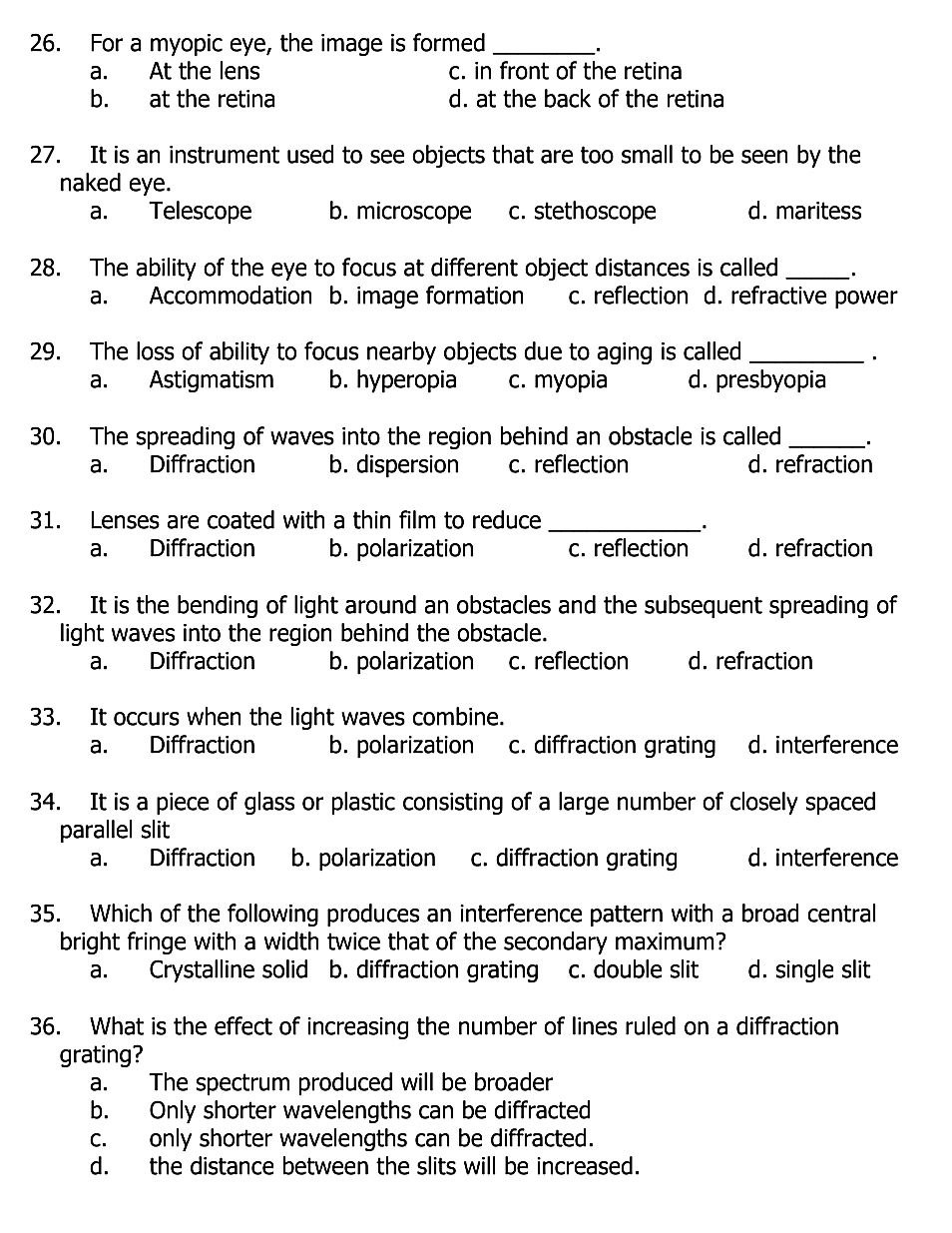
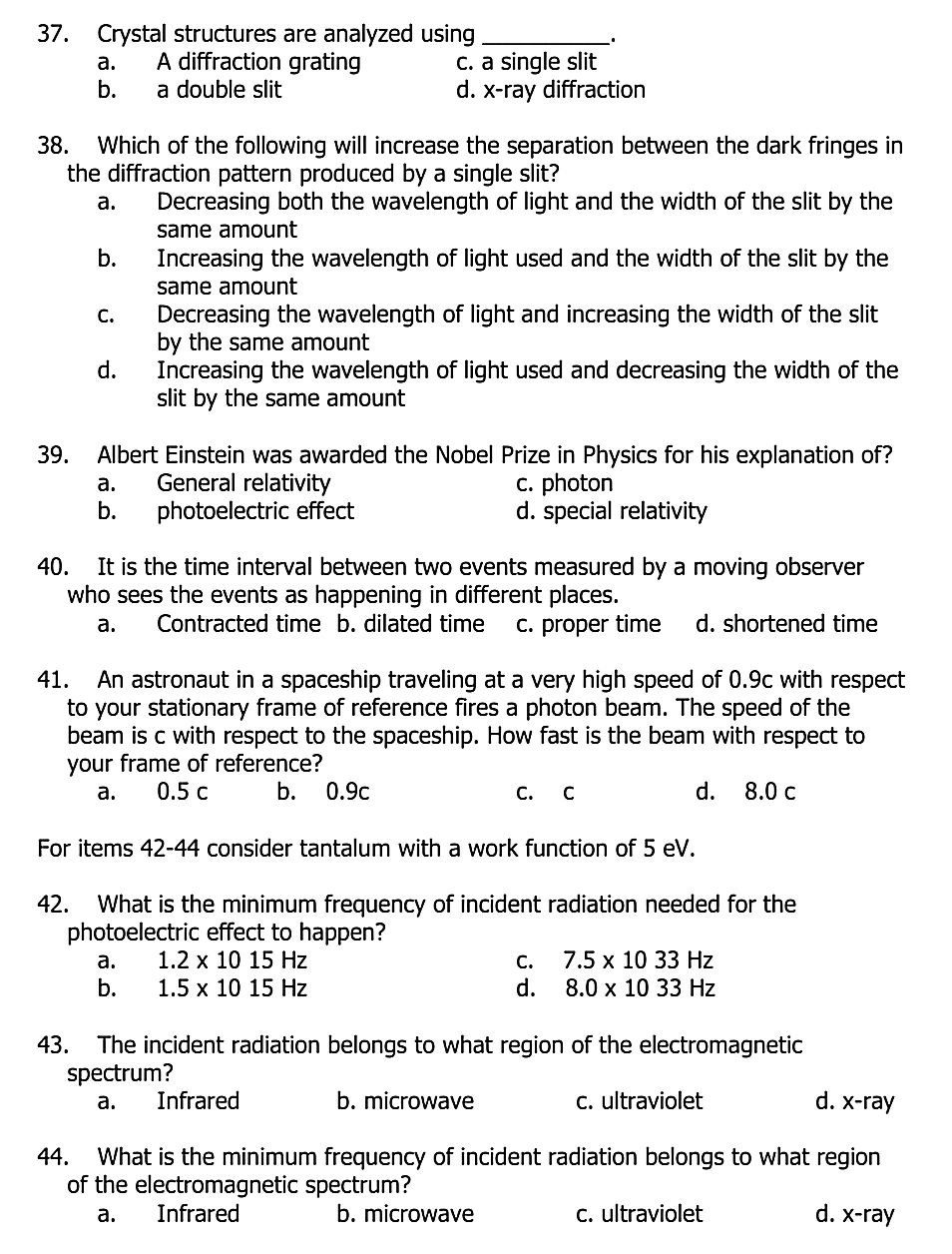
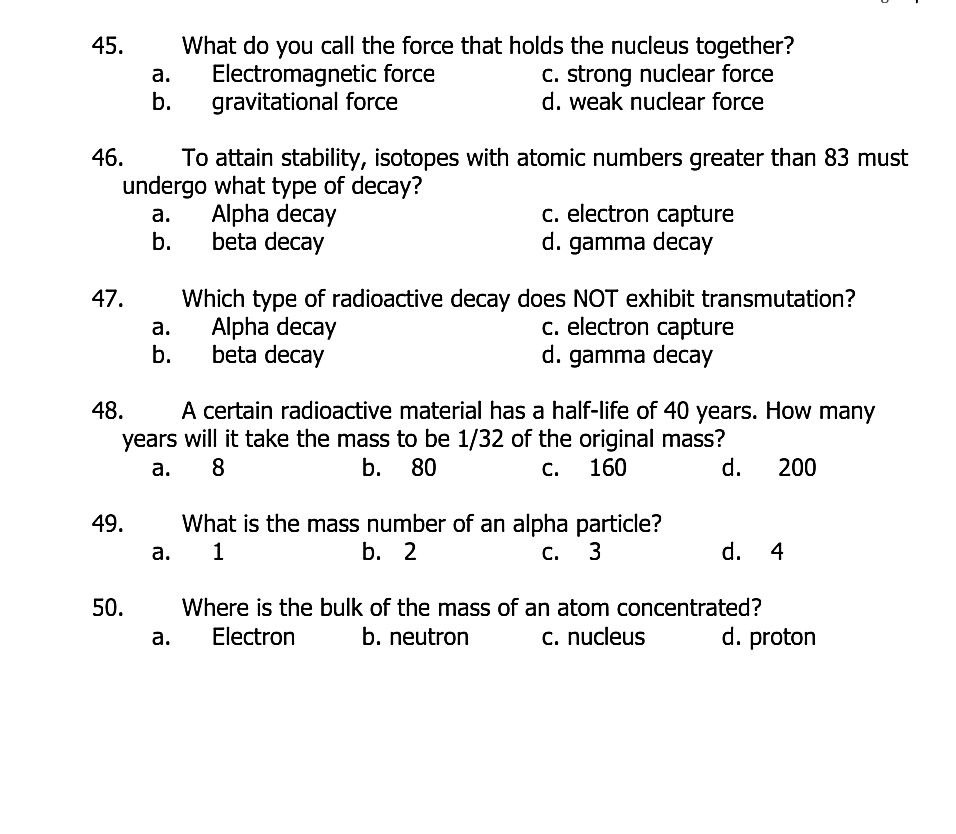
26. For a myopic eye, the image is formed a. At the lens c. in front of the retina b. at the retina d. at the back of the retina 27. It is an instrument used to see objects that are too small to be seen by the naked eye. a. Telescope b. microscope c. stethoscope d. maritess 28. The ability of the eye to focus at different object distances is called a. Accommodation b. image formation c. reflection d. refractive power 29. The loss of ability to focus nearby objects due to aging is called a. Astigmatism b. hyperopia c. myopia d. presbyopia 30. The spreading of waves into the region behind an obstacle is called a. Diffraction b. dispersion c. reflection d. refraction 31. Lenses are coated with a thin film to reduce a . Diffraction b. polarization c. reflection d. refraction 32. It is the bending of light around an obstacles and the subsequent spreading of light waves into the region behind the obstacle. a. Diffraction b. polarization c. reflection d. refraction 33. It occurs when the light waves combine. a. Diffraction b. polarization c. diffraction grating d. interference 34. It is a piece of glass or plastic consisting of a large number of closely spaced parallel slit a. Diffraction b. polarization c. diffraction grating d. interference 35. Which of the following produces an interference pattern with a broad central bright fringe with a width twice that of the secondary maximum? a. Crystalline solid b. diffraction grating c. double slit d. single slit 36. What is the effect of increasing the number of lines ruled on a diffraction grating? a. The spectrum produced will be broader b. Only shorter wavelengths can be diffracted C. only shorter wavelengths can be diffracted. d. the distance between the slits will be increased.37. Crystal structures are analyzed using . a. A diffraction grating c. a single slit b. a double slit d. x-ray diffraction 38. Which of the following will increase the separation between the dark fringes in the diffraction pattern produced by a single slit? a. Decreasing both the wavelength of light and the width of the slit by the same amount b. Increasing the wavelength of light used and the width of the slit by the same amount c. Decreasing the wavelength of light and increasing the width of the slit by the same amount d. Increasing the wavelength of light used and decreasing the width of the slit by the same amount 39. Albert Einstein was awarded the Nobel Prize in Physics for his explanation of? a. General relativity c. photon b. photoelectric effect d. special relativity 40. It is the time interval between two events measured by a moving observer who sees the events as happening in different places. a. Contracted time b. dilated time c. proper time d. shortened time 41. An astronaut in a spaceship traveling at a very high speed of 0.9c with respect to your stationary frame of reference res a photon beam. The speed of the beam is c with respect to the spaceship. How fast is the beam with respect to your frame of reference? a. 0.5 c b. 0.9c c. c d. 8.0 c For items 42-44 consider tantalum with a work function of 5 eV. 42. What is the minimum frequency of incident radiation needed for the photoelectric effect to happen? a. 1.2 x 10 15 Hz c. 7.5 x 10 33 Hz b. 1.5 x 10 15 Hz d. 8.0 x 10 33 Hz 43. The incident radiation belongs to what region of the electromagnetic spectrum? a. Infrared b. microwave c. ultraviolet d. x-ray 44. What is the minimum frequency of incident radiation belongs to what region of the electromagnetic spectrum? a. Infrared b. microwave c. ultraviolet d. x-ray 45. What do you call the force that holds the nucleus together? a. Electromagnetic force c. strong nuclear force b. gravitational force d. weak nuclear force 46. To attain stability, isotopes with atomic numbers greater than 83 must undergo what type of decay? a. Alpha decay c. electron capture b. beta decay d. gamma decay 47. Which type of radioactive decay does NOT exhibit transmutation? a. Alpha decay c. electron capture b. beta decay d. gamma decay 48. A certain radioactive material has a half-life of 40 years. How many years will it take the mass to be 1132 of the original mass? a. 8 b. 80 c. 150 d. 200 49. What is the mass number of an alpha particle? a. 1 b. 2 c. 3 cl. 4 50. Where is the bulk of the mass of an atom concentrated? a. Electron b. neub'on c. nucleus d. proton
Step by Step Solution
There are 3 Steps involved in it

Get step-by-step solutions from verified subject matter experts
 Study Help