





Question: General Question Solution to general questions already solved. Additional quedtions: A sheet metal manufacturer for architectural products recently acquired a distributer. This distributer sold products

General Question General Question Solution to general questions
Solution to general questions already solved.
Additional quedtions:
General Question Solution to general questions
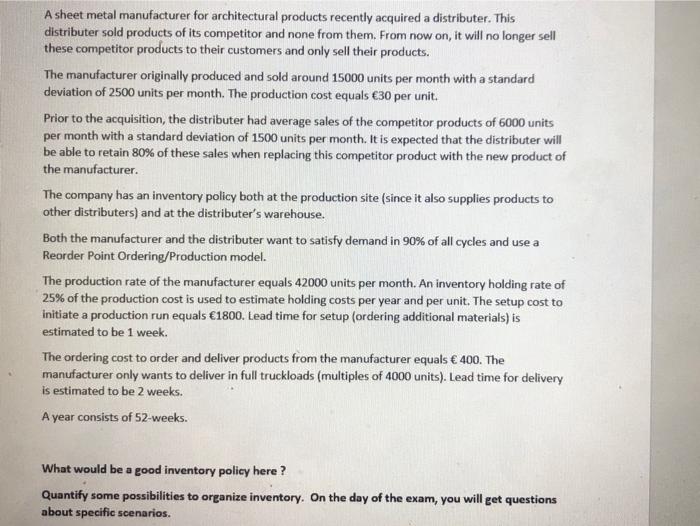
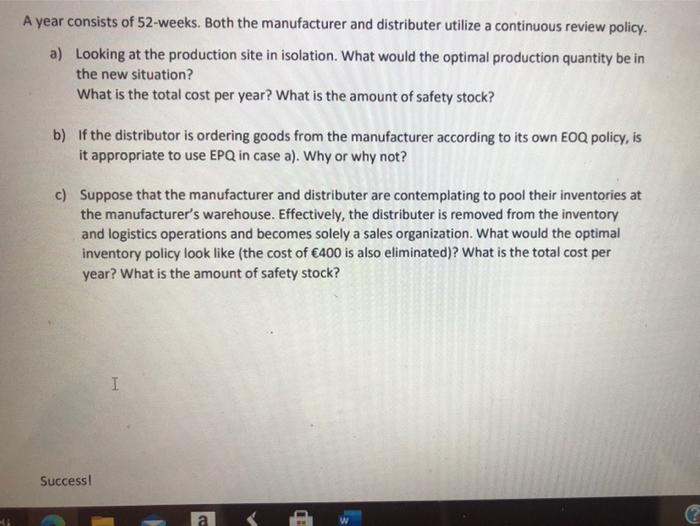
A sheet metal manufacturer for architectural products recently acquired a distributer. This distributer sold products of its competitor and none from them. From now on, it will no longer sell these competitor products to their customers and only sell their products. The manufacturer originally produced and sold around 15000 units per month with a standard deviation of 2500 units per month. The production cost equals 30 per unit. Prior to the acquisition, the distributer had average sales of the competitor products of 6000 units per month with a standard deviation of 1500 units per month. It is expected that the distributer will be able to retain 80% of these sales when replacing this competitor product with the new product of the manufacturer The company has an inventory policy both at the production site (since it also supplies products to other distributers) and at the distributer's warehouse. Both the manufacturer and the distributer want to satisfy demand in 90% of all cycles and use a Reorder Point Ordering/Production model. The production rate of the manufacturer equals 42000 units per month. An inventory holding rate of 25% of the production cost is used to estimate holding costs per year and per unit. The setup cost to initiate a production run equals 1800. Lead time for setup (ordering additional materials) is estimated to be 1 week. The ordering cost to order and deliver products from the manufacturer equals 400. The manufacturer only wants to deliver in full truckloads (multiples of 4000 units). Lead time for delivery is estimated to be 2 weeks. A year consists of 52-weeks. What would be a good inventory policy here? Quantify some possibilities to organize inventory. On the day of the exam, you will get questions about specific scenarios. A year consists of 52-weeks. Both the manufacturer and distributer utilize a continuous review policy. a) Looking at the production site in isolation. What would the optimal production quantity be in the new situation? What is the total cost per year? What is the amount of safety stock? b) If the distributor is ordering goods from the manufacturer according to its own EOQ policy, is it appropriate to use EPQ in case a). Why or why not? c) Suppose that the manufacturer and distributer are contemplating to pool their inventories at the manufacturer's warehouse. Effectively, the distributer is removed from the inventory and logistics operations and becomes solely a sales organization. What would the optimal inventory policy look like (the cost of 400 is also eliminated)? What is the total cost per year? What is the amount of safety stock? I Success

Step by Step Solution

There are 3 Steps involved in it

1 Expert Approved Answer
Step: 1 Unlock blur-text-image

Question Has Been Solved by an Expert!

Get step-by-step solutions from verified subject matter experts

Step: 2 Unlock
Step: 3 Unlock

Students Have Also Explored These Related General Management Questions!