



Question: Generate a iid process {X} where Xt's are independently and identically distributed exponential random variables with mean A = 1, that is, their probability density
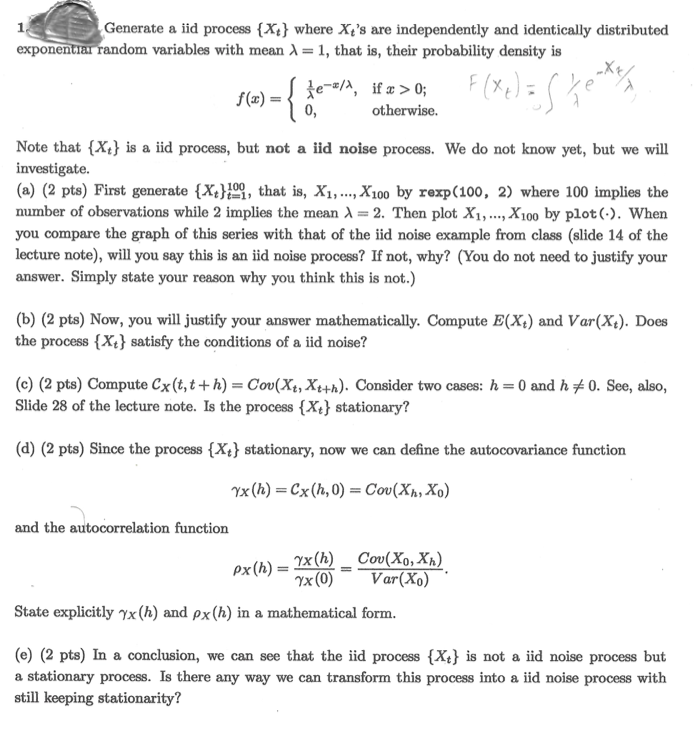
Generate a iid process {X} where Xt's are independently and identically distributed exponential random variables with mean A = 1, that is, their probability density is - Kt 0 , f(z) = e-a/d, ifx > 0; F ( x t ) = She otherwise. Note that {X } is a iid process, but not a iid noise process. We do not know yet, but we will investigate. (a) (2 pts) First generate {X:}12), that is, X1, ..., X10o by rexp(100, 2) where 100 implies the number of observations while 2 implies the mean A = 2. Then plot X1, ..., X10o by plot(.). When you compare the graph of this series with that of the iid noise example from class (slide 14 of the lecture note), will you say this is an iid noise process? If not, why? (You do not need to justify your answer. Simply state your reason why you think this is not.) (b) (2 pts) Now, you will justify your answer mathematically. Compute E(X,) and Var(Xt). Does the process {Xt} satisfy the conditions of a iid noise? (c) (2 pts) Compute Cx(t, t + h) = Cov(Xt, Xtth). Consider two cases: h = 0 and h 0. See, also, Slide 28 of the lecture note. Is the process {X} stationary? (d) (2 pts) Since the process {X} stationary, now we can define the autocovariance function Yx (h) = Cx(h, 0) = Cov(Xn, Xo) and the autocorrelation function Px (h) = Yx(h) _Cov(Xo, Xh) Yx (0) Var(Xo) State explicitly yx (h) and px (h) in a mathematical form. (e) (2 pts) In a conclusion, we can see that the iid process {Xt} is not a iid noise process but a stationary process. Is there any way we can transform this process into a iid noise process with still keeping stationarity
Step by Step Solution
There are 3 Steps involved in it

Get step-by-step solutions from verified subject matter experts