







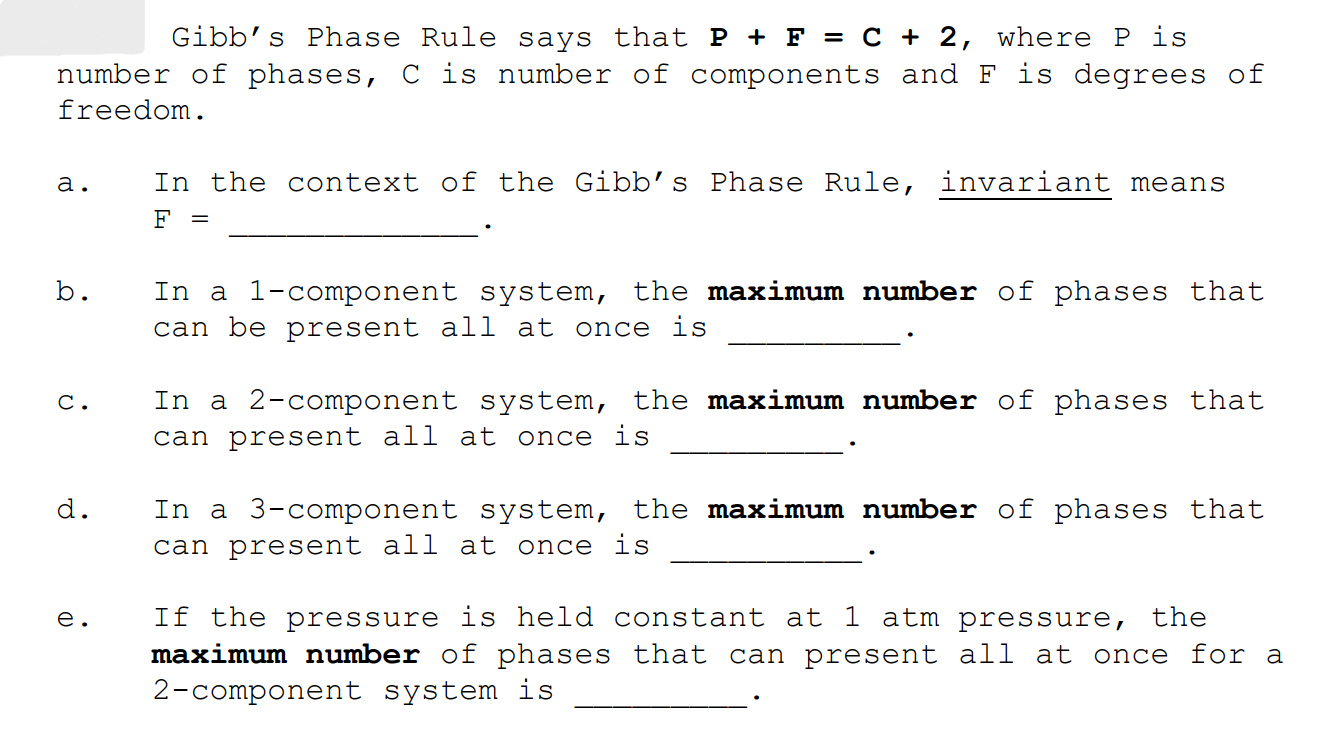
Question: Gibb's Phase Rule says that ( mathbf { P } + mathbf { F } = mathbf { C } +
Gibb's Phase Rule says that mathbfPmathbfFmathbfCmathbf where P is
number of phases, C is number of components and F is degrees of freedom.
a In the context of the Gibb's Phase Rule, invariant means mathrmF
b In a component system, the maximum number of phases that can be present all at once is
c In a component system, the maximum number of phases that can present all at once is
d In a component system, the maximum number of phases that can present all at once is
e If the pressure is held constant at atm pressure, the maximum number of phases that can present all at once for a component system is
Step by Step Solution
There are 3 Steps involved in it
1 Expert Approved Answer
Step: 1 Unlock

Question Has Been Solved by an Expert!
Get step-by-step solutions from verified subject matter experts
Step: 2 Unlock
Step: 3 Unlock
 Study Help