







Question: give me the 2 no. and 4 no. answer CASE INCIDENT 1 Is It Okay to Gry at W As this chapter has shown, emotions
give me the 2 no. and 4 no. answer
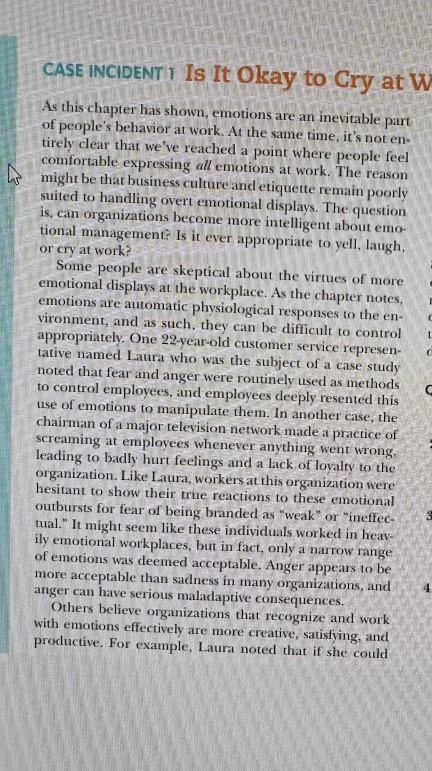
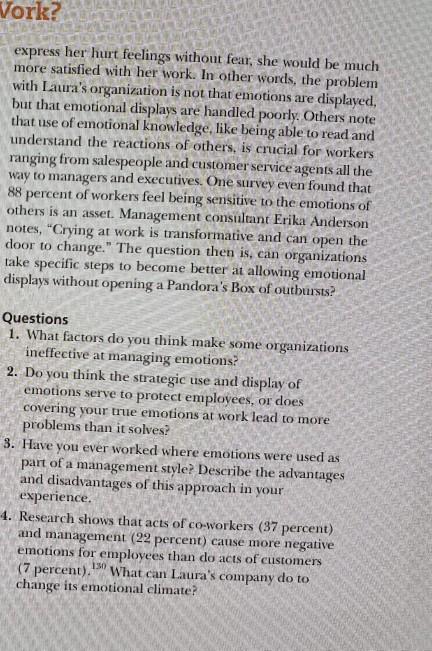
CASE INCIDENT 1 Is It Okay to Gry at W As this chapter has shown, emotions are an inevitable part of people's behavior at work. At the same time, it's not en tirely clear that we've reached a point where people feel comfortable expressing all emotions at work. The reason might be that business culture and etiquette remain poorly suited to handling overt emotional displays. The question is, can organizations become more intelligent about emo- tional management? Is it ever appropriate to yell, laugh, or cry at work? Some people are skeptical about the virtues of more emotional displays at the workplace. As the chapter notes, emotions are automatic physiological responses to the en- vironment, and as such, they can be difficult to control appropriately. One 22-year-old customer service represen- tative named Laura who was the subject of a case study noted that fear and anger were routinely used as methods to control employees, and employees deeply resented this use of emotions to manipulate them. In another case, the chairman of a major television network made a practice of screaming at employees whenever anything went wrong, leading to badly hurt feelings and a lack of loyalty to the organization. Like Laura, workers at this organization were hesitant to show their true reactions to these emotional outbursts for fear of being branded as "weak" or "ineffec- tual." It might seem like these individuals worked in heav- ily emotional workplaces, but in fact, only a narrow range of emotions was deemed acceptable. Anger appears to be more acceptable than sadness in many organizations, and anger can have serious maladaptive consequences. Others believe organizations that recognize and work with emotions effectively are more creative, satisfying, and productive. For example, Laura noted that if she could Vork? express her hurt feelings without fear, she would be much more satisfied with her work. In other words, the problem with Laura's organization is not that emotions are displayed, but that emotional displays are handled poorly. Others note that use of emotional knowledge, like being able to read and understand the reactions of others, is crucial for workers ranging from salespeople and customer service agents all the way to managers and executives. One survey even found that 88 percent of workers feel being sensitive to the emotions of others is an asset. Management consultant Erika Anderson notes, "Crying at work is transformative and can open the door to change." The question then is, can organizations take specific steps to become better at allowing emotional displays without opening a Pandora's Box of outbursts? Questions 1. What factors do you think make some organizations ineffective at managing emotions? 2. Do you think the strategic use and display of emotions serve to protect employees, or does covering your true emotions at work lead to more problems than it solves? 3. Have you ever worked where emotions were used as part of a management style? Describe the advantages and disadvantages of this approach in your experience. 4. Research shows that acts of co-workers (37 percent) and management (22 percent) cause more negative emotions for emplovees than do acts of customers (7 percent), What can Laura's company do to change its emotional climate? 130Step by Step Solution
There are 3 Steps involved in it
1 Expert Approved Answer
Step: 1 Unlock

Question Has Been Solved by an Expert!
Get step-by-step solutions from verified subject matter experts
Step: 2 Unlock
Step: 3 Unlock
 Study Help