







Question: Given a graph G = (V, E), a vertex v is called sink if there are no outgoing edges from v. A vertex v is
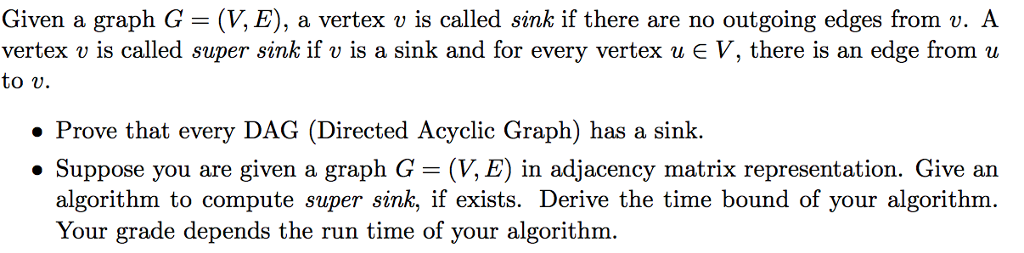
Given a graph G = (V, E), a vertex v is called sink if there are no outgoing edges from v. A vertex v is called super sink if v is a sink and for every vertex u elementof V, there is an edge from u to v. Prove that every DAG (Directed Acyclic Graph) has a sink. Suppose you are given a graph G = (V, E) in adjacency matrix representation. Give an algorithm to compute super sink, if exists. Derive the time bound of your algorithm. Your grade depends the run time of your algorithm. Given a graph G = (V, E), a vertex v is called sink if there are no outgoing edges from v. A vertex v is called super sink if v is a sink and for every vertex u elementof V, there is an edge from u to v. Prove that every DAG (Directed Acyclic Graph) has a sink. Suppose you are given a graph G = (V, E) in adjacency matrix representation. Give an algorithm to compute super sink, if exists. Derive the time bound of your algorithm. Your grade depends the run time of your algorithm
Step by Step Solution
There are 3 Steps involved in it

Get step-by-step solutions from verified subject matter experts
 Study Help