







Question: Given a graph G = (V, E), where V is the vertex set and E is the edge set, e.g., in the following graph V
Given a graph G = (V, E), where V is the vertex set and E is the edge set, e.g., in the following graph V = {S, 1, 2, 3, 4, 5, 6, 7, 8, 9} and E = {(S, 1),(S, 2),(S, 3),(1, 2),(1, 4), }. Propose your algorithm that can find a shortest path from a node to every other nodes, where the shortest path is the path with the minimum hop counts [Hint: You can simply modify the Dijkstras algorithm]. Then, use your algorithm to find the shortest paths from node S to every other nodes in the following graph.
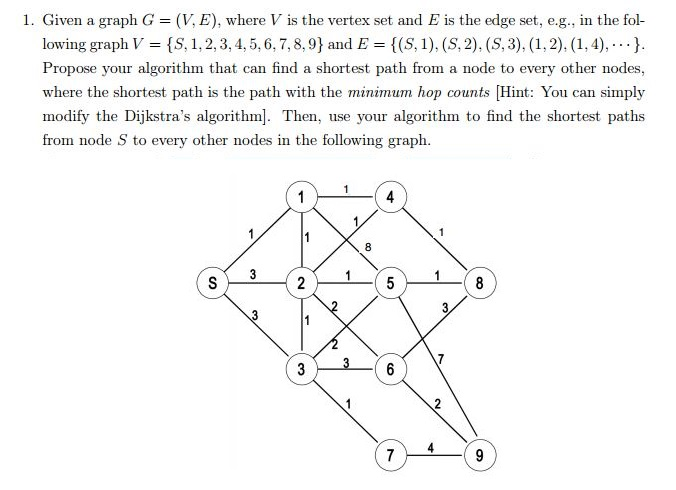
1. Given a graph G (V, E), where V is the vertex set and E is the edge set, e.g., in the fol- lowing graph W {S, 1, 2, 3, 4, 5, 6, 7, 8, 9) and E (S, 1), (S, 2), (S,3), (1,2), (1, 4), Y. Propose your algorithm that can find a shortest path from a node to every other nodes, where the shortest path is the path with the minimum hop counts Hint: You can simply modify the Dijkstra's algorithm Then use your algorithm to find the shortest paths from node S to every other nodes in the following graph
Step by Step Solution
There are 3 Steps involved in it

Get step-by-step solutions from verified subject matter experts
 Study Help