







Question: Given an NFA N = ({A, B, C, D}, {x, y, z}, &, A, {A}, {C}) with the below state diagram y N1 Z
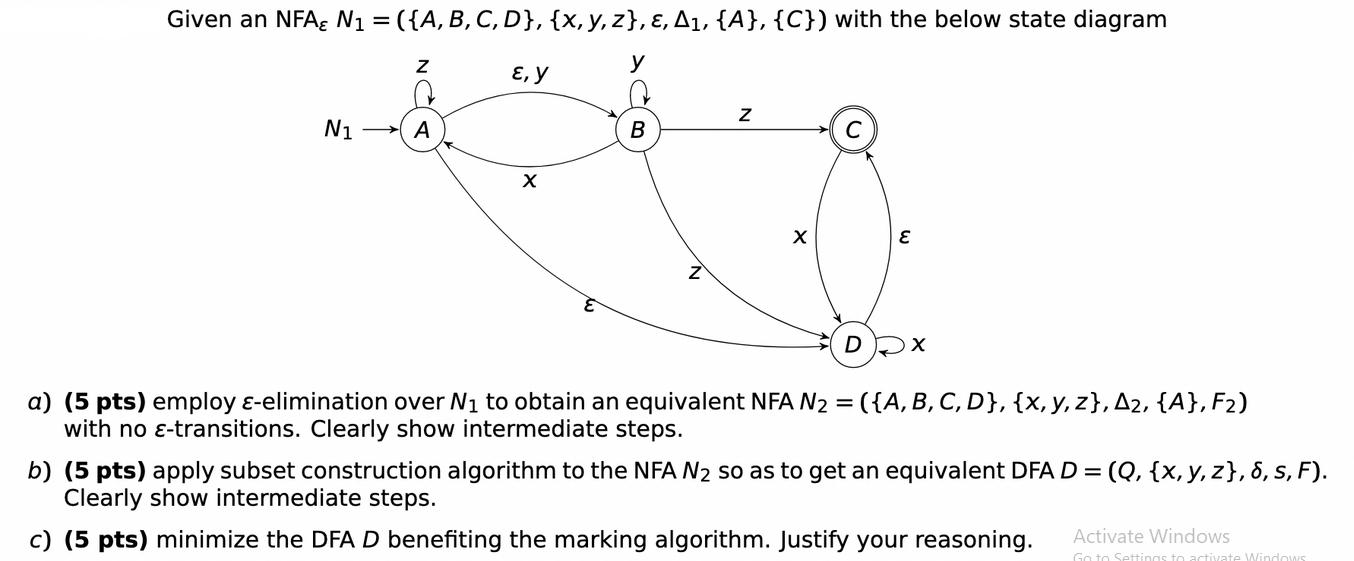
Given an NFA N = ({A, B, C, D}, {x, y, z}, &, A, {A}, {C}) with the below state diagram y N1 Z A , y X B Z X E D X a) (5 pts) employ -elimination over N to obtain an equivalent NFA N = ({A, B, C, D }, {x, y, z}, A2, {A},F2) with no -transitions. Clearly show intermediate steps. b) (5 pts) apply subset construction algorithm to the NFA N so as to get an equivalent DFA D = (Q, {x,y, z}, 8, s, F). Clearly show intermediate steps. c) (5 pts) minimize the DFA D benefiting the marking algorithm. Justify your reasoning. Activate Windows Go to Settings to activate Windows
Step by Step Solution
There are 3 Steps involved in it
a To perform elimination on N1 1 Remove the transition from A to C 2 Add transitions from A to C for ... View full answer

Get step-by-step solutions from verified subject matter experts
 Study Help