







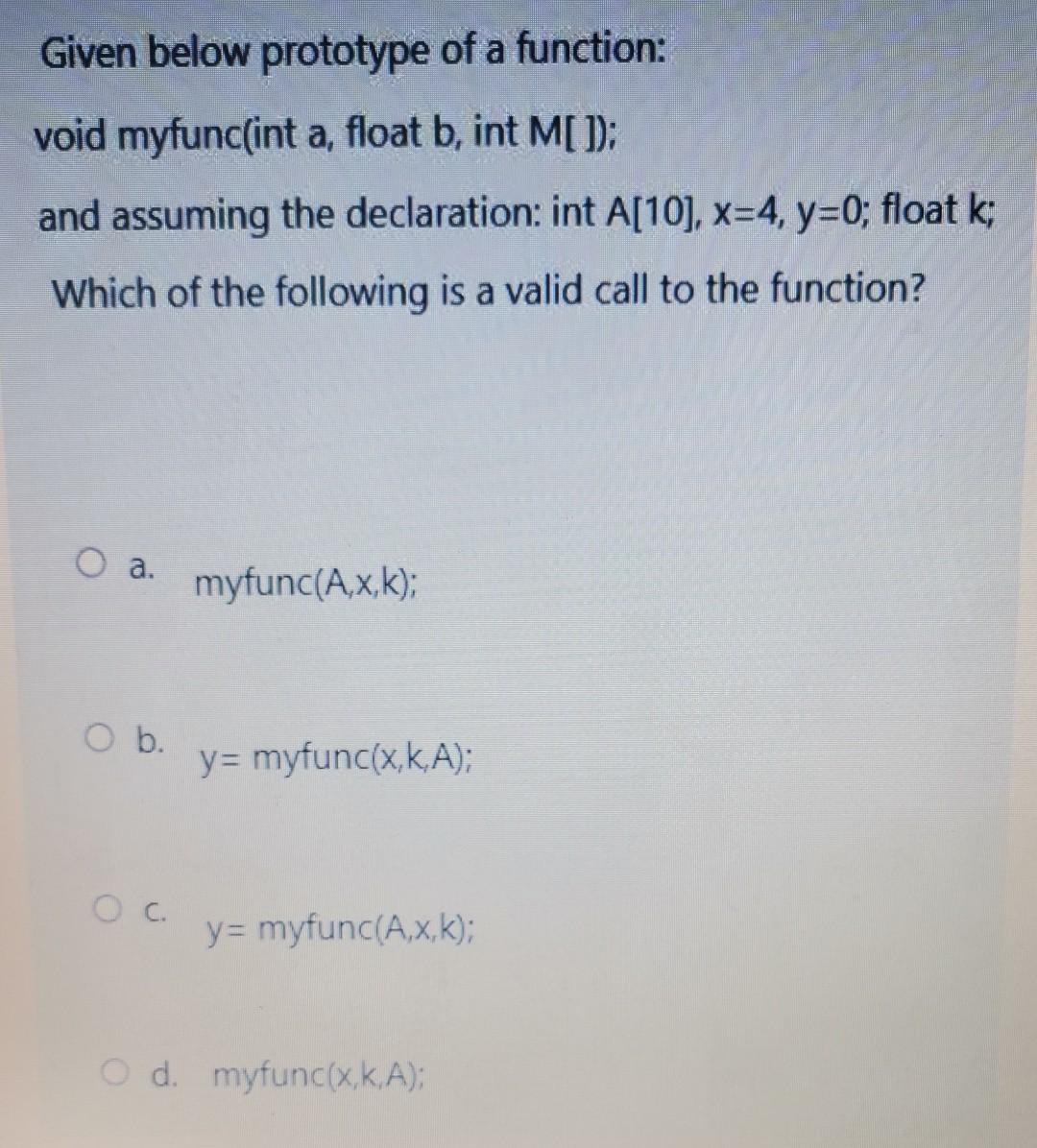
Question: Given below prototype of a function: void myfunc(int a, float b, int M[ ]); and assuming the declaration: int A[10],x=4,y=0; float k; Which of the
![int M[ ]); and assuming the declaration: int A[10],x=4,y=0; float k; Which](https://s3.amazonaws.com/si.experts.images/answers/2024/09/66d8365e2a5df_72566d8365d9379c.jpg)
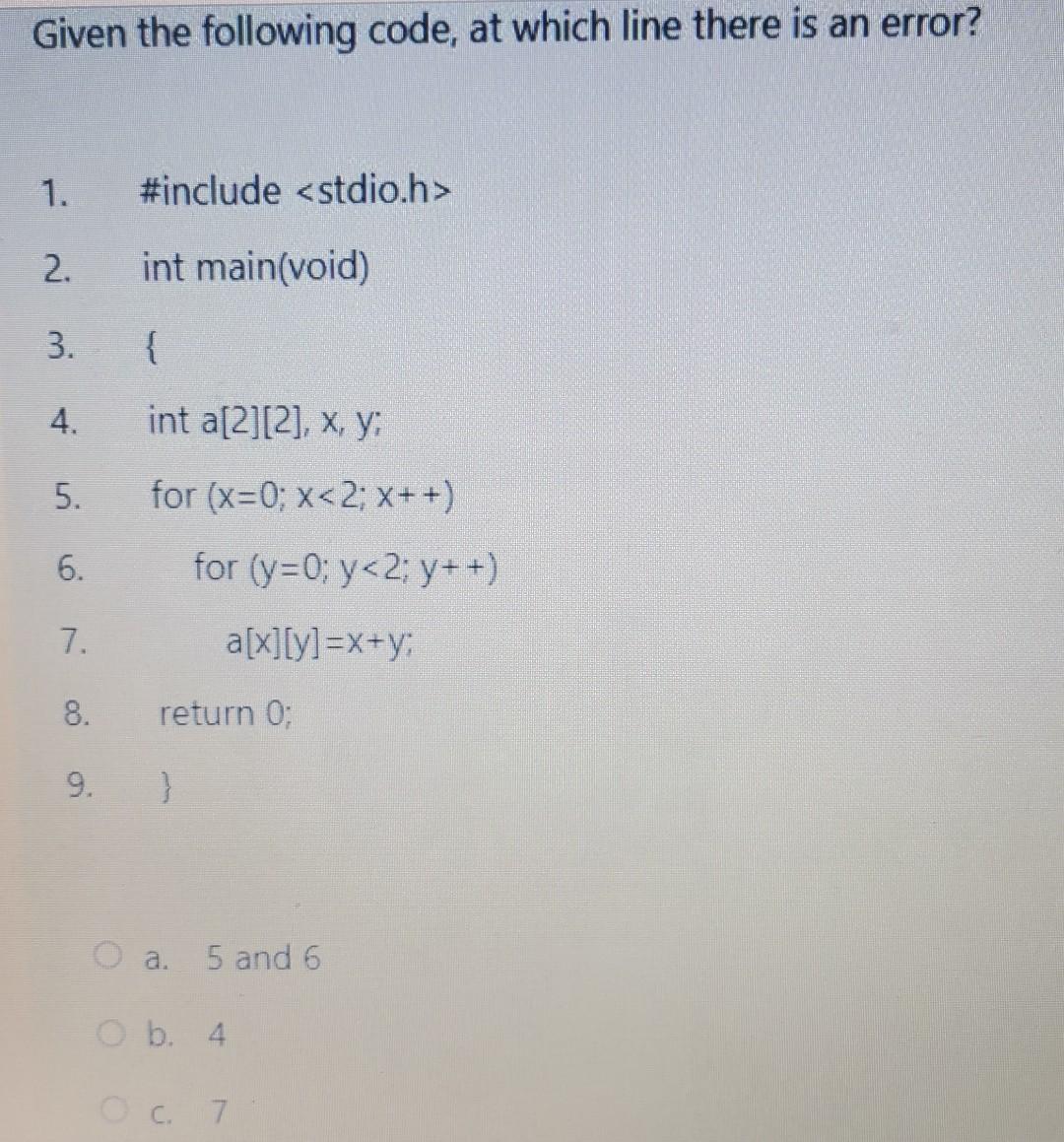
Given below prototype of a function: void myfunc(int a, float b, int M[ ]); and assuming the declaration: int A[10],x=4,y=0; float k; Which of the following is a valid call to the function? a. myfunc(A,x,k); b. y=myfunc(x,k,A); c. y=myfunc(A,x,k); d. myfunc (x,k,A); Which one is an invalid array initialization? a. int a[5]={1,2,3,4,5}; b. int a[4]=\{1,2,3,4,5\}; c. int a[6]={1,2,3,4,5}; d. int a[]={1,2,3,4,5}; Given the following code, at which line there is an error? 1. \#include stdio. h 2. int main(void) 3. \{ 4. int a[2][2],x,y; 5. for (x=0;x
Step by Step Solution
There are 3 Steps involved in it
1 Expert Approved Answer
Step: 1 Unlock

Question Has Been Solved by an Expert!
Get step-by-step solutions from verified subject matter experts
Step: 2 Unlock
Step: 3 Unlock
 Study Help