







Question: Given the following MIPS code segment: ti, 0(s3) sub $3, $t1, $82 beq $t1, $t2, next addi $t2, $t2, 1 and $t3, t2, $t1 BW
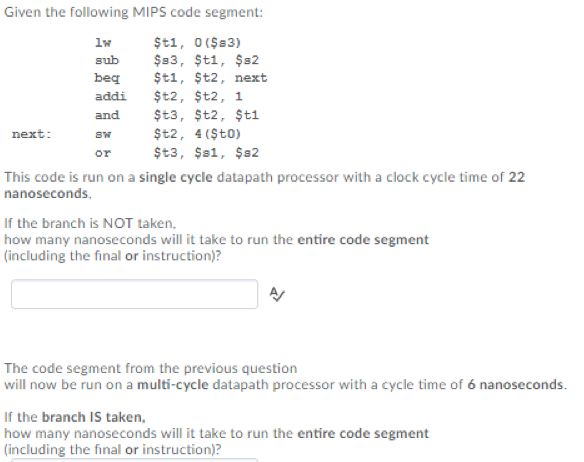
Given the following MIPS code segment: ti, 0(s3) sub $3, $t1, $82 beq $t1, $t2, next addi $t2, $t2, 1 and $t3, t2, $t1 BW or next This code is run on a single cycle datapath processor with a clock cycle time of 22 nanoseconds, If the branch is NOT taken, how many nanoseconds will it take to run the entire code segment (including the final or instruction)? The code segment from the previous question will now be run on a multi-cycle datapath processor with a cycle time of 6 nanoseconds If the branch IS taken. how many nanoseconds will it take to run the entire code segment (including the final or instruction)? Given the following MIPS code segment: ti, 0(s3) sub $3, $t1, $82 beq $t1, $t2, next addi $t2, $t2, 1 and $t3, t2, $t1 BW or next This code is run on a single cycle datapath processor with a clock cycle time of 22 nanoseconds, If the branch is NOT taken, how many nanoseconds will it take to run the entire code segment (including the final or instruction)? The code segment from the previous question will now be run on a multi-cycle datapath processor with a cycle time of 6 nanoseconds If the branch IS taken. how many nanoseconds will it take to run the entire code segment (including the final or instruction)
Step by Step Solution
There are 3 Steps involved in it

Get step-by-step solutions from verified subject matter experts
 Study Help