



Question: Given the following procedures for establishing an increasing block tariff, determine the best prices for the first for four blocks for a town in a
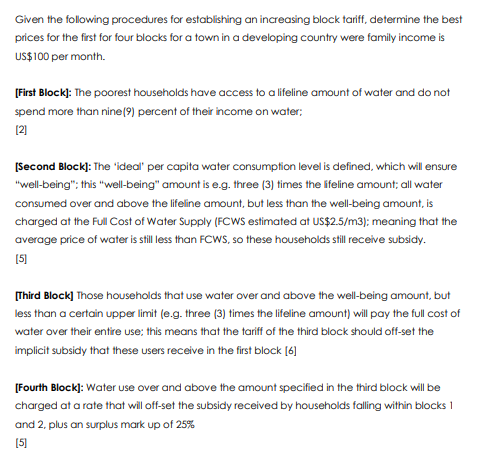
Given the following procedures for establishing an increasing block tariff, determine the best prices for the first for four blocks for a town in a developing country were family income is US$100 per month. [First Block]: The poorest households have access to a lifeline amount of water and do not spend more than nine (9) percent of their income on water; [2] (Second Block]: The ideal per capita water consumption level is defined, which will ensure "Well-being"; this "well-being" amount is e.g. three (3) times the ifeline amount: all water consumed over and above the lifeline amount, but less than the well-being amount, is charged at the Full Cost of Water Supply (FCWS estimated at US$2.5/m3); meaning that the average price of water is still less than FCWS, so these households still receive subsidy. [5] [Third Block] Those households that use water over and above the well-being amount, but less than a certain upper limit (e.g. three (3) times the lifeline amount) will pay the full cost of water over their entire use; this means that the tariff of the third block should off-set the implicit subsidy that these users receive in the first block [6] [Fourth Block]: Water use over and above the amount specified in the third block will be charged at a rate that will off-set the subsidy received by households falling within blocks 1 and 2, plus an surplus mark up of 25% [5] Given the following procedures for establishing an increasing block tariff, determine the best prices for the first for four blocks for a town in a developing country were family income is US$100 per month. [First Block]: The poorest households have access to a lifeline amount of water and do not spend more than nine (9) percent of their income on water; [2] (Second Block]: The ideal per capita water consumption level is defined, which will ensure "Well-being"; this "well-being" amount is e.g. three (3) times the ifeline amount: all water consumed over and above the lifeline amount, but less than the well-being amount, is charged at the Full Cost of Water Supply (FCWS estimated at US$2.5/m3); meaning that the average price of water is still less than FCWS, so these households still receive subsidy. [5] [Third Block] Those households that use water over and above the well-being amount, but less than a certain upper limit (e.g. three (3) times the lifeline amount) will pay the full cost of water over their entire use; this means that the tariff of the third block should off-set the implicit subsidy that these users receive in the first block [6] [Fourth Block]: Water use over and above the amount specified in the third block will be charged at a rate that will off-set the subsidy received by households falling within blocks 1 and 2, plus an surplus mark up of 25% [5]
Step by Step Solution
There are 3 Steps involved in it

Get step-by-step solutions from verified subject matter experts