Question: Sawchyn Guitars Case Study Questions: Who are the main players within the organization affected by the challenges? In what business and industry is the company
Sawchyn Guitars Case Study Questions:
- Who are the main players within the organization affected by the challenges?
- In what business and industry is the company operating? Describe the characteristics of the industry.
- Briefly describe the history of the organization and milestones.
- What are the strengths and problems facing the organization? What do they do well? What do they need to improve upon? (Use the Internal Perspective from the SWOT as a foundation).
- What internal circumstances caused or influenced the emergence of the identified problems? (Use the Internal Perspective from the SWOT as a foundation)
- What external circumstances caused or influenced the emergence of the identified problems? (Use the External Perspective from the SWOT as a foundation)
- What external influences potentially provide a competitive advantage to create a strategy for differentiation enabling them to compete within the context of their industry? (Use the External Perspective from the SWOT as a foundation, and refer to strategic management chapter in textbook and the YouTube SWOT video)
- What are the possible solutions to the identified problems?
- What are the advantages and disadvantages of the possible solutions?
- If you were the key decision maker in this organization, which solution would you choose, and why?
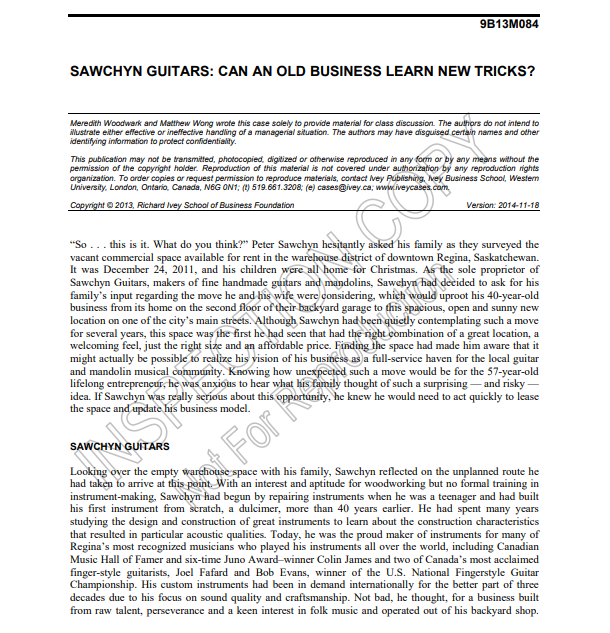
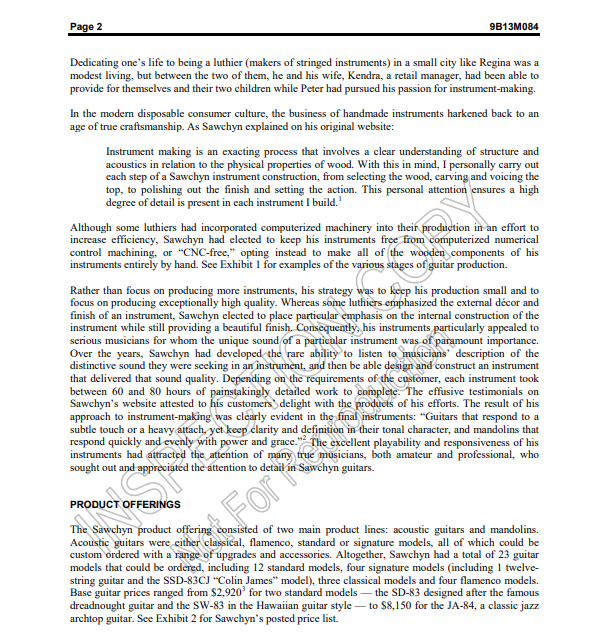
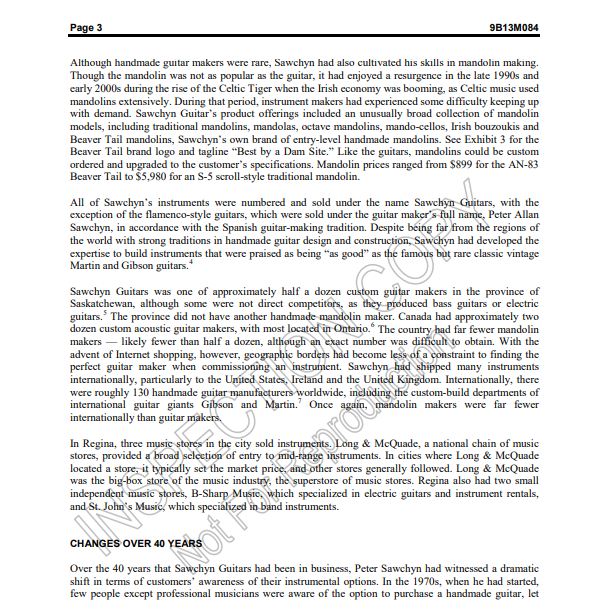
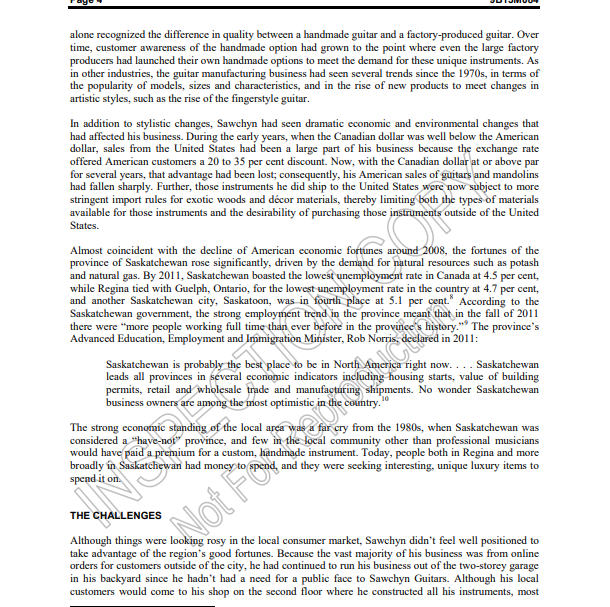
9B13M084 SAWCHYN GUITARS: CAN AN OLD BUSINESS LEARN NEW TRICKS? Meredith Woodwark and Matthew Wong wrote this case solely to provide material for class discussion. The authors do not intend to illustrate either effective or ineffective handling of a managerial situation. The authors may have disguised certain names and other identifying information to protect confidentiality. This publication may not be transmitted, photocopied do ed or otherwise reproduced in any form or by any means without the permission of the copyright holder. Reproduction of this material is not covered under authorization by any reproduction rights organization. To order copies or request permission to reproduce materials, contact Ivey Publishing, Ivey Business School, Western University, London, Ontario, Canada, NOG ONT: (0) 519.681.3208; (e) cases@ivey.ca, www.iveycases.com Copyright 2013, Richard Ivey School of Business Foundation Version 2014-11-18 "So ... this is it. What do you think?" Peter Sawchyn hesitantly asked his family as they surveyed the vacant commercial space available for rent in the warehouse district of downtown Regina, Saskatchewan. It was December 24, 2011, and his children were all home for Christmas. As the sole proprietor of Sawchyn Guitars, makers of fine handmade guitars and mandolins, Sawchyn had decided to ask for his family's input regarding the move he and his wife were considering, which would uproot his 40-year-old business from its home on the second floor of their backyard garage to this spacious, open and sunny new location on one of the city's main streets. Although Sawchyn had been quietly contemplating such a move for several years, this space was the first he had seen that had the night combination of a great location, a welcoming feel, just the right size and an affordable price. Finding the space had made him aware that it might actually be possible to realize his vision of his business as a full-service haven for the local guitar and mandolin musical community. Knowing how unexpected such a move would be for the 57-year-old lifelong entrepreneur, he was anxious to hear what his family thought of such a surprising and risky idea. If Sawchyn was really serious about this opportunity, he knew he would need to act quickly to lease the space and update his business model. SAWCHYN GUITARS Looking over the empty warehouse space with his family, Sawchyn reflected on the unplanned route he had taken to arrive at this point. With an interest and aptitude for woodworking but no formal training in instrument-making, Sawchyn had begun by repairing instruments when he was a teenager and had built his first instrument from scratch, a dulcimer, more than 40 years earlier. He had spent many years studying the design and construction of great instruments to learn about the construction characteristics that resulted in particular acoustic qualities. Today, he was the proud maker of instruments for many of Regina's most recognized musicians who played his instruments all over the world, including Canadian Music Hall of Famer and six-time Juno Award-winner Colin James and two of Canada's most acclaimed finger-style guitarists, Joel Fafard and Bob Evans, winner of the U.S. National Fingerstyle Guitar Championship. His custom instruments had been in demand internationally for the better part of three decades due to his focus on sound quality and craftsmanship. Not bad, he thought, for a business built from raw talent, perseverance and a keen interest in folk music and operated out of his backyard shop. Page 2 9B13M084 Dedicating one's life to being a luthier (makers of stringed instruments) in a small city like Regina was a modest living, but between the two of them, he and his wife, Kendra, a retail manager, had been able to provide for themselves and their two children while Peter had pursued his passion for instrument-making. In the modern disposable consumer culture, the business of handmade instruments harkened back to an age of true craftsmanship. As Sawchyn explained on his original website: Instrument making is an exacting process that involves a clear understanding of structure and acoustics in relation to the physical properties of wood. With this in mind, I personally carry out each step of a Sawchyn instrument construction, from selecting the wood carving and voicing the top, to polishing out the finish and setting the action. This personal attention ensures a high degree of detail is present in each instrument I build. Although some luthiers had incorporated computerized machinery into their production in an effort to increase efficiency, Sawchyn had elected to keep his instruments free from computerized numerical control machining, or "CNC-free," opting instead to make all of the wooden components of his instruments entirely by hand. See Exhibit 1 for examples of the various stages of guitar production. Rather than focus on producing more instruments, his strategy was to keep his production small and to focus on producing exceptionally high quality. Whereas some luthiers emphasized the external dcor and finish of an instrument, Sawchyn elected to place particular emphasis on the internal construction of the instrument while still providing a beautiful finish. Consequently, his instruments particularly appealed to serious musicians for whom the unique sound of a particular instrument was of paramount importance. Over the years, Sawchyn had developed the rare ability to listen to musicians' description of the distinctive sound they were seeking in an instrument, and then be able design and construct an instrument that delivered that sound quality. Depending on the requirements of the customer, each instrument took between 60 and 80 hours of painstakingly detailed work to complete. The effusive testimonials on Sawchyn's website attested to his customers' delight with the products of his efforts. The result of his approach to instrument-making was clearly evident in the final instruments: "Guitars that respond to a subtle touch or a heavy attach, yet keep clarity and definition in their tonal character, and mandolins that respond quickly and evenly with power and grace. The excellent playability and responsiveness of his instruments had attracted the attention of many true musicians, both amateur and professional, who sought out and appreciated the attention to detail in Sawchyn guitars. PRODUCT OFFERINGS The Sawchyn product offering consisted of two main product lines: acoustic guitars and mandolins. Acoustic guitars were either classical, flamenco, standard or signature models, all of which could be custom ordered with a range of upgrades and accessories. Altogether, Sawchyn had a total of 23 guitar models that could be ordered, including 12 standard models, four signature models including 1 twelve- string guitar and the SSD-83CJ "Colin James" model), three classical models and four flamenco models. Base guitar prices ranged from $2,920' for two standard models - the SD-83 designed after the famous dreadnought guitar and the SW-83 in the Hawaiian guitar style - to $8.150 for the JA-84, a classic jazz archtop guitar. See Exhibit 2 for Sawchyn's posted price list. Page 3 9B13M084 Although handmade guitar makers were rare, Sawchyn had also cultivated his skills in mandolin making. Though the mandolin was not as popular as the guitar, it had enjoyed a resurgence in the late 1990s and early 2000s during the rise of the Celtic Tiger when the Irish economy was booming, as Celtic music used mandolins extensively. During that period, instrument makers had experienced some difficulty keeping up with demand. Sawchyn Guitar's product offerings included an unusually broad collection of mandolin models, including traditional mandolins, mandolas, octave mandolins, mando-cellos, Irish bouzoukis and Beaver Tail mandolins, Sawchyn's own brand of entry-level handmade mandolins. See Exhibit 3 for the Beaver Tail brand logo and tagline "Best by a Dam Site." Like the guitars, mandolins could be custom ordered and upgraded to the customer's specifications. Mandolin prices ranged from $899 for the AN-83 Beaver Tail to $5,980 for an S-5 scroll-style traditional mandolin. All of Sawchyn's instruments were numbered and sold under the name Sawchyn Guitars, with the exception of the flamenco-style guitars, which were sold under the guitar maker's full name, Peter Allan Sawchyn, in accordance with the Spanish guitar-making tradition. Despite being far from the regions of the world with strong traditions in handmade guitar design and construction, Sawchyn had developed the expertise to build instruments that were praised as being as good as the famous but rare classic vintage Martin and Gibson guitars. Sawchyn Guitars was one of approximately half a dozen custom guitar makers in the province of Saskatchewan, although some were not direct competitors, as they produced bass guitars or electric guitars. The province did not have another handmade mandolin maker. Canada had approximately two dozen custom acoustic guitar makers, with most located in Ontario. The country had far fewer mandolin makers - likely fewer than half a dozen, although an exact number was difficult to obtain. With the advent of Internet shopping, however, geographic borders had become less of a constraint to finding the perfect guitar maker when commissioning an instrument. Sawchyn had shipped many instruments internationally, particularly to the United States, Ireland and the United Kingdom. Internationally, there were roughly 130 handmade guitar manufacturers worldwide, including the custom-build departments of international guitar giants Gibson and Martin. Once again, mandolin makers were far fewer internationally than guitar makers. In Regina, three music stores in the city sold instruments. Long & McQuade, a national chain of music stores, provided a broad selection of entry to mid-range instruments. In cities where Long & McQuade located a store, it typically set the market price, and other stores generally followed. Long & McQuade was the big-box store of the music industry, the superstore of music stores. Regina also had two small independent music stores, B-Sharp Music, which specialized in electric guitars and instrument rentals, and St. John's Music, which specialized in band instruments. CHANGES OVER 40 YEARS Over the 40 years that Sawchyn Guitars had been in business, Peter Sawchyn had witnessed a dramatic shift in terms of customers' awareness of their instrumental options. In the 1970s, when he had started, few people except professional musicians were aware of the option to purchase a handmade guitar, let alone recognized the difference in quality between a handmade guitar and a factory-produced guitar. Over time, customer awareness of the handmade option had grown to the point where even the large factory producers had launched their own handmade options to meet the demand for these unique instruments. As in other industries, the guitar manufacturing business had seen several trends since the 1970s, in terms of the popularity of models, sizes and characteristics, and in the rise of new products to meet changes in artistic styles, such as the rise of the fingerstyle guitar. In addition to stylistic changes, Sawchyn had seen dramatic economic and environmental changes that had affected his business. During the carly years, when the Canadian dollar was well below the American dollar, sales from the United States had been a large part of his business because the exchange rate offered American customers a 20 to 35 per cent discount. Now, with the Canadian dollar at or above par for several years, that advantage had been lost; consequently, his American sales of guitars and mandolins had fallen sharply. Further, those instruments he did ship to the United States were now subject to more stringent import rules for exotic woods and dcor materials, thereby limiting both the types of materials available for those instruments and the desirability of purchasing those instruments outside of the United States. Almost coincident with the decline of American economic fortunes around 2008, the fortunes of the province of Saskatchewan rose significantly, driven by the demand for natural resources such as potash and natural gas. By 2011, Saskatchewan boasted the lowest unemployment rate in Canada at 4.5 per cent, while Regina tied with Guelph, Ontario, for the lowest unemployment rate in the country at 4.7 per cent, and another Saskatchewan city, Saskatoon, was in fourth place at 5.1 per cent. According to the Saskatchewan government, the strong employment trend in the province meant that in the fall of 2011 there were more people working full time than ever before in the province's history. The province's Advanced Education, Employment and Immigration Minister, Rob Norris, declared in 2011: Saskatchewan is probably the best place to be in North America right now.... Saskatchewan leads all provinces in several economic indicators including housing starts, value of building permits, retail and wholesale trade and manufacturing shipments. No wonder Saskatchewan business owners are among the most optimistic in the country. The strong economic standing of the local area was a far cry from the 1980s, when Saskatchewan was considered a "have-not province, and few in the local community other than professional musicians would have paid a premium for a custom, handmade instrument. Today, people both in Regina and more broadly in Saskatchewan had money to spend, and they were seeking interesting, unique luxury items to spend it on. THE CHALLENGES Although things were looking rosy in the local consumer market, Sawchyn didn't feel well positioned to take advantage of the region's good fortunes. Because the vast majority of his business was from online orders for customers outside of the city, he had continued to run his business out of the two-storey garage in his backyard since he hadn't had a need for a public face to Sawchyn Guitars. Although his local customers would come to his shop on the second floor where he constructed all his instruments, most customers relied on his website and on word of mouth as their sources of information about his business, Consequently, Sawchyn had continued to operate out of his small garage. Because of the space constraints in the garage, Sawchyn's production was spread across two storeys, which meant frequent trips up and down the stairs for materials and equipment. The space was dark and crowded with instruments in various stages of construction, and others that had been purchased for refurbishment or consignment stored wherever room was available. As a result, Sawchyn was unable to accommodate frequent requests for instrument repairs since he had little extra space to store any additional instruments. Early on in his business, Sawchyn had operated a healthy repair business but had stopped the repair work so he could focus his time and space on custom orders. He also had nowhere to store instrument accessories that customers needed for their new instruments, such as extra strings, straps and cases, so he sent customers to other stores for these products. The layout of production necessitated by the space constraints limited any production innovation because he had insufficient room to develop new models to add to his range of products. As he continued to master his instruments, Sawchyn felt the need to grow as an instrument maker by continuing to pursue new challenges, but felt unable to do so because of the current space restrictions. His shop had served him well for many decades but Sawchyn was beginning to realize how his lack of workspace was limiting his business's growth and new opportunities in the vibrant economic climate. He was aware of greater demand for repairs, accessories and the consignment of vintage guitars. He also suspected that his custom-order business would benefit from providing a more customer-friendly public face to the people of the city and, more widely, people across the province who were quickly becoming the base of his clientele. He also knew that, as a craftsman, he needed to continue to grow and develop, even after four decades of mastering his craft. THE POTENTIAL OPTIONS The Sawchyns had periodically discussed the idea of acquiring a new space for the workshop to take advantage of some of these opportunities. They had even gone so far as to view several rental spaces over the years, but had never found a space that they liked enough to seriously consider. Their indecision in part reflected their uncertainty about what kind of space they were looking for just a new workshop or a retail store location. In many ways, a bigger workshop space with a more efficient layout and more storage capacity would be sufficient to meet most of Sawchyn's immediate needs. This option would also resolve his production issues and allow him to again take on repairs and pursue challenging new projects. Although he had seriously considered the new workshop route, he had never acted on it, in part because, despite a new space resolving his production challenges, he had a lingering feeling that such a move would leave many other opportunities on the table. Sawchyn had long been attracted to the idea of having a proper music store where he could sell his instruments and provide related products such as instrument accessories and related services such as repairs. Due to his connections in the music industry, he often found himself with great opportunities to either consign rare vintage instruments or to buy and restore them. He felt he might one day have an opportunity to combine all of these products and services into one fantastic music store. Sawchyn had given much thought to what the right store space would look like and how he would adapt his business to develop the full suite of product and service offerings that his customers wanted: custom-ordered handmade instruments, retail instrument accessories, consignment of vintage instruments and instrument repairs. His personal dream for the final decade of Sawchyn Guitars was to be able to provide all those products and services in a welcoming, community-friendly environment where musicians could have all their instrument needs met under one roof. But Sawchyn's expertise was instruments not business management, and he was unsure what would be the best option for him. Perhaps he should consider putting more effort into marketing his custom work through more promotion online. He maintained a decent website and tried to keep an online presence, but he hadn't devoted much time to developing an online marketing strategy. If he increased his orders enough, he might be able to offset the extra cost of a new workshop that would help him produce more efficiently. Also, maybe the time had come to realize that his stance on CNC-free instruments was overly limiting his throughput. On the other hand, perhaps instead of increasing capacity and sales, he should consider increasing his prices. He had always been careful to keep his prices lower than those of comparable-quality products as he built up his brand in the industry. Perhaps it was time to start reaping credit for superior quality and 40 years of expertise by reflecting those qualities in his prices. If he could get away with lower volume sales at higher prices maybe he didn't need a new workshop after all. With all these possibilities on his mind and no clear winning strategy, Sawchyn had simply continued managing with the status quo set-up THE OPPORTUNITY One night in late 2011, Sawchyn and his wife learned through a friend about a retail space on Dewdney Avenue that might be attractive to them. It was on the main floor of an old warehouse building that had been renovated and converted into condominiums. The martial arts school that had previously operated on the site had been closed for about a year, and the space was just sitting empty. They heard that the landlord was not actively looking for a renter but might be interested in a stable tenant that would not attract heavy customer traffic, thereby not adding to the location's current parking and noise problems. As life would have it, earlier that year, Sawchyn's wife, Kendra, had been laid off from her job at the RCMP Heritage Centre. Since then, she had been working several part-time jobs but was finding it difficult to secure full-time work appropriate for her skills and experience. She had experience in several retail management jobs over the past few decades, including at Superstore and Eddie Bauer. She had also tried her hand at running a small gift shop business in the 1980s. Kendra had been thinking about new business opportunities for herself, including opening a restaurant, but had recognized that she would be facing a very steep learning curve on such a venture. While she pursued more rewarding work, it had occurred to them that maybe they should invest in developing Sawchyn Guitars by combining Peter's existing business with Kendra's retail and managerial experience. Perhaps with their combined concerted attention and the investment of time and money, they could work on realizing Peter's vision of a full- service music store. As they peered in the window of the empty rental space, the location appeared to meet all their criteria. It was on a busy, well-known street and had an attractive entrance that faced the street with parking on the side. At 2,400 square feet, it was roughly the size they had imagined. Even better, it was within three to four blocks of the major music store competition, Long &McQuade, and was surrounded by the popular bars and restaurants frequented by local musicians. Driving home that night, they discussed the idea and decided to try to view the inside of the space as soon as possible. If they liked the interior, it could be just the place to transform Sawchyn Guitars into a full- service music store. Such a move would accomplish two things: it would resolve many of Sawchyn's production challenges and it would allow them to take advantage of the opportunities they were currently missing. Plus, they realized they knew the building owner and were confident they could get a good deal on rent. As they thought about the possibility, they grew more and more excited that perhaps at last things were coming together for realizing the vision for Sawchyn Guitars. With Peter managing production and Page 7 9B13M084 repairs, and Kendra managing retail and consignment, they felt they could offer a music store for customers who disliked the big-box model and instead sought personalized attention and expertise. As long as the interior of the shop could be renovated into a high-class space that fit the image of Sawchyn's products, his new store could really become a hotspot for the local musical community. Having a bricks- and-mortar store for the first time could even increase the legitimacy of his business and help boost sales of commissioned instruments through higher consumer confidence. CONCERNS AND DELIBERATIONS A quick tour of the space a few days later and a discussion with the landlord confirmed that it was about as perfect a spot as they would ever find. It was available immediately, the price was right and the room had a warm, welcoming feel and flexible layout. Faced with a realistic opportunity for the first time, the Sawchyns now had to stop and consider: Were they serious about this idea? Were they willing to put in all the work to effectively start what would appear to be a brand new business? As they took stock of the work required to make their plan a reality, they quickly realized that they were considering not simply moving the shop to Dewdney Avenue but a complete reinvention of Sawchyn Guitars. They would need to renovate and decorate the space, which, as handy people, they would do themselves to save money. They would also need to invest in retail inventory, such as string, picks, cases and straps and to purchase vintage and other retail instruments. They estimated the upfront cost for the renovations and increased inventory would be in the range of $20,000 to $25,000 since all the manufacturing equipment was already owned. That was a substantial amount of money that they didn't want to waste, but they knew they could finance those costs using their secured line of credit. Plus, they would also have the additional monthly operating costs of running the shop, including rent. Although they hoped the extra monthly costs would be almost offset by taking on the repair work currently being turned down, it was difficult to know for sure; and, if their calculations weren't correct, they didn't want to find themselves out of pocket each month. co The Sawchyns had prepared estimates of the new costs and revenues they expected as a result of running the new store (see Exhibit 4). With a little digging, most of the additional expenses were easy to estimate, such as rent, utilities, insurance and telecommunications. Because they knew a store would require more advertising than just the current website, they assumed they would need to run a regular classified ad for repair and consignment services in the local newspaper. Additionally, they would need to advertise each in-house concert as well as at each of the city's two major annual music festivals. Although they would have loved to have more part-time help available to cover the retail counter when they were busy, they knew it would cost them at least $15 per hour and so budgeted for a bare minimum of three hours per week. They were unsure whether they could afford that luxury until the store was more established, especially because they knew that running the store was sure to involve unanticipated expenses as well, which they needed to consider. Finally, because the Sawchyns would now have to drive to work each day, the business would have automobile expenses for the first time, which they estimated at $250 per month The new revenue side was much more difficult to estimate. Sawchyn thought he could get a minimum of 35 hours of repair work each month at a rate of $55 per hour (materials charged separately). This estimate was conservative because it was roughly based on the amount of work he was currently tuming down; the demand for high-quality repairs could be much higher but how much higher was difficult to estimate. Kendra estimated they could sell approximately $100 of accessories per day (Monday to Saturday) at a markup of 30 per cent. She also estimated she could sell 30 tickets to cach of the concerts every other month and net $20 each. The biggest unknowns were how many more consigned instruments and new instruments they would sell cach month at the store. They charged a 25 per cent commission fee on each consigned instrument sale and 50 per cent of the price of each new instrument sold was profit. They weren't sure how many instruments would sell at the store each month but estimated that initially it would be at least one and maybe even two of each kind. As news about the store spread, they hoped that instruments sales would reach one of each type per week. Although they had compiled all this information, the Sawchyns were unsure how to calculate whether they would break even on the store, and if so, how long it would take to repay their line of credit. Looking at the list of things they would need to do, they felt exhausted just thinking about it. Did they really want to take on such a huge time commitment? Reinventing Sawchyni Guitars would be a seven- day a week commitment with long hours for many months maybe even for many years. They considered the prospect that in their excitement they were taking on more work than they could handle. It was a distinct possibility that this venture could simply unravel everything they had worked for and that pursuing the dream for Sawchyn Guitars at this late stage would only lead to its demise. TIME FOR A CHANGE? With the family tour of the rental building over, Sawchyn closed the door behind him, wondering whether opening such a store was the craziest move he had ever contemplated. While most 57-year-olds were busy planning a relaxing retirement, he was contemplating completely reinventing the business he'd been running since he was a teenager. He considered himself lucky that with the two of them working they had been able to earn a comfortable living while dedicating his entire adult life to his passion for instrument- making, but the prospect of opening a store was an altogether different league of risk and commitment. It was one thing to take that kind of risk at age 20 and quite another at his current age. He reminded himself that neither he nor Kendra had pensions to fall back on if his business failed. Sure, he knew how to make guitars and mandolins like the back of his hand, but what did he know about running a store, managing inventory and employees, marketing and all the other new tasks that would be required to realize his vision for a full-service musical instrument store! He knew wood and instruments, and he knew how to make his customers happy, but the rest would all be completely new to him. Even with Kendra's help, he wasn't sure it would be manageable, let alone financially viable. They still needed a decent income stream from this business for many more years; and, if Kendra dedicated herself to running the store, then she would be giving up the potential for a steady employment income when a new job opportunity came along. Was it crazy to take this level of risk now when there was really no need to? After all, his old business model wasn't really that broken since he continued to have sufficient custom orders to keep his business afloat, so why unnecessarily change it? On the other hand, in some ways, the convergence of a great space and the local economic boom could be just the opportunity he had been waiting for to truly fulfill his vision for the business to which he had devoted his entire adult life. A new challenge could provide him with his most satisfying working years after many decades of devotion and sacrifice. Plus, both the Sawchyns felt the new store could lead to more options for an eventual exit strategy when the time came that they wanted to be less involved in the daily running of the business. Still, he couldn't help but wonder how long the boom in the local economy would last, and whether the city would support a new luxury-goods store at all let alone for several more years. Regina and Saskatchewan had seen tough times before and not that long ago either. Although Page 9 9B13M084 there was no slowing of the Saskatchewan economic engine in sight, the boom couldn't last forever. Was the timing right for this new venture, or had they already missed their chance to transform Sawchyn Guitars? Were they making the right choice between all the alternatives available to them? As he turned the key in the lock, he knew he needed to decide soon whether to open the door on a new life for Sawchyn Guitars, or whether to close that door for good. ONE YEAR LATER MANAGING GROWING PAINS Since the grand opening of the new store in April 2012, Sawchyn Guitars looked and felt like an entirely new business. Gone was the cramped workshop in Sawchyn's backyard, now replaced by the bright and spacious workshop at the back of the renovated shop on Dewdney Street. The new workshop was approximately three times the size of the old one and already it was brimming with equipment, materials and instruments. The main display room was right off the main entrance and featured Sawchyn's guitars and mandolins and select instruments by other manufacturers. Sawchyn's handmade instruments remained the highlight of the store and were prominently displayed. The till display case featured picks and other accessories, and the selection of strings was hung behind the counter. The side display room featured vintage Gibson and Martin guitars. The shop had a warm, welcoming feel and was playfully decorated with a variety of beaver-themed decorations - gifts in honour of their Beaver Tail mandolins. The Sawchyns had decided to seize the opportunity and jump in with both feet, signing a five-year lease for the space. To prepare for the new store, Sawchyn changed Sawchyn Guitars from a sole proprietorship to a limited company. They rented the space in January 2012 and renovated until April when they opened for business. They did all the renovations and decorating themselves with the help of friends and family. The renovation and inventory were financed by a secured line of credit from their local credit union. In an effort to draw traffic to the store and start building a sense of musical community, the Sawchyns had started a series of in-house concerts in the front retail area. The concerts were held every second month or so and featured local musicians from a range of musical styles. With only 30 seats, tickets were always in demand and sold out quickly. Although the in-house concerts were a lot of work to put together, they brought customers and media exposure to the store. Kendra also promoted the store using classified ads in the local paper and a few ads in specialized outlets like the Regina Folk Festival program (see Exhibit 5). Several local media outlets had covered the opening of the new store, which had also helped with promotion. The Sawchyns also started more actively networking with the local music industry and using social media Production-wise, Sawchyn was now able to arrange his workshop more efficiently - no more going up and down stairs for materials and equipment. He also had much more storage capacity for instruments in various states of production and for repairs, while still having plenty of space to work. As he had hoped, the demand for instrument repairs was strong and accounted for approximately one-third of the store's revenue. Sawchyn quickly felt he was more productive due to the better set-up of his workspace. For efficiency, he was planning to start building Beaver Tails in larger batches so he could sell them wholesale to other stores. The response from customers and the city had been complimentary and supportive. Local musicians appreciated a store where all the services and products they needed were available in one place, a feature that made the store "pretty much unique to Western Canada." The media coverage of the store's Page 10 YBUMU84 opening also praised the shop's one-stop format. Customers, in particular, loved that Sawchyn could repair both acoustic and electric guitars and other stringed instruments. The focal point of the store, however, remained Sawchyn's handmade instruments, which were praised by the local media as world- class instruments available at affordable prices. Strong early sales at the store had been a pleasant surprise. In fact, the Sawchyns had been a bit surprised by how quickly his own instruments had sold within the first months of opening. That was great news, of course, but it had left them short on showcase instruments for display in the store. Being accustomed to mostly custom orders, they had underestimated the need for a stockpile of Sawchyn's instruments to put on display as the retail items sold. As the economic indicators had suggested they would, people were spending money in Regina. Even farmers had been buying expensive instruments! Consequently, in the eight months since they opened, they had already used their cash flow to start paying down their line of credit. NEW CHALLENGES - CHRISTMAS 2012 With strong demand for repairs, retail instruments and custom orders, Sawchyn had limited capacity to keep producing new instruments for display in the shop. He was able to be more efficient in production than in his old shop, but the improved efficiency wasn't enough to offset the demands on his time from repairs and other new responsibilities. Even with Kendra taking over responsibility for managing the website, inventory, promotion and bookkeeping. Peter still had many more demands on his time than before. Customers dropped by and wanted to talk, they wanted someone to demonstrate a guitar, they brought in repairs, they asked about accessories and they enquired about vintage instruments. All these interactions, while fun and interesting, consumed time that Sawchyn needed to devote to instrument- making Consequently, they were both still spending long hours at the shop before and after retail hours. Nonetheless, the new spray room that they had planned to finish installing soon after they opened was no further ahead in late December than it had been in April. Though they were both careful about being organized, their days just never seemed to have enough hours to finish what needed to be done. And since neither of them had anticipated the constraint to be on the production rather than the sales side, they hadn't planned for this scenario. When one of Sawchyn's musician customers, Ben, expressed an interest in working part-time at the store, they gladly accepted.Ben worked the front desk about 50 hours per month on days when they expected higher traffic. While he was a great asset on the retail side since he knew the products well and could demonstrate them to customers, Sawchyn still found it difficult to produce enough instruments. Ben was not experienced with woodworking so was unable to help in the workshop when the front area wasn't busy. So although Ben's help was an improvement, it wasn't a complete solution to the production capacity problem. Sawchyn knew he needed a solution fairly quickly because experience told him that custom orders dropped off when the wait times increased. Finding local people with the right skills who were willing to work part-time with little job security, however, was a challenge in the city's competitive labour market. Despite these growing pains, the Sawchyns were both having far more fun at work than either of them had experienced in many years. They enjoyed getting to know new customers and had gained a tremendous sense of accomplishment. If things kept going well and they could maintain a stable income, Page 11 9B13M084 their goal was to run the shop for at least another five years. Sawchyn wondered how he could build the business into something that he could sell when he decided to retire and what he needed to do to make that possible. Although they were enjoying running the new business, it was definitely all-consuming and constantly stressful. While they were pleased with their progress so far, the lingering concerns about limited production capacity and questions about how they should be prioritizing the work kept them awake at night over this year's Christmas season. 9B13M084 SAWCHYN GUITARS: CAN AN OLD BUSINESS LEARN NEW TRICKS? Meredith Woodwark and Matthew Wong wrote this case solely to provide material for class discussion. The authors do not intend to illustrate either effective or ineffective handling of a managerial situation. The authors may have disguised certain names and other identifying information to protect confidentiality. This publication may not be transmitted, photocopied do ed or otherwise reproduced in any form or by any means without the permission of the copyright holder. Reproduction of this material is not covered under authorization by any reproduction rights organization. To order copies or request permission to reproduce materials, contact Ivey Publishing, Ivey Business School, Western University, London, Ontario, Canada, NOG ONT: (0) 519.681.3208; (e) cases@ivey.ca, www.iveycases.com Copyright 2013, Richard Ivey School of Business Foundation Version 2014-11-18 "So ... this is it. What do you think?" Peter Sawchyn hesitantly asked his family as they surveyed the vacant commercial space available for rent in the warehouse district of downtown Regina, Saskatchewan. It was December 24, 2011, and his children were all home for Christmas. As the sole proprietor of Sawchyn Guitars, makers of fine handmade guitars and mandolins, Sawchyn had decided to ask for his family's input regarding the move he and his wife were considering, which would uproot his 40-year-old business from its home on the second floor of their backyard garage to this spacious, open and sunny new location on one of the city's main streets. Although Sawchyn had been quietly contemplating such a move for several years, this space was the first he had seen that had the night combination of a great location, a welcoming feel, just the right size and an affordable price. Finding the space had made him aware that it might actually be possible to realize his vision of his business as a full-service haven for the local guitar and mandolin musical community. Knowing how unexpected such a move would be for the 57-year-old lifelong entrepreneur, he was anxious to hear what his family thought of such a surprising and risky idea. If Sawchyn was really serious about this opportunity, he knew he would need to act quickly to lease the space and update his business model. SAWCHYN GUITARS Looking over the empty warehouse space with his family, Sawchyn reflected on the unplanned route he had taken to arrive at this point. With an interest and aptitude for woodworking but no formal training in instrument-making, Sawchyn had begun by repairing instruments when he was a teenager and had built his first instrument from scratch, a dulcimer, more than 40 years earlier. He had spent many years studying the design and construction of great instruments to learn about the construction characteristics that resulted in particular acoustic qualities. Today, he was the proud maker of instruments for many of Regina's most recognized musicians who played his instruments all over the world, including Canadian Music Hall of Famer and six-time Juno Award-winner Colin James and two of Canada's most acclaimed finger-style guitarists, Joel Fafard and Bob Evans, winner of the U.S. National Fingerstyle Guitar Championship. His custom instruments had been in demand internationally for the better part of three decades due to his focus on sound quality and craftsmanship. Not bad, he thought, for a business built from raw talent, perseverance and a keen interest in folk music and operated out of his backyard shop. Page 2 9B13M084 Dedicating one's life to being a luthier (makers of stringed instruments) in a small city like Regina was a modest living, but between the two of them, he and his wife, Kendra, a retail manager, had been able to provide for themselves and their two children while Peter had pursued his passion for instrument-making. In the modern disposable consumer culture, the business of handmade instruments harkened back to an age of true craftsmanship. As Sawchyn explained on his original website: Instrument making is an exacting process that involves a clear understanding of structure and acoustics in relation to the physical properties of wood. With this in mind, I personally carry out each step of a Sawchyn instrument construction, from selecting the wood carving and voicing the top, to polishing out the finish and setting the action. This personal attention ensures a high degree of detail is present in each instrument I build. Although some luthiers had incorporated computerized machinery into their production in an effort to increase efficiency, Sawchyn had elected to keep his instruments free from computerized numerical control machining, or "CNC-free," opting instead to make all of the wooden components of his instruments entirely by hand. See Exhibit 1 for examples of the various stages of guitar production. Rather than focus on producing more instruments, his strategy was to keep his production small and to focus on producing exceptionally high quality. Whereas some luthiers emphasized the external dcor and finish of an instrument, Sawchyn elected to place particular emphasis on the internal construction of the instrument while still providing a beautiful finish. Consequently, his instruments particularly appealed to serious musicians for whom the unique sound of a particular instrument was of paramount importance. Over the years, Sawchyn had developed the rare ability to listen to musicians' description of the distinctive sound they were seeking in an instrument, and then be able design and construct an instrument that delivered that sound quality. Depending on the requirements of the customer, each instrument took between 60 and 80 hours of painstakingly detailed work to complete. The effusive testimonials on Sawchyn's website attested to his customers' delight with the products of his efforts. The result of his approach to instrument-making was clearly evident in the final instruments: "Guitars that respond to a subtle touch or a heavy attach, yet keep clarity and definition in their tonal character, and mandolins that respond quickly and evenly with power and grace. The excellent playability and responsiveness of his instruments had attracted the attention of many true musicians, both amateur and professional, who sought out and appreciated the attention to detail in Sawchyn guitars. PRODUCT OFFERINGS The Sawchyn product offering consisted of two main product lines: acoustic guitars and mandolins. Acoustic guitars were either classical, flamenco, standard or signature models, all of which could be custom ordered with a range of upgrades and accessories. Altogether, Sawchyn had a total of 23 guitar models that could be ordered, including 12 standard models, four signature models including 1 twelve- string guitar and the SSD-83CJ "Colin James" model), three classical models and four flamenco models. Base guitar prices ranged from $2,920' for two standard models - the SD-83 designed after the famous dreadnought guitar and the SW-83 in the Hawaiian guitar style - to $8.150 for the JA-84, a classic jazz archtop guitar. See Exhibit 2 for Sawchyn's posted price list. Page 3 9B13M084 Although handmade guitar makers were rare, Sawchyn had also cultivated his skills in mandolin making. Though the mandolin was not as popular as the guitar, it had enjoyed a resurgence in the late 1990s and early 2000s during the rise of the Celtic Tiger when the Irish economy was booming, as Celtic music used mandolins extensively. During that period, instrument makers had experienced some difficulty keeping up with demand. Sawchyn Guitar's product offerings included an unusually broad collection of mandolin models, including traditional mandolins, mandolas, octave mandolins, mando-cellos, Irish bouzoukis and Beaver Tail mandolins, Sawchyn's own brand of entry-level handmade mandolins. See Exhibit 3 for the Beaver Tail brand logo and tagline "Best by a Dam Site." Like the guitars, mandolins could be custom ordered and upgraded to the customer's specifications. Mandolin prices ranged from $899 for the AN-83 Beaver Tail to $5,980 for an S-5 scroll-style traditional mandolin. All of Sawchyn's instruments were numbered and sold under the name Sawchyn Guitars, with the exception of the flamenco-style guitars, which were sold under the guitar maker's full name, Peter Allan Sawchyn, in accordance with the Spanish guitar-making tradition. Despite being far from the regions of the world with strong traditions in handmade guitar design and construction, Sawchyn had developed the expertise to build instruments that were praised as being as good as the famous but rare classic vintage Martin and Gibson guitars. Sawchyn Guitars was one of approximately half a dozen custom guitar makers in the province of Saskatchewan, although some were not direct competitors, as they produced bass guitars or electric guitars. The province did not have another handmade mandolin maker. Canada had approximately two dozen custom acoustic guitar makers, with most located in Ontario. The country had far fewer mandolin makers - likely fewer than half a dozen, although an exact number was difficult to obtain. With the advent of Internet shopping, however, geographic borders had become less of a constraint to finding the perfect guitar maker when commissioning an instrument. Sawchyn had shipped many instruments internationally, particularly to the United States, Ireland and the United Kingdom. Internationally, there were roughly 130 handmade guitar manufacturers worldwide, including the custom-build departments of international guitar giants Gibson and Martin. Once again, mandolin makers were far fewer internationally than guitar makers. In Regina, three music stores in the city sold instruments. Long & McQuade, a national chain of music stores, provided a broad selection of entry to mid-range instruments. In cities where Long & McQuade located a store, it typically set the market price, and other stores generally followed. Long & McQuade was the big-box store of the music industry, the superstore of music stores. Regina also had two small independent music stores, B-Sharp Music, which specialized in electric guitars and instrument rentals, and St. John's Music, which specialized in band instruments. CHANGES OVER 40 YEARS Over the 40 years that Sawchyn Guitars had been in business, Peter Sawchyn had witnessed a dramatic shift in terms of customers' awareness of their instrumental options. In the 1970s, when he had started, few people except professional musicians were aware of the option to purchase a handmade guitar, let alone recognized the difference in quality between a handmade guitar and a factory-produced guitar. Over time, customer awareness of the handmade option had grown to the point where even the large factory producers had launched their own handmade options to meet the demand for these unique instruments. As in other industries, the guitar manufacturing business had seen several trends since the 1970s, in terms of the popularity of models, sizes and characteristics, and in the rise of new products to meet changes in artistic styles, such as the rise of the fingerstyle guitar. In addition to stylistic changes, Sawchyn had seen dramatic economic and environmental changes that had affected his business. During the carly years, when the Canadian dollar was well below the American dollar, sales from the United States had been a large part of his business because the exchange rate offered American customers a 20 to 35 per cent discount. Now, with the Canadian dollar at or above par for several years, that advantage had been lost; consequently, his American sales of guitars and mandolins had fallen sharply. Further, those instruments he did ship to the United States were now subject to more stringent import rules for exotic woods and dcor materials, thereby limiting both the types of materials available for those instruments and the desirability of purchasing those instruments outside of the United States. Almost coincident with the decline of American economic fortunes around 2008, the fortunes of the province of Saskatchewan rose significantly, driven by the demand for natural resources such as potash and natural gas. By 2011, Saskatchewan boasted the lowest unemployment rate in Canada at 4.5 per cent, while Regina tied with Guelph, Ontario, for the lowest unemployment rate in the country at 4.7 per cent, and another Saskatchewan city, Saskatoon, was in fourth place at 5.1 per cent. According to the Saskatchewan government, the strong employment trend in the province meant that in the fall of 2011 there were more people working full time than ever before in the province's history. The province's Advanced Education, Employment and Immigration Minister, Rob Norris, declared in 2011: Saskatchewan is probably the best place to be in North America right now.... Saskatchewan leads all provinces in several economic indicators including housing starts, value of building permits, retail and wholesale trade and manufacturing shipments. No wonder Saskatchewan business owners are among the most optimistic in the country. The strong economic standing of the local area was a far cry from the 1980s, when Saskatchewan was considered a "have-not province, and few in the local community other than professional musicians would have paid a premium for a custom, handmade instrument. Today, people both in Regina and more broadly in Saskatchewan had money to spend, and they were seeking interesting, unique luxury items to spend it on. THE CHALLENGES Although things were looking rosy in the local consumer market, Sawchyn didn't feel well positioned to take advantage of the region's good fortunes. Because the vast majority of his business was from online orders for customers outside of the city, he had continued to run his business out of the two-storey garage in his backyard since he hadn't had a need for a public face to Sawchyn Guitars. Although his local customers would come to his shop on the second floor where he constructed all his instruments, most customers relied on his website and on word of mouth as their sources of information about his business, Consequently, Sawchyn had continued to operate out of his small garage. Because of the space constraints in the garage, Sawchyn's production was spread across two storeys, which meant frequent trips up and down the stairs for materials and equipment. The space was dark and crowded with instruments in various stages of construction, and others that had been purchased for refurbishment or consignment stored wherever room was available. As a result, Sawchyn was unable to accommodate frequent requests for instrument repairs since he had little extra space to store any additional instruments. Early on in his business, Sawchyn had operated a healthy repair business but had stopped the repair work so he could focus his time and space on custom orders. He also had nowhere to store instrument accessories that customers needed for their new instruments, such as extra strings, straps and cases, so he sent customers to other stores for these products. The layout of production necessitated by the space constraints limited any production innovation because he had insufficient room to develop new models to add to his range of products. As he continued to master his instruments, Sawchyn felt the need to grow as an instrument maker by continuing to pursue new challenges, but felt unable to do so because of the current space restrictions. His shop had served him well for many decades but Sawchyn was beginning to realize how his lack of workspace was limiting his business's growth and new opportunities in the vibrant economic climate. He was aware of greater demand for repairs, accessories and the consignment of vintage guitars. He also suspected that his custom-order business would benefit from providing a more customer-friendly public face to the people of the city and, more widely, people across the province who were quickly becoming the base of his clientele. He also knew that, as a craftsman, he needed to continue to grow and develop, even after four decades of mastering his craft. THE POTENTIAL OPTIONS The Sawchyns had periodically discussed the idea of acquiring a new space for the workshop to take advantage of some of these opportunities. They had even gone so far as to view several rental spaces over the years, but had never found a space that they liked enough to seriously consider. Their indecision in part reflected their uncertainty about what kind of space they were looking for just a new workshop or a retail store location. In many ways, a bigger workshop space with a more efficient layout and more storage capacity would be sufficient to meet most of Sawchyn's immediate needs. This option would also resolve his production issues and allow him to again take on repairs and pursue challenging new projects. Although he had seriously considered the new workshop route, he had never acted on it, in part because, despite a new space resolving his production challenges, he had a lingering feeling that such a move would leave many other opportunities on the table. Sawchyn had long been attracted to the idea of having a proper music store where he could sell his instruments and provide related products such as instrument accessories and related services such as repairs. Due to his connections in the music industry, he often found himself with great opportunities to either consign rare vintage instruments or to buy and restore them. He felt he might one day have an opportunity to combine all of these products and services into one fantastic music store. Sawchyn had given much thought to what the right store space would look like and how he would adapt his business to develop the full suite of product and service offerings that his customers wanted: custom-ordered handmade instruments, retail instrument accessories, consignment of vintage instruments and instrument repairs. His personal dream for the final decade of Sawchyn Guitars was to be able to provide all those products and services in a welcoming, community-friendly environment where musicians could have all their instrument needs met under one roof. But Sawchyn's expertise was instruments not business management, and he was unsure what would be the best option for him. Perhaps he should consider putting more effort into marketing his custom work through more promotion online. He maintained a decent website and tried to keep an online presence, but he hadn't devoted much time to developing an online marketing strategy. If he increased his orders enough, he might be able to offset the extra cost of a new workshop that would help him produce more efficiently. Also, maybe the time had come to realize that his stance on CNC-free instruments was overly limiting his throughput. On the other hand, perhaps instead of increasing capacity and sales, he should consider increasing his prices. He had always been careful to keep his prices lower than those of comparable-quality products as he built up his brand in the industry. Perhaps it was time to start reaping credit for superior quality and 40 years of expertise by reflecting those qualities in his prices. If he could get away with lower volume sales at higher prices maybe he didn't need a new workshop after all. With all these possibilities on his mind and no clear winning strategy, Sawchyn had simply continued managing with the status quo set-up THE OPPORTUNITY One night in late 2011, Sawchyn and his wife learned through a friend about a retail space on Dewdney Avenue that might be attractive to them. It was on the main floor of an old warehouse building that had been renovated and converted into condominiums. The martial arts school that had previously operated on the site had been closed for about a year, and the space was just sitting empty. They heard that the landlord was not actively looking for a renter but might be interested in a stable tenant that would not attract heavy customer traffic, thereby not adding to the location's current parking and noise problems. As life would have it, earlier that year, Sawchyn's wife, Kendra, had been laid off from her job at the RCMP Heritage Centre. Since then, she had been working several part-time jobs but was finding it difficult to secure full-time work appropriate for her skills and experience. She had experience in several retail management jobs over the past few decades, including at Superstore and Eddie Bauer. She had also tried her hand at running a small gift shop business in the 1980s. Kendra had been thinking about new business opportunities for herself, including opening a restaurant, but had recognized that she would be facing a very steep learning curve on such a venture. While she pursued more rewarding work, it had occurred to them that maybe they should invest in developing Sawchyn Guitars by combining Peter's existing business with Kendra's retail and managerial experience. Perhaps with their combined concerted attention and the investment of time and money, they could work on realizing Peter's vision of a full- service music store. As they peered in the window of the empty rental space, the location appeared to meet all their criteria. It was on a busy, well-known street and had an attractive entrance that faced the street with parking on the side. At 2,400 square feet, it was roughly the size they had imagined. Even better, it was within three to four blocks of the major music store competition, Long &McQuade, and was surrounded by the popular bars and restaurants frequented by local musicians. Driving home that night, they discussed the idea and decided to try to view the inside of the space as soon as possible. If they liked the interior, it could be just the place to transform Sawchyn Guitars into a full- service music store. Such a move would accomplish two things: it would resolve many of Sawchyn's production challenges and it would allow them to take advantage of the opportunities they were currently missing. Plus, they realized they knew the building owner and were confident they could get a good deal on rent. As they thought about the possibility, they grew more and more excited that perhaps at last things were coming together for realizing the vision for Sawchyn Guitars. With Peter managing production and Page 7 9B13M084 repairs, and Kendra managing retail and consignment, they felt they could offer a music store for customers who disliked the big-box model and instead sought personalized attention and expertise. As long as the interior of the shop could be renovated into a high-class space that fit the image of Sawchyn's products, his new store could really become a hotspot for the local musical community. Having a bricks- and-mortar store for the first time could even increase the legitimacy of his business and help boost sales of commissioned instruments through higher consumer









 Study Help