







Question: Given the following semantic rule for a let expression and a call expression: Value of LetExp value exp; envo = V;, for i = 0...k
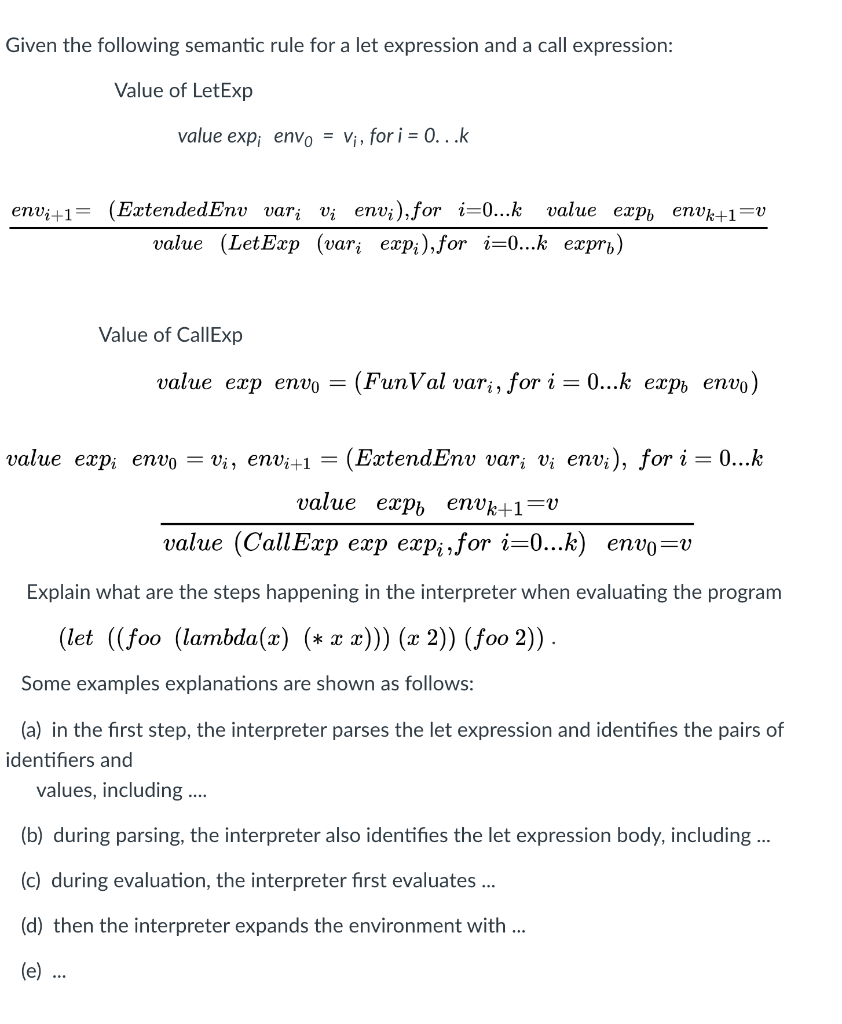
Given the following semantic rule for a let expression and a call expression: Value of LetExp value exp; envo = V;, for i = 0...k envi+1= (Extended Env vari Vi envi), for i=0...k value expb enuk+1=v value (LetExp (vari expi), for i=0...k expry) Value of CallExp value exp envo = (FunVal vari, for i = 0...k expo envo) value expi envo = Vi, envi+1 = (ExtendEnv var; vi envi), for i = 0...k value expb enuk+1=V value (CallExp exp expi, for i=0...k) envo=v Explain what are the steps happening in the interpreter when evaluating the program (let ((foo (lambda(x) (* x x))) (x 2)) (foo 2)). Some examples explanations are shown as follows: (a) in the first step, the interpreter parses the let expression and identifies the pairs of identifiers and values, including .... (b) during parsing, the interpreter also identifies the let expression body, including ... (c) during evaluation, the interpreter first evaluates ... (d) then the interpreter expands the environment with ... (e) ... Given the following semantic rule for a let expression and a call expression: Value of LetExp value exp; envo = V;, for i = 0...k envi+1= (Extended Env vari Vi envi), for i=0...k value expb enuk+1=v value (LetExp (vari expi), for i=0...k expry) Value of CallExp value exp envo = (FunVal vari, for i = 0...k expo envo) value expi envo = Vi, envi+1 = (ExtendEnv var; vi envi), for i = 0...k value expb enuk+1=V value (CallExp exp expi, for i=0...k) envo=v Explain what are the steps happening in the interpreter when evaluating the program (let ((foo (lambda(x) (* x x))) (x 2)) (foo 2)). Some examples explanations are shown as follows: (a) in the first step, the interpreter parses the let expression and identifies the pairs of identifiers and values, including .... (b) during parsing, the interpreter also identifies the let expression body, including ... (c) during evaluation, the interpreter first evaluates ... (d) then the interpreter expands the environment with ... (e)
Step by Step Solution
There are 3 Steps involved in it

Get step-by-step solutions from verified subject matter experts
 Study Help