







Question: Given the relation R(A, B, C, D, E, F, G) and the function dependencies FD1: E --> {C,G} FD2: {F,G} --> {A,B,E} FD3: {B,C} -->
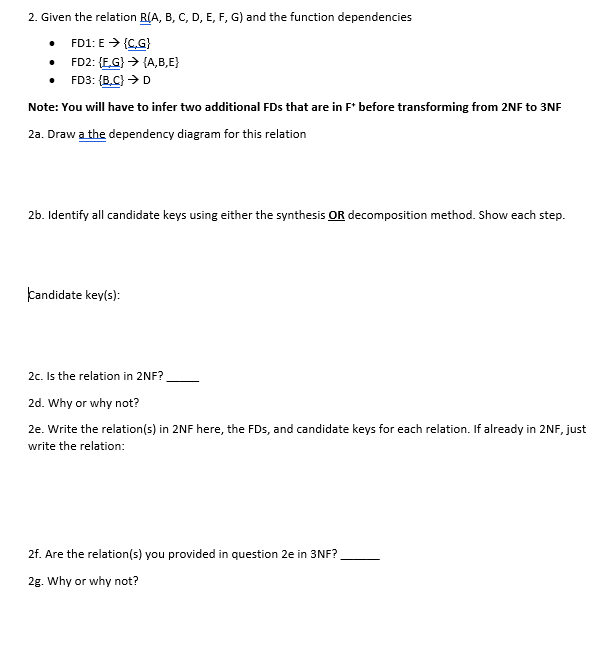
Given the relation R(A, B, C, D, E, F, G) and the function dependencies
FD1: E --> {C,G}
FD2: {F,G} --> {A,B,E}
FD3: {B,C} --> D
Note: You will have to infer two additional FDs that are in F+ before transforming from 2NF to 3NF
2. Given the relation R(A, B, C, D, E, F, G) and the function dependencies FD3: {B,C) D Note: You will have to infer two additional FDs that are in F* before transforming from 2NF to 3NF 2a. Draw a the dependency diagram for this relation 2b. Identify all candidate keys using either the synthesis OR decomposition method. Show each step. Candidate key(s) 2c. Is the relation in 2NF? 2d. Why or why not? 2e. Write the relation(s) in 2NF here, the FDs, and candidate keys for each relation. If already in 2NF, just write the relation: 2f. Are the relation(s) you provided in question 2e in 3NF? 2g. Why or why not? 2. Given the relation R(A, B, C, D, E, F, G) and the function dependencies FD3: {B,C) D Note: You will have to infer two additional FDs that are in F* before transforming from 2NF to 3NF 2a. Draw a the dependency diagram for this relation 2b. Identify all candidate keys using either the synthesis OR decomposition method. Show each step. Candidate key(s) 2c. Is the relation in 2NF? 2d. Why or why not? 2e. Write the relation(s) in 2NF here, the FDs, and candidate keys for each relation. If already in 2NF, just write the relation: 2f. Are the relation(s) you provided in question 2e in 3NF? 2g. Why or why not
Step by Step Solution
There are 3 Steps involved in it

Get step-by-step solutions from verified subject matter experts
 Study Help