







Question: Given the scenario below, construct the relational schema for the tables you will generate later. All the requirements that are needed are in the images
Given the scenario below, construct the relational schema for the tables you will generate later.
All the requirements that are needed are in the images shown above.
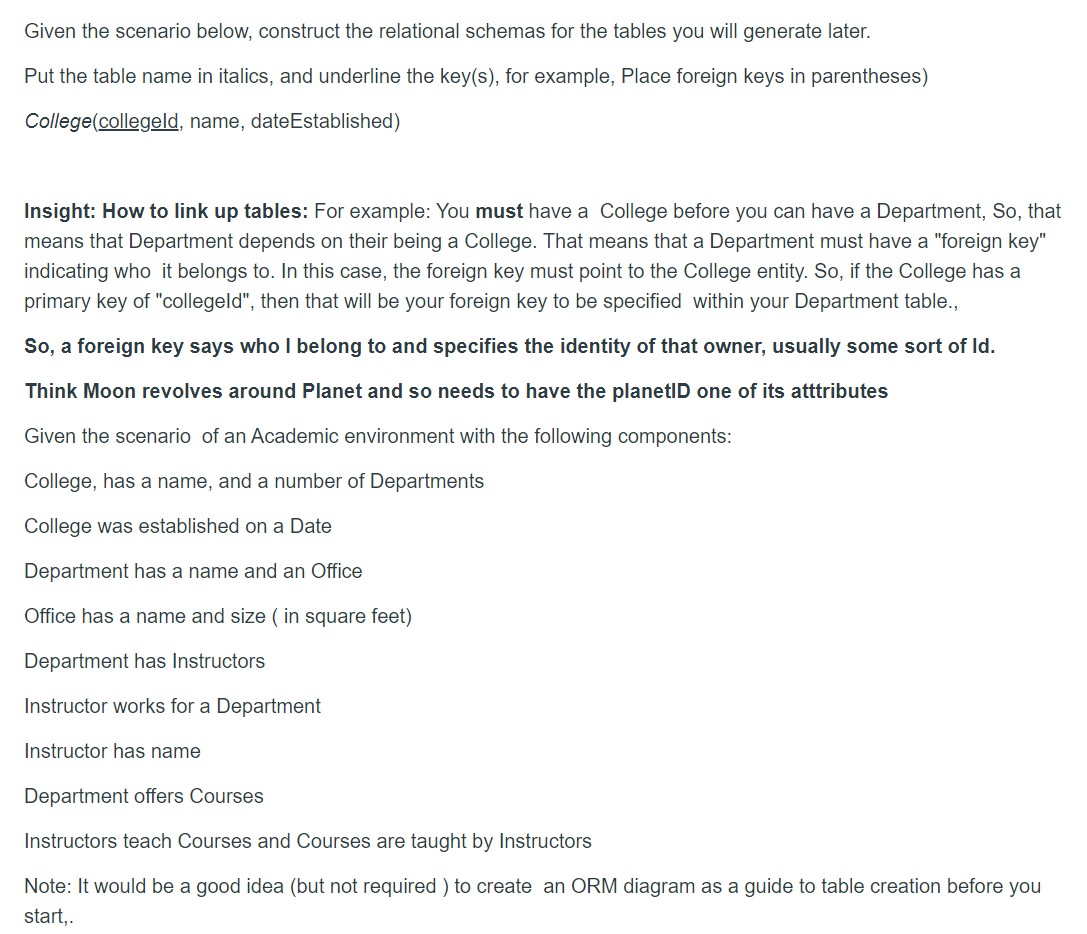
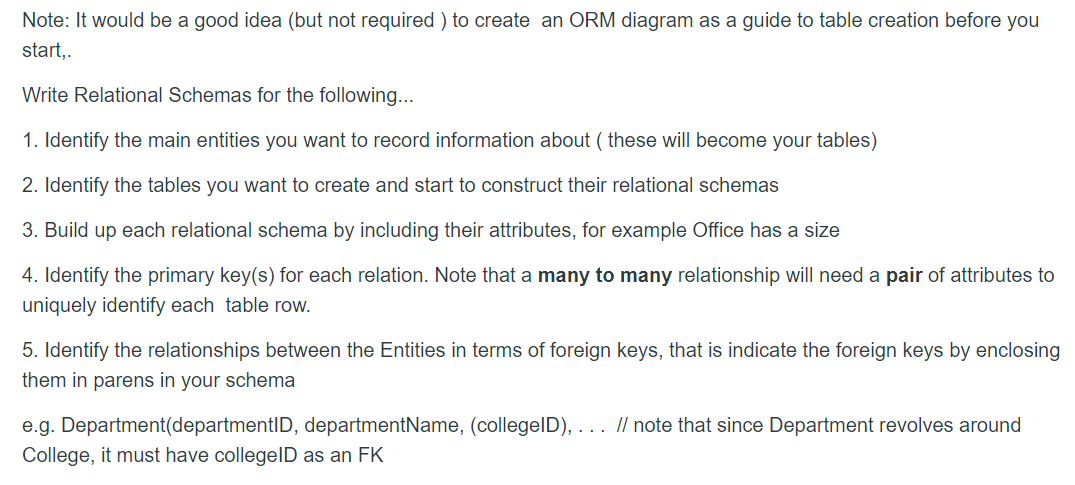
Given the scenario below, construct the relational schemas for the tables you will generate later. Put the table name in italics, and underline the key(s), for example, Place foreign keys in parentheses) College(collegeld, name, date Established) Insight: How to link up tables: For example: You must have a College before you can have a Department, So, that means that Department depends on their being a College. That means that a Department must have a "foreign key" indicating who it belongs to. In this case, the foreign key must point to the College entity. So, if the College has a primary key of "collegeld", then that will be your foreign key to be specified within your Department table., So, a foreign key says who I belong to and specifies the identity of that owner, usually some sort of Id. Think Moon revolves around Planet and so needs to have the planetID one of its atttributes Given the scenario of an Academic environment with the following components: College, has a name, and a number of Departments College was established on a Date Department has a name and an Office Office has a name and size (in square feet) Department has Instructors Instructor works for a Department Instructor has name Department offers Courses Instructors teach Courses and Courses are taught by Instructors Note: It would be a good idea (but not required ) to create an ORM diagram as a guide to table creation before you start, Note: It would be a good idea (but not required) to create an ORM diagram as a guide to table creation before you start, Write Relational Schemas for the following... 1. Identify the main entities you want to record information about these will become your tables) 2. Identify the tables you want to create and start to construct their relational schemas 3. Build up each relational schema by including their attributes, for example Office has a size 4. Identify the primary key(s) for each relation. Note that a many to many relationship will need a pair of attributes to uniquely identify each table row. 5. Identify the relationships between the Entities in terms of foreign keys, that is indicate the foreign keys by enclosing them in parens in your schema e.g. Department(departmentID, departmentName, (collegelD), ... // note that since Department revolves around College, it must have collegeld as an FK
Step by Step Solution
There are 3 Steps involved in it

Get step-by-step solutions from verified subject matter experts
 Study Help