







Question: Given the steady - state, non - dimensional velocity field: vec ( V ) ( x , y ) = c s c x (
Given the steadystate, nondimensional velocity field:
vec over the domain and
ptsa Compute the equation of the streamlines ie family of curves for this flow
field. Leave your answer in the form of a graph: Warning: Do not attempt
to find a functional form: or at this stage in the problem.
ptsb Determine the equation for the streamline going through the point in the
form of a function:
ptsc Compute the pathline for a particle that is moving with the velocity field start
ing from the initial position at time leftmost dot in figure
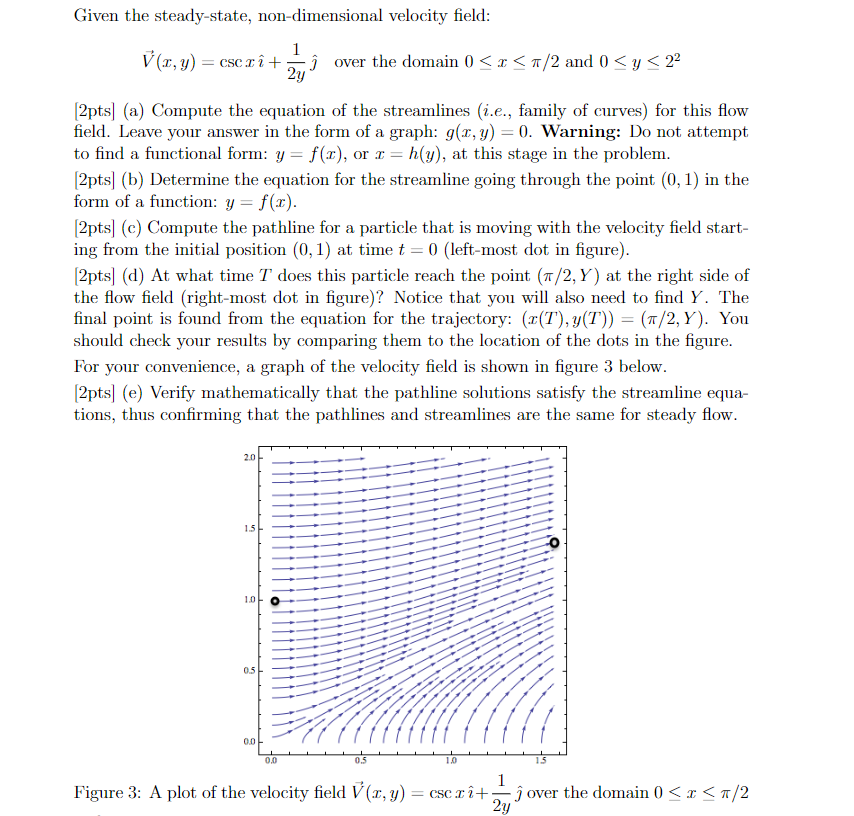
ptsd At what time does this particle reach the point at the right side of
the flow field rightmost dot in figure Notice that you will also need to find The
final point is found from the equation for the trajectory: You
should check your results by comparing them to the location of the dots in the figure.
For your convenience, a graph of the velocity field is shown in figure below.
ptse Verify mathematically that the pathline solutions satisfy the streamline equa
tions, thus confirming that the pathlines and streamlines are the same for steady flow.
Figure : A plot of the velocity field vec over the domain
Step by Step Solution
There are 3 Steps involved in it
1 Expert Approved Answer
Step: 1 Unlock

Question Has Been Solved by an Expert!
Get step-by-step solutions from verified subject matter experts
Step: 2 Unlock
Step: 3 Unlock
 Study Help