







Question: Given the two Boolean functions F and G below. You are asked to compare the gate input cost of their implementation using optimised sum-of-products form
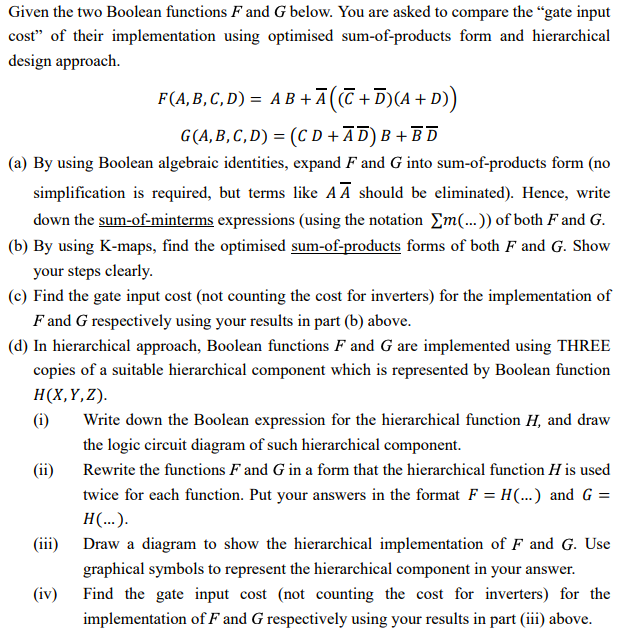
Given the two Boolean functions F and G below. You are asked to compare the gate input cost of their implementation using optimised sum-of-products form and hierarchical design approach. F(A,B,C,D) = AB +((T + D) (A + D)) G(A,B,C,D) = (CD+D) B+BD (a) By using Boolean algebraic identities, expand F and G into sum-of-products form (no simplification is required, but terms like A should be eliminated). Hence, write down the sum-of-minterms expressions (using the notation {m(...)) of both F and G. (b) By using K-maps, find the optimised sum-of-products forms of both F and G. Show your steps clearly. (C) Find the gate input cost (not counting the cost for inverters) for the implementation of F and G respectively using your results in part (b) above. (d) In hierarchical approach, Boolean functions F and G are implemented using THREE copies of a suitable hierarchical component which is represented by Boolean function H(X,Y,Z). (i) Write down the Boolean expression for the hierarchical function H, and draw the logic circuit diagram of such hierarchical component. (ii) Rewrite the functions F and G in a form that the hierarchical function H is used twice for each function. Put your answers in the format F = H(...) and G = H(...). (iii) Draw a diagram to show the hierarchical implementation of F and G. Use graphical symbols to represent the hierarchical component in your answer. (iv) Find the gate input cost (not counting the cost for inverters) for the implementation of F and G respectively using your results in part (iii) above
Step by Step Solution
There are 3 Steps involved in it

Get step-by-step solutions from verified subject matter experts
 Study Help