







Question: Given the zeroth, first and second order correction, solve for the third order correction in time-dependent perturbation theory. 11.1.2 Time-Dependent Perturbation Theory So far, everything
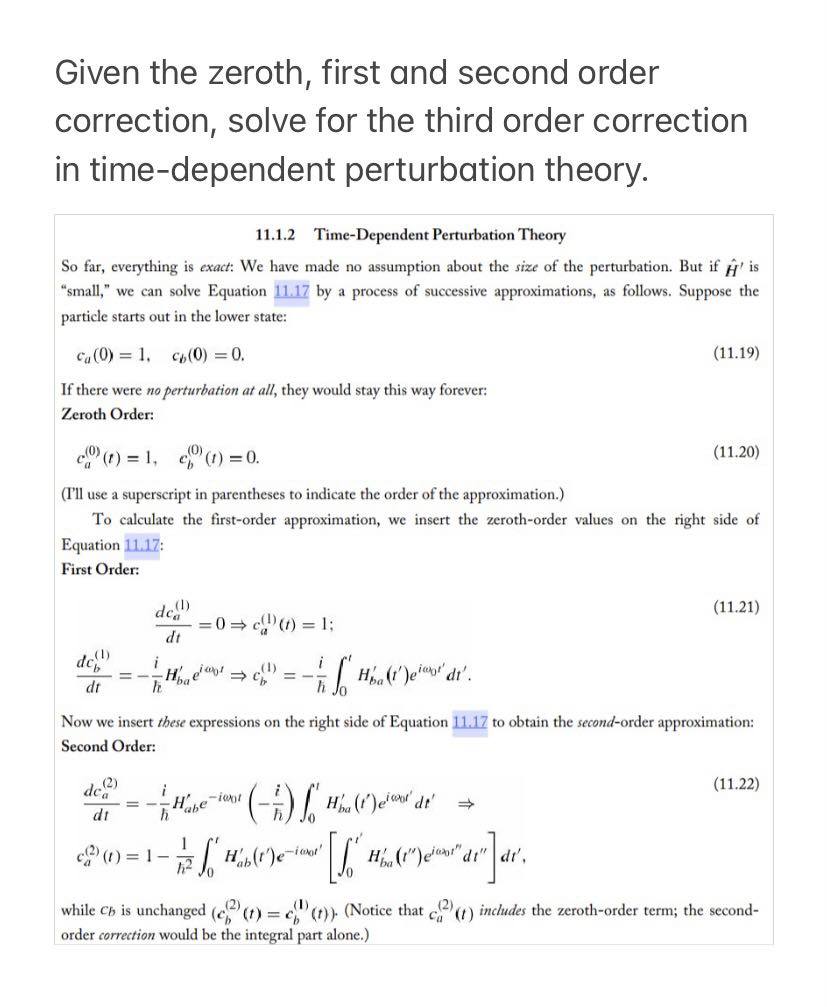
Given the zeroth, first and second order correction, solve for the third order correction in time-dependent perturbation theory. 11.1.2 Time-Dependent Perturbation Theory So far, everything is exact: We have made no assumption about the size of the perturbation. But if fy' is "small," we can solve Equation 11.17 by a process of successive approximations, as follows. Suppose the particle starts out in the lower state: ca (0) = 1, c (0) = 0. (11.19) If there were no perturbation at all, they would stay this way forever: Zeroth Order: (1) = 1, (1) =0. (11.20) (I'll use a superscript in parentheses to indicate the order of the approximation.) To calculate the first-order approximation, we insert the zeroth-order values on the right side of Equation 11.17: First Order: (11.21) =0= (1) =1; dt dt Law= =-[ Hbe(recordr. Now we insert these expressions on the right side of Equation 11.17 to obtain the second-order approximation: Second Order: (11.22) di while Ch is unchanged (c.(1) = c.(1)) (Notice that co)(1) includes the zeroth-order term; the second- order correction would be the integral part alone.)
Step by Step Solution
There are 3 Steps involved in it

Get step-by-step solutions from verified subject matter experts
 Study Help