Question: Please read the question Question: Give five examples (one per hypothesis) of actions teachers can take to support a child's second language development using the
Please read the question
Question: Give five examples (one per hypothesis) of actions teachers can take to support a child's second language development using the five hypotheses in Krashen's Monitor Model.
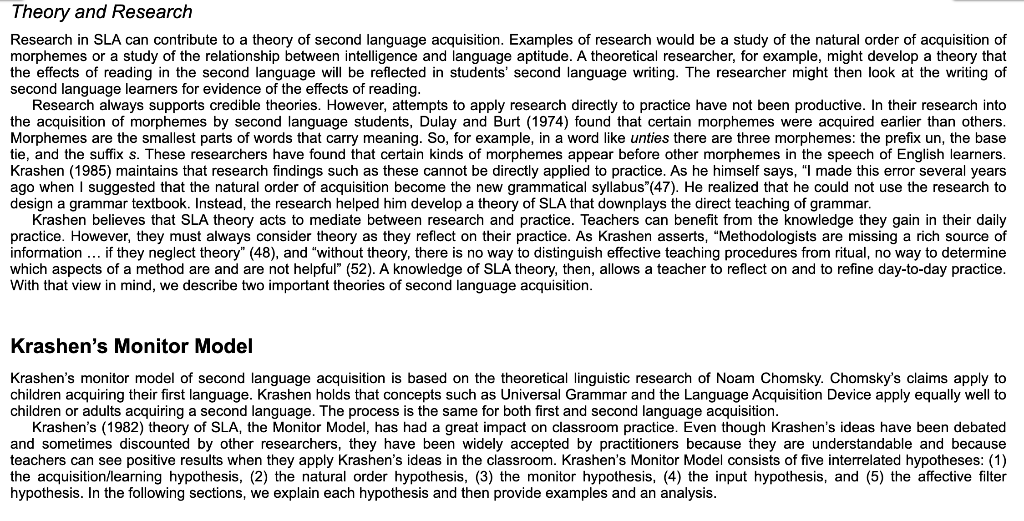


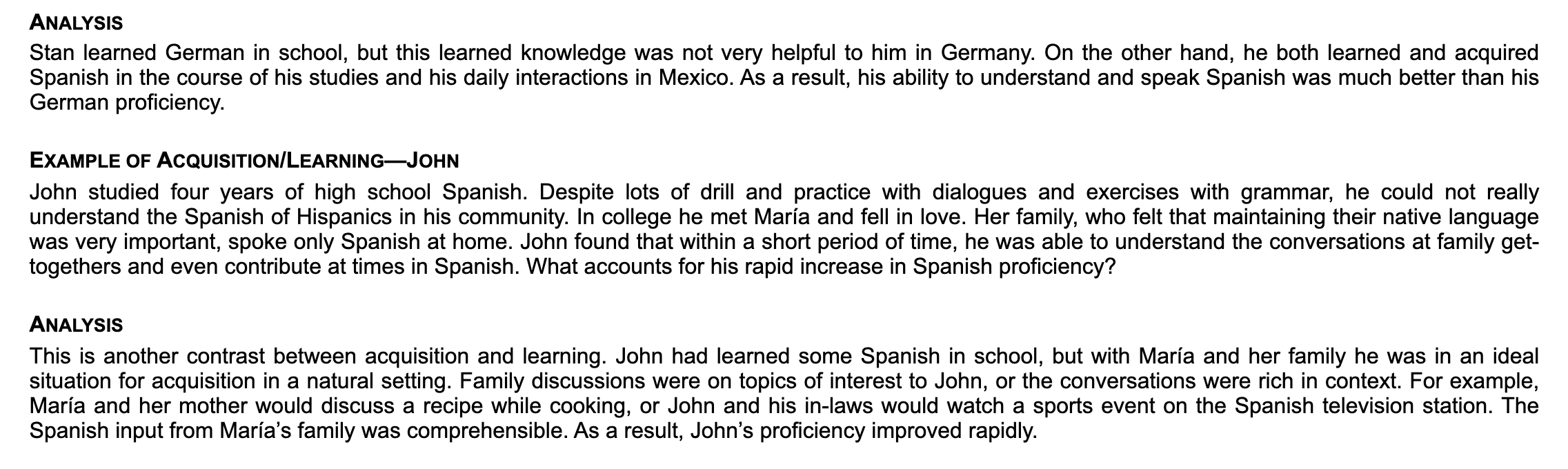

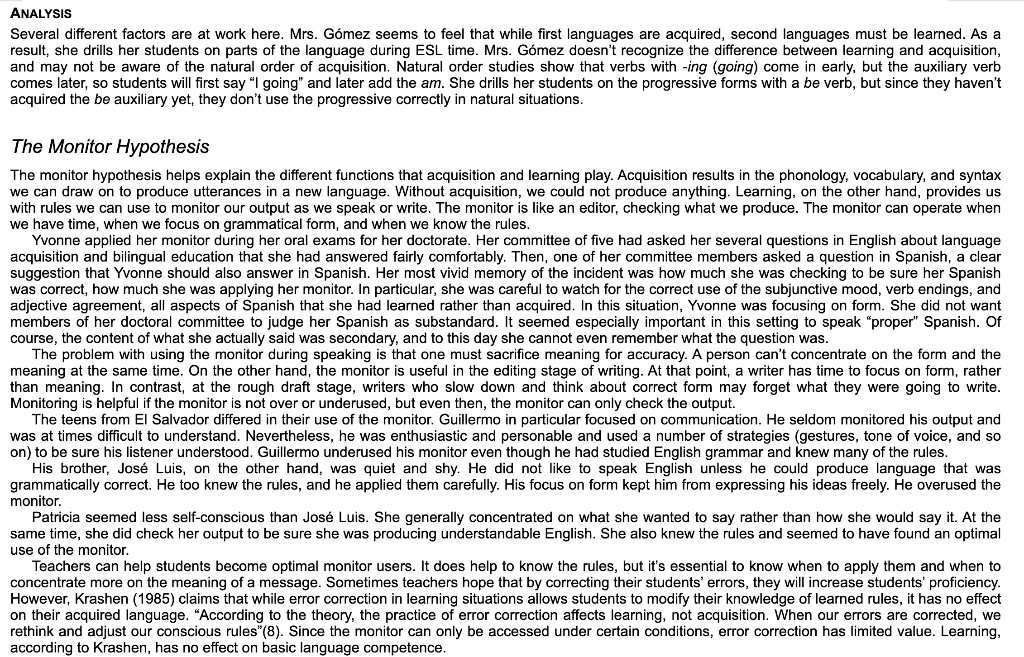
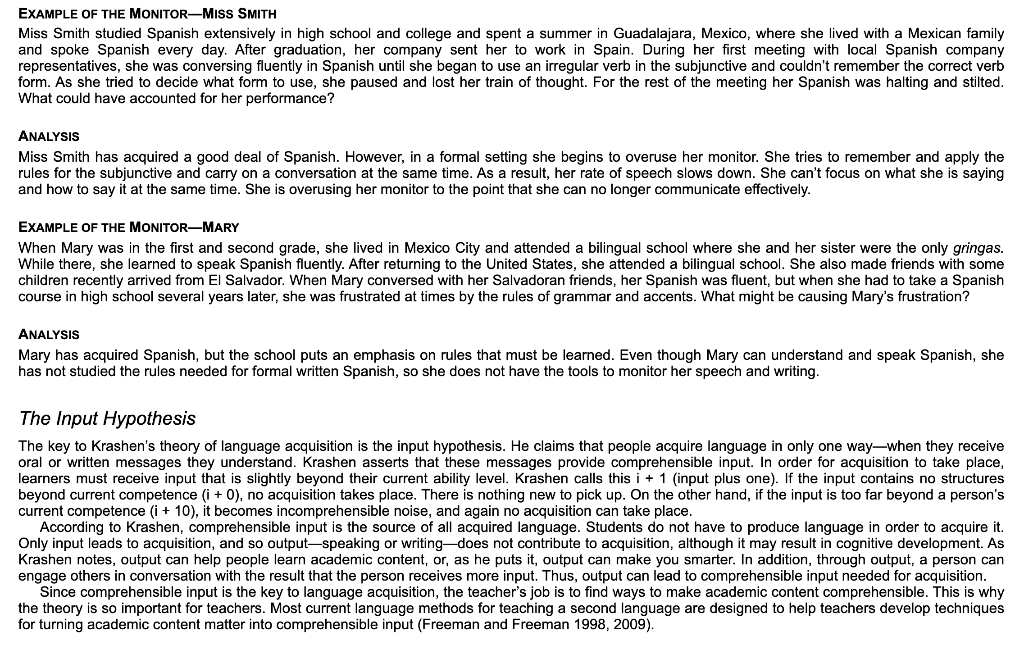


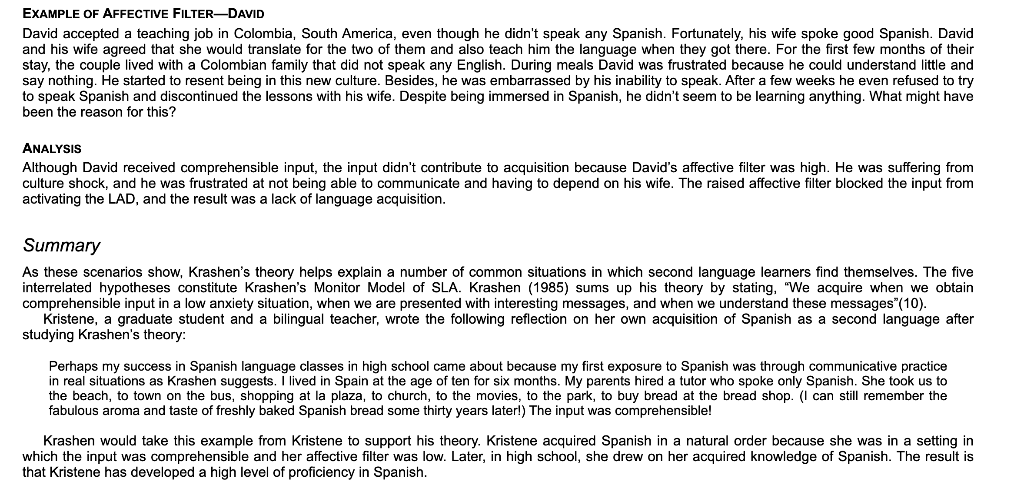
Theory and Research Research in SLA can contribute to a theory of second language acquisition. Examples of research would be a study of the natural order of acquisition of morphemes or a study of the relationship between intelligence and language aptitude. A theoretical researcher, for example, might develop a theory that the effects of reading in the second language will be reflected in students' second language writing. The researcher might then look at the writing of second language learners for evidence of the effects of reading. Research always supports credible theories. However, attempts to apply research directly to practice have not been productive. In their research into the acquisition of morphemes by second language students, Dulay and Burt (1974) found that certain morphemes were acquired earlier than others. Morphemes are the smallest parts of words that carry meaning. So, for example, in a word like unties there are three morphemes: the prefix un, the base tie, and the suffix s. These researchers have found that certain kinds of morphemes appear before other morphemes in the speech of English learners. Krashen (1985) maintains that research findings such as these cannot be directly applied to practice. As he himself says, "I made this error several years ago when I suggested that the natural order of acquisition become the new grammatical syllabus"(47). He realized that he could not use the research to design a grammar textbook. Instead, the research helped him develop a theory of SLA that downplays the direct teaching of grammar. Krashen believes that SLA theory acts to mediate between research and practice. Teachers can benefit from the knowledge they gain in their daily practice. However, they must always consider theory as they reflect on their practice. As Krashen asserts, "Methodologists are missing a rich source of information ... if they neglect theory" (48), and "without theory, there is no way distinguish effective teaching procedures from ritual, no way to determine which aspects of a method are and are not helpful" (52). A knowledge of SLA theory, then, allows a teacher to reflect on and to refine day-to-day practice. With that view in mind, we describe two important theories of second language acquisition. Krashen's Monitor Model Krashen's monitor model of second language acquisition is based on the theoretical linguistic research of Noam Chomsky. Chomsky's claims apply to children acquiring their first language. Krashen holds that concepts such as Universal Grammar and the Language Acquisition Device apply equally well to children or adults acquiring a second language. The process is the same for both first and second language acquisition. Krashen's (1982) theory of SLA, the Monitor Model, has had a great impact on classroom practice. Even though Krashen's ideas have been debated and sometimes discounted by other researchers, they have been widely accepted by practitioners because they are understandable and because teachers can see positive results when they apply Krashen's ideas in the classroom. Krashen's Monitor Model consists of five interrelated hypotheses: (1) the acquisition/learning hypothesis, (2) the natural order hypothesis, (3) the monitor hypothesis, (4) the input hypothesis, and (5) the affective filter hypothesis. In the following sections, we explain each hypothesis and then provide examples and an analysis. The Acquisition/Learning Hypothesis Krashen begins by making an important distinction between two ways of getting a new language. The first of these is acquisition. According to Krashen we acquire a new language subconsciously as we receive messages we understand. For example, if we are living in a foreign country and go to the store to buy food, we may acquire new vocabulary or syntactic structures in the process of trying to understand what the clerk is saying. We are not focused on the language. Rather, we are using the language for real purposes, and acquisition occurs naturally as we attempt to conduct our business. Acquisition can also occur in classrooms in which teachers engage students in authentic communicative experiences. Krashen (2004a) has shown that we can acquire language as we read. In fact, since people are able to read more rapidly than they speak, written language is a better source for acquisition than oral language. Krashen contrasts acquisition with learning. Learning is a conscious process in which we focus on various aspects of the language itself. It is what generally occurs in classrooms when teachers divide language up into chunks, present one chunk at a time, and provide students with feedback to indicate how well they have mastered the various aspects of language that have been taught. A teacher might present a lesson on regular verbs in the present tense, for example, giving attention to the s that is added to third-person forms in sentences such as He walks." It is this structure that students are expected to learn. Learning is associated with classroom instruction and is usually tested. It is less common in the world beyond the classroom. Al though Krashen's theory focuses on individual psychological factors involved in second language acquisition, Gee (1992) offers a definition of acquisition that expands on Krashen's by including a social component: Acquisition is a process of acquiring something subconsciously by exposure to models, a process of trial and error, and practice within social groups, without formal teaching. It happens in natural settings that are meaningful and functional in the sense that acquirers know that they need to acquire the thing they are exposed to in order to function and that they in fact want to so function. (113) This expanded definition of acquisition brings an important social element into the distinction between acquisition and learning. Acquisition occurs in social contexts as people attempt to communicate with others. It appears that acquisition and learning lead to different kinds of abilities. As Gee (1992) puts it: "We are better at performing what we acquire, but we consciously know more about what we have learned"(114). In the case of second languages, acquisition allows us to speak and understand, read and write the language. Learning allows us to talk about (or pass exams on) the language. Many adults who have studied a foreign language in high school and/or college and received high grades never developed the ability to speak or understand the language they studied. Their performance on grammar and vocabulary tests determined their grades. Yvonne's experiences studying French in college certainly proved this. She took four years of French, could translate French into English quite well, and knew French grammar. Her grades were always very high in the courses she took. However, her ability to communicate in French is severely limited. Recently, when Yvonne and David were in Costa Rica staying at a remote inn, the only other guests were from Paris. Although Yvonne had studied French extensively, she struggled to understand simple conversation and communicate basic ideas. I The difference between the effects of acquisition and learning is most evident in the case of second or foreign language learning. As Gee (1988) comments, "It "It appears that some substantive degree of incidental learning (acquisition) must take place before intentional learning is very efficacious"(217). Yvonne's foreign language French classes had not helped her acquire French because those classes focused on learning the grammar and vocabulary. Yvonne knew French grammar but could not converse with French speakers. Once someone has acquired a language, they may then want to learn more about the language, the grammar and vocabulary, to refine their knowledge. A good example of the acquisition/learning distinction comes from the experiences of Jos Luis, Guillermo, and Patricia, who were discussed in Chapter 1. The teens studied English in El Salvador. This was a case of learning the rules and structures of the language. When they came to the United States, they did know some English, but it was very limited. In their new home in Tucson they were immersed in English and began to acquire the language as they used it daily. Krashen argues that children acquire they don't learn) their first language(s) as they use language to communicate and to make sense of the world. Krashen claims that both children and adults have the capacity to acquire additional languages because they possess a language acquisition device (LAD). He claims that acquisition accounts for almost all of our language development and that learning plays a minimal role. While second language classrooms should be places for acquisition, more often second and foreign language teachers focus on learning. When teaching second language learners, Yvonne was constantly struggling with the difference between acquisition and learning, though she had not studied Krashen's theory and did not even know about it until graduate school. She was worried that students needed to learn the grammar, because that is how she had been taught language. However, she saw that students were more involved and more successful when they talked and read about things that were related to their lives. Discussions of music and television programs engaged students and got them involved in using language for authentic purposes, and they acquired language as they used it. Yet, the textbooks available for teaching all seemed to emphasize direct or indirect teaching of grammar and vocabulary. Yvonne had to depart from traditional approaches to change her classroom from a place for learning to a setting for acquisition. EXAMPLE OF ACQUISITION/LEARNINGSTAN Stan studied three years of German in high school and two more years in college. After college he joined the army and was sent to Germany. He found that he could read signs and some newspaper articles, but he had a great deal of trouble in trying to communicate with native Germans. After he was discharged, he went to work for a company that assigned him to head a branch located in Mexico City. On arrival, he took a crash course in Spanish. At the same time, he had to try to communicate with his fellow workers, entertain important Mexican businessmen, and use Spanish for daily life transactions such as shopping. After only six months, Stan's spoken Spanish was much better than his German had ever been. What might account for this? ANALYSIS Stan learned German in school, but this learned knowledge was not very helpful to him in Germany. On the other hand, he both learned and acquired Spanish in the course of his studies and his daily interactions in Mexico. As a result, his ability to understand and speak Spanish was much better than his German proficiency. EXAMPLE OF ACQUISITION/LEARNINGJOHN John studied four years of high school Spanish. Despite lots of drill and practice with dialogues and exercises with grammar, he could not really understand the Spanish of Hispanics in his community. In college he met Mara and fell in love. Her family, who felt that maintaining their native language was very important, spoke only Spanish at home. John found that within a short period of time, he was able to understand the conversations at family get- togethers and even contribute at times in Spanish. What accounts for his rapid increase in Spanish proficiency? ANALYSIS This is another contrast between acquisition and learning. John had learned some Spanish in school, but with Maria and her family he was in an ideal situation for acquisition in a natural setting. Family discussions were on topics of interest to John, or the conversations were rich in context. For example, Mara and her mother would discuss a recipe while cooking, or John and his in-laws would watch a sports event on the Spanish television station. The Spanish input from Mara's family was comprehensible. As a result, John's proficiency improved rapidly. The Natural Order Hypothesis Krashen's second hypothesis is that language is acquired in a natural order. Some aspects of a language are picked up earlier than others. For example, the plural s morpheme added to a word like girl to form girls comes earlier than the third person s added to the word walk in "He walks." Most parents are aware that phonemes like /p/or /m/ are acquired earlier than others, like /r/. That's why English-speaking parents are called papa or mama by babies, not roro. In the area of syntax, statements generally precede questions. Children do not acquire the structure of questions early, so they often use statement structures with rising intonation such as "I go store, too?" or "You like teddy?" to pose questions. Krashen points out that all learners of a particular language, such as English, seem to acquire the language in the same order no matter what their first language may be. Krashen bases this hypothesis on studies carried out by Dulay and Burt (1974). These researchers collected samples of speech from Chinese- and Spanish-speaking students learning English. They found that both groups acquired English morphemes in about the same order. They found, for example, that students acquired the plural s form fairly early, but the third-person s of "He walks" came much later. These early studies were subsequently confirmed by the work of a number of other researchers. The natural order applies to language that is acquired, not language that is learned. In fact, students may be asked to learn aspects of language before they are ready them. The result may be good performance of the items on a test but inability to use the same items in a natural setting. In these cases, students' performance may exceed their competence. In teaching Spanish, Yvonne found that the expression for like in Spanish was a late-acquired item. In Spanish, "I like" is Me gusta (It is pleasing to me). If the things I like are plural, I say Me gustan (They are pleasing to me). This structure caused no end of confusion for Yvonne's beginning students. She worked with them diligently, explaining how the structure worked and giving examples. Even those who did well on the department test that covered the structure, however, had not acquired the structure. When Yvonne asked her students to evaluate the course in their daily diary at the end of the semester, almost all the students incorrectly wrote Yo gusto for "I like." They knew that yo meant "T" and knew the verb gustar was "to like." So they simply conjugated the verb as a regular verb despite the emphasis on learning the expression Me gusta. Most books used in language courses present grammar in a certain order, but since linguists have only a rudimentary understanding of the complete order of acquisition of phonemes, morphemes, syntax, and so on, no book can be written that can claim to mirror the natural order. Even if such a book were written, students would invariably be at different stages, and in a class of thirty students, no grammar lesson would be appropriate for everyone. Krashen, however, points out that if a teacher focuses on acquisition activities, rather than trying to get students to learn certain grammatical points, all students will acquire language in a natural order. The rate of acquisition of morphemes and structures will differ for different students, but the order will be the same. to acquire the EXAMPLE OF NATURAL ORDER-MRS. GMEZ Mrs. Gmez is a bilingual second-grade teacher. She does lots of reading and writing with her students in Spanish. During ESL time, she believes that students need large doses of drill and practice to master English. She teaches her students how to use the-ing form of the verb with the auxiliary form of be. So the students practice "We are going to the library" and "I am studying math." What she cannot understand is that when her students ask her questions or tell her things in English informally, they consistently leave the be auxiliary out of the constructions: "Teacher, we going to the park"; "Look teacher, I swinging high!" What might be the reason for this? ANALYSIS Several different factors are at work here. Mrs. Gmez seems to feel that while first languages are acquired, second languages must be learned. As a result, she drills her students on parts of the language during ESL time. Mrs. Gmez doesn't recognize the difference between learning and acquisition, and may not be aware of the natural order of acquisition. Natural order studies show that verbs with -ing (going) come in early, but the auxiliary verb comes later, so students will first say "I going" and later add the am. She drills her students on the progressive forms with a be verb, but since they haven't acquired the be auxiliary yet, they don't use the progressive correctly in natural situations. Seemed with The Monitor Hypothesis The monitor hypothesis helps explain the different functions that acquisition and learning play. Acquisition results in the phonology, vocabulary, and syntax we can draw on to produce utterances in a new language. Without acquisition, we could not produce anything. Learning, on the other hand, provides us with rules we can use to monitor our output as we speak or write. The monitor is like an editor, checking what we produce. The monitor can operate when we have time, when we focus on grammatical form, and when we know the rules. Yvonne applied her monitor during her oral exams for her doctorate. Her committee of five had asked her several questions in English about language acquisition and bilingual education that she had answered fairly comfortably. Then, one of her committee members asked a question in Spanish, a clear suggestion that Yvonne should also answer in Spanish. Her most vivid mem was correct, how much she was applying her monitor. In particular, she was care for the incident was how much she was checking to be sure her Spanish careful to watch for agreement, all aspects of Spanish that she had learned rather than acquired. In this situation, Yvonne was focusing on form. She did not want members of her doctoral committee judge her Spanish as substandard. especially important in this setting to speak "proper" Spanish. Of course, the content of what she actually said was secondary, and to this day she cannot even remember what the question was. nito The problem eskin id using the monitor during speaking is that one one must sacrifice me meaning for accuracy. A person can't concentrate on the form and the meaning at the same time. On the other hand, the monitor is useful in the editing stage of writing. At that point, a writer has time to focus on form, rather than meaning. In contrast, at the rough draft stage, writers who slow down and think about correct form may forget what they were going to write. Monitoring is helpful if the monitor is not over or underused, but even then, the monitor can only check the output. The teens from El Salvador differed in their use of the monitor. Guillermo in particular focused on communication. He seldom monitored his output and was at times difficult to understand. Nevertheless, he was enthusiastic and personable and used a number of strategies (gestures, tone of voice, and so on) to be sure his listener understood. Guillermo underused his monitor even though he had studied English grammar and knew many of the rules. His brother, Jos Luis, on the other hand, was quiet and shy. He did not like to speak English unless he could produce language that was grammatically correct. He too knew the rules, and he applied them carefully. His focus on form kept him from expressing his ideas freely. He overused the monitor. Patricia seemed less self-conscious than Jos Luis. She generally concentrated on what she wanted to say rather than how she would say it. At the same time, she did check her output to be sure she was producing understandable English. She also knew the rules and seemed to have found an optimal use of of the monitor. Teachers can help students become optimal monitor users. It does help to know the rules, but it's essential to know when to apply them and when to concentrate more on the meaning of a message. Sometimes teachers hope that by correcting their students' errors, they will increase students' proficiency. However, Krashen (1985) claims that while error correction in learning situations allows students to modify their knowledge of learned rules, it has no effect on their acquired language. According to the theory, the practice of error correction affects learning, not acquisition. When our errors are corrected, we rethink and adjust our conscious rules"(8). Since the monitor can only be accessed under certain conditions, error correction has limited value. Learning, according to Krashen, has no effect on basic language competence. EXAMPLE OF THE MONITOR-Miss SMITH Miss Smith studied Spanish extensively in high school and college and spent a summer in Guadalajara, Mexico, where she lived with a Mexican family and spoke Spanish every day. After graduation, her company sent her to work in Spain. During her first meeting with local Spanish company representatives, she was conversing fluently in Spanish until she began to use an irregular verb in the subjunctive and couldn't remember the correct verb form. As she tried to decide what form to use, she paused and lost her train of thought. For the rest of the meeting her Spanish was halting and stilted. What could have accounted for her performance? ANALYSIS Miss Smith has acquired a good deal of Spanish. However, in a formal setting she begins to overuse her monitor. She tries to remember and apply the rules for the subjunctive and carry on a conversation at the same time. As a result, her rate of speech slows down. She can't focus on what she is saying and how to say it at the same time. She is overusing her monitor to the point that she can no longer communicate effectively. EXAMPLE OF THE MONITORMARY When Mary was in the first and second grade, she lived in Mexico City and attended a bilingual school where she and her sister were the only gringas. While there, she learned to speak Spanish fluently. After returning to the United States, she attended a bilingual school. She also made friends with some children recently arrived from El Salvador. When Mary conversed with her Salvadoran friends, her Spanish was fluent, but when she had to take a Spanish course in high school several years later, she was frustrated at times by the rules of grammar and accents. What might be causing Mary's frustration? ANALYSIS Mary has acquired Spanish, but the school puts an emphasis on rules that must be learned. Even though Mary can understand and speak Spanish, she has not studied the rules needed for formal written Spanish, so she does not have the tools to monitor her speech and writing. The Input Hypothesis The key to Krashen's theory of language acquisition is the input hypothesis. He claims that people acquire language in only one waywhen they receive oral or written messages they understand. Krashen asserts that these messages ide comprehensible input. In order for acquisition to place, learners must receive input that is slightly beyond their current ability level. Krashen calls this i + 1 (input plus one). If the input contains no structures beyond current competence (i + 0), no acquisition takes place. There is nothing new to pick up. On the other hand, if the input is too far beyond a person's current competence (i + 10), it becomes incomprehensible noise, and again no acquisition can take place. According to Krashen, comprehensible alla ande the source of all acquired language. Students do not have to produce language in order to acquire it. input Only input leads to acquisition, and so output-speaking or writing-does not contribute to acquisition, although it may result in cognitive development. As Krashen notes, output can help people learn academic content, or, as he puts it, output can make you smarter. In addition, through output, a person can engage others in conversation with the result that the person receives more input. Thus, output can lead to comprehensible input needed for acquisition. Since comprehensible input is the key to language acquisition, the teacher's job is to find ways to make academic content comprehensible. This is why the theory is so important for teachers. Most current language methods for teaching a second language are designed to help teachers develop techniques for turning academic content matter into comprehensible input (Freeman and Freeman 1998, 2009). Simplified Input Studies by Hatch (1983) suggest that the kind of input that leads to language development is simplified input. According to Hatch, simplified input includes caregiver talk, teacher talk, and talk to nonnative speakers. Hatch identified some characteristics of simplified talk. The phonology includes fewer reduced vowels and contractions, and the rate of speech is slower, with longer pauses. The vocabulary is characterized by more high-frequency items, fewer idioms, and less slang. There are fewer pronouns, and speakers often use gestures and pictures. At the level of syntax, sentences are shorter, with more repetitions and restatements. Discourse includes more requests for clarification and fewer interruptions. When speaking directly to us During our year in Venezuela, one thing we noticed in early interactions with colleagues was that they often tried to provide us with simplified input. a meeting, for example, they obviously slowed their speech. fact, if someone in the meeting used slang, the meeting would usually stop and everyone would try to explain the expression to us. Our landlord spoke no English at all and was nervous about talking to us. In our she slowly and used lots gestures in an effort to make herself understood. She used all the techniques of an excellent language teacher, even though she is a lawyer by profession. One problem with claiming that simplified input leads to acquisition is that simplified input may not contain new language structures or items. Krashen claims that we acquire language when we receive input that contains language slightly beyond our current level of competence. second problem with simplified input is that it may result in unnatural language with short sentences and short, everyday words. Language that is not natural is more difficult to acquire because it doesn't follow predictable language patterns. In addition, texts with short sentences and words do not prepare students for the academic language in school textbooks (Goodman and Freeman 1993). first meeting, spoke som EXAMPLE OF INPUT-MR. ROBERTS The students in Mr. Roberts' first-year Spanish class do well in his structured program, although they seem bored at times. Mr. Roberts is careful to introduce only one new structure at a time and drill that structure until the students have mastered it. Al though the students are making satisfactory progress, the class seems to lack animation, so to liven things up Mr. Roberts decides to bring in a guest speaker to talk about dating customs among Mexican teenagers. Despite the fact that Mr. Roberts warned his guest to limit his vocabulary and grammatical structures, the speaker gets carried away with his subject and uses the full range of Spanish. Surprisingly, although the students don't understand everything, they seem to be following most of the lecture. In addition, for the first time all year, they seem interested. What is going on here? ANALYSIS The speaker is using structures slightly beyond the students' current level of comprehension. Some of the input is comprehensible because of the students' background knowledge of dating. In addition, the students are interested in the topic and make an effort to understand it. As a result, this input has probably contributed to their Spanish acquisition. (See also "The Affective Filter Hypothesis," on the next page.) EXAMPLE OF INPUT-JOS Jos is in the fifth grade and doing very well this year, despite the fact that his fourth-grade teacher, Mrs. Lynch, recommended him for special education. In Mrs. Lynch's class, students studied grammar rules and practiced accurate oral reading of basal reader selections during language arts. Mrs. Lynch contended that Jos was in the lowest reading group, had done poorly on standardized tests, and could not do the worksheets assigned to him. Jos's parents asked that he be given another chance. In grade his teacher had students do lots of reading and writing and work on projects in groups. The children did not use the basal readers or worksheets but instead studied literature using drama, art, and music. In only one semester, Jos's English had improved noticeably, and he was enthusiastically reading and writing in English. When Mrs. Lynch insisted that he be tested with the basal reader tests, Jos's results showed a two-year gain despite the fact that he had not been working with worksheets or basal readers. What might be the reason for this dramatic progress? ANALYSIS Mrs. Lynch focused on grammar and accurate decoding of texts. This approach did not provide Jos with comprehensible input. The kinds of activities his new teacher uses make the English input comprehensible for Jos. Because of this, Jos has acquired a great deal of English in a short time, and this acquired language has increased his overall proficiency, as shown on the reading tests. The Affective Filter Hypothesis The affective filter hypothesis explains the role of affective factors in the process of language acquisition. Even if a teacher provides comprehensible input, acquisition may not take place. Affective factors such as anxiety or boredom may serve as a filter that blocks input. When the filter is up, input can't reach those parts of the brain (the LAD) where acquisition occurs. Many language learners realize that the reason they have trouble is because they are nervous or embarrassed and simply "can't concentrate." Lack of desire to learn can also "clog" the affective filter. Yvonne's e's intern experience teaching high school Spanish to get ther credential provides an example of the affective filter. Her class consisted of twenty- four boys, all on the junior varsity football team, and three girls. Most of the students had signed up for the "new intern" teacher mainly because they had failed Spanish 1 the year before. Positive affective factors such as as high interest or motivation can help keep the filter down, but those students had neither. Yvonne's major job was to try to lower the students' filter by getting them interested and convincing them that they wanted to learn Spanish. Since Krashen's theory of language acquisition is based on input, in his discussion of the affective filter he only refers to language that is coming in, not to language the person is attempting to produce. In other words, the affective filter can prevent a person from getting more comprehensible input. This hypothesis does not apply to a person's output, only to the ability to acquire language. At times, students who have developed high levels of language proficiency may not perform up to their capacity. As we have explained, there are times when students are nervous, bored, or unmotivated, and their performance does not match their competence. This was the case for Leny, whom we described in Chapter 4. She became nervous trying to speak Spanish in the beauty parlor, and her performance did not reflect her competence. Students may not perform well in a new language if they overuse their monitor. However, when Krashen refers to an affective filter, he is referring only to affective factors that block input. a EXAMPLE OF AFFECTIVE FILTER-DAVID David accepted a teaching job in Colombia, South America, even though he didn't speak any Spanish. Fortunately, his wife spoke good Spanish. David and his wife agreed that she would translate for the two of them and also teach him the language when they got there. For the first few months of their stay, couple lived with a Colombian family that did not speak any English. During meals David was frustrated because he could understand little and say nothing. He started to resent being in this new culture. Besides, he was embarrassed by his inability to speak. After a few weeks he even refused to try to speak Spanish and discontinued the lessons with his wife. Despite being immersed in Spanish, he didn't seem to be learning anything. What might have been the reason for this? ANALYSIS Although David received comprehensible input, the input didn't contribute to acquisition because David's affective filter was high. He was suffering from culture shock, and he was frustrated at not being able to communicate and having to depend on his wife. The raised affective filter blocked the input from activating the LAD, and the result was a lack of language acquisition. Summary As these scenarios show, Krashen's theory helps explain a number of common situations in which second language learners find themselves. The five interrelated hypotheses constitute Krashen's Monitor Model of SLA. Krashen (1985) sums up his theory by stating, "We acquire when we obtain comprehensible input in a low anxiety situation, when we are presented with interesting messages, and when we understand these messages"(10). Kristene, a graduate student and a bilingual teacher, wrote the following reflection on her own acquisition of Spanish as a second language after studying Krashen's theory: Perhaps my success in Spanish language classes in high school came about because my first exposure to Spanish was through communicative practice in real situations as Krashen suggests. I lived in Spain at the age of ten for six months. My parents hired a tutor who spoke only Spanish. She took us to the beach, to town on the bus, shopping at la plaza, to church, to the movies, to the park, to buy bread at the bread shop. (I can still remember the fabulous aroma and taste of freshly baked Spanish bread some thirty years later!) The input was comprehensible! Krashen would take this example from Kristene to support his theory. Kristene acquired Spanish in a natural order because she was in a setting in which the input was comprehensible and her affective filter was low. Later, in high school, she drew on her acquired knowledge of Spanish. The result is that Kristene has developed a high level of proficiency in Spanish









 Study Help