



Question: given this answer these WASHINGTON More than 3.4 billion people, nearly half the world's population, own at least one mobile phone in 2013. As of
given this answer these
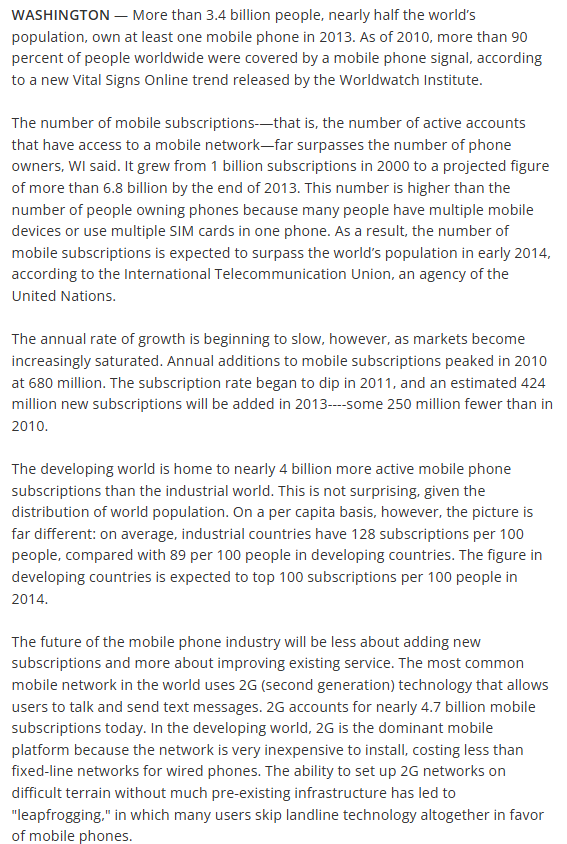 WASHINGTON More than 3.4 billion people, nearly half the world's population, own at least one mobile phone in 2013. As of 2010, more than 90 percent of people worldwide were covered by a mobile phone signal, according to a new Vital Signs Online trend released by the Worldwatch Institute. The number of mobile subscriptions-that is, the number of active accounts that have access to a mobile networkfar surpasses the number of phone owners, WI said. It grew from 1 billion subscriptions in 2000 to a projected figure of more than 6.8 billion by the end of 2013. This number is higher than the number of people owning phones because many people have multiple mobile devices or use multiple SIM cards in one phone. As a result, the number of mobile subscriptions is expected to surpass the world's population in early 2014, according to the International Telecommunication Union, an agency of the United Nations. The annual rate of growth is beginning to slow, however, as markets become increasingly saturated. Annual additions to mobile subscriptions peaked in 2010 at 680 million. The subscription rate began to dip in 2011, and an estimated 424 million new subscriptions will be added in 2013--same 250 million fewer than in 2010. The developing world is home to nearly 4 billion more active mobile phone subscriptions than the industrial world. This is not surprising, given the distribution of world population. On a per capita basis, however, the picture is far different: on average, industrial countries have 128 subscriptions per 100 peaple, compared with 89 per 100 people in developing countries. The figure in developing countries is expected to top 100 subscriptions per 100 people in 2014, The future of the mobile phone industry will be less about adding new subscriptions and more about improving existing service. The most common mobile network in the world uses 2G (second generation) technology that allows users to talk and send text messages. 2G accounts for nearly 4.7 billion mobile subscriptions today. In the developing world, 2G is the dominant mobile platform because the network is very inexpensive to install, costing less than fixed-line networks for wired phones. The ability to set up 2G networks on difficult terrain without much pre-existing infrastructure has led to "leapfrogging." in which many users skip landline technology altogether in favor of mobile phones
Step by Step Solution
There are 3 Steps involved in it
1 Expert Approved Answer
Step: 1 Unlock

Question Has Been Solved by an Expert!
Get step-by-step solutions from verified subject matter experts
Step: 2 Unlock
Step: 3 Unlock