







Question: Given this problem, can someone please guide me to the answers. Chapter 7: Bayesian Inference 403 419/776 if inference was discussed in this section, namely,
Given this problem, can someone please guide me to the answers.
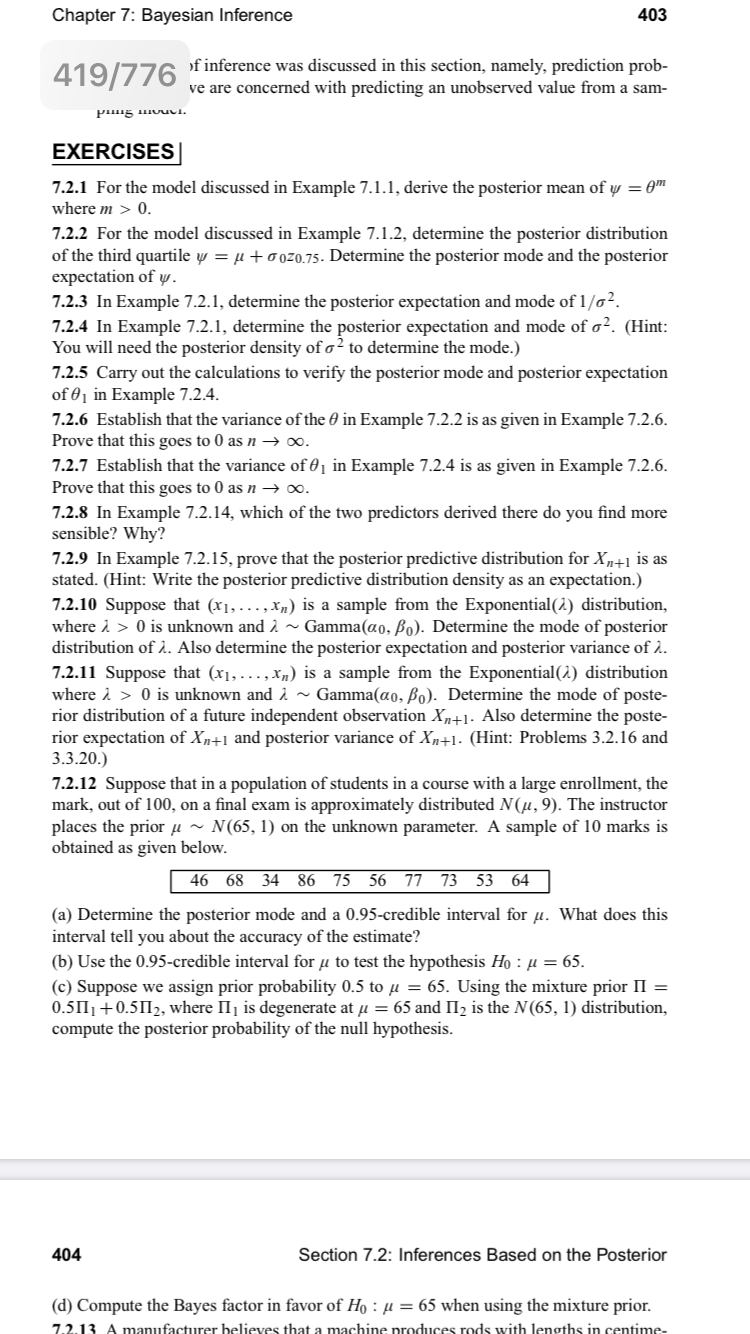
Chapter 7: Bayesian Inference 403 419/776 if inference was discussed in this section, namely, prediction prob- ve are concerned with predicting an unobserved value from a sam- pung Hurt. EXERCISES 7.2.1 For the model discussed in Example 7.1.1, derive the posterior mean of w = 0' where m > 0. 7.2.2 For the model discussed in Example 7.1.2, determine the posterior distribution of the third quartile w = / + 6020.75. Determine the posterior mode and the posterior expectation of w. 7.2.3 In Example 7.2.1, determine the posterior expectation and mode of 1/62. 7.2.4 In Example 7.2.1, determine the posterior expectation and mode of o. (Hint: You will need the posterior density of o to determine the mode.) 7.2.5 Carry out the calculations to verify the posterior mode and posterior expectation of 61 in Example 7.2.4. 7.2.6 Establish that the variance of the O in Example 7.2.2 is as given in Example 7.2.6. Prove that this goes to 0 as n - co. 7.2.7 Establish that the variance of 01 in Example 7.2.4 is as given in Example 7.2.6. Prove that this goes to 0 as n - co. 7.2.8 In Example 7.2.14, which of the two predictors derived there do you find more sensible? Why? 7.2.9 In Example 7.2.15, prove that the posterior predictive distribution for X,+ 1 is as stated. (Hint: Write the posterior predictive distribution density as an expectation.) 7.2.10 Suppose that (X1, . .., X,) is a sample from the Exponential(1) distribution, where 1 > 0 is unknown and 2 ~ Gamma(ao, Bo). Determine the mode of posterior distribution of 1. Also determine the posterior expectation and posterior variance of 1. 7.2.11 Suppose that (x1, . .., X,) is a sample from the Exponential(1) distribution where 1 > 0 is unknown and 1 ~ Gamma(ao, So). Determine the mode of poste- rior distribution of a future independent observation X,+1. Also determine the poste- rior expectation of Xn+1 and posterior variance of Xn+1. (Hint: Problems 3.2.16 and 3.3.20.) 7.2.12 Suppose that in a population of students in a course with a large enrollment, the mark, out of 100, on a final exam is approximately distributed N(u, 9). The instructor places the prior # ~ N(65, 1) on the unknown parameter. A sample of 10 marks is obtained as given below. 46 68 34 86 75 56 77 73 53 64 (a) Determine the posterior mode and a 0.95-credible interval for u. What does this interval tell you about the accuracy of the estimate? (b) Use the 0.95-credible interval for / to test the hypothesis Ho : / = 65. (c) Suppose we assign prior probability 0.5 to u = 65. Using the mixture prior II = 0.511 1 + 0.5112, where II, is degenerate at u = 65 and II2 is the N(65, 1) distribution, compute the posterior probability of the null hypothesis. 404 Section 7.2: Inferences Based on the Posterior (d) Compute the Bayes factor in favor of Ho : / = 65 when using the mixture prior. 7213
Step by Step Solution
There are 3 Steps involved in it

Get step-by-step solutions from verified subject matter experts
 Study Help