







Question: Given time increments, initial condition, a vector of parameters (mass and drag coefficient), and right-hand-side force (gravity coefficient), compute values of bungee jumper velocity (downward
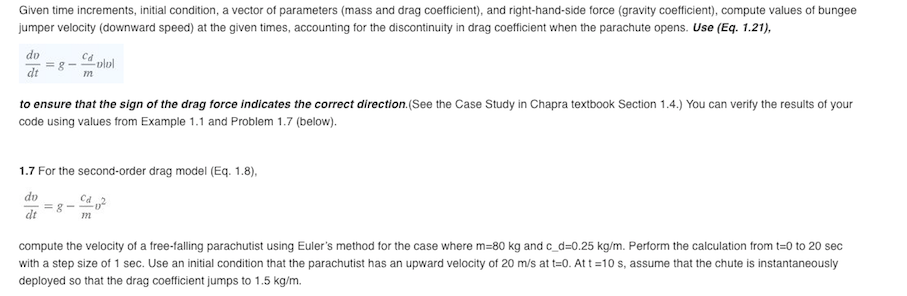
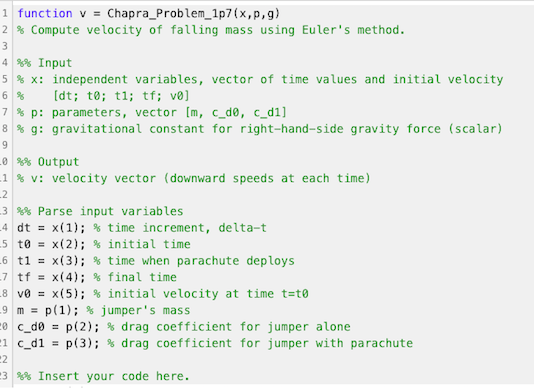
Given time increments, initial condition, a vector of parameters (mass and drag coefficient), and right-hand-side force (gravity coefficient), compute values of bungee jumper velocity (downward speed) at the given times, accounting for the discontinuity in drag coefficient when the parachute opens. Use (Eq. 1.21), do dt = 8 -plol m to ensure that the sign of the drag force indicates the correct direction. (See the Case Study in Chapra textbook Section 1.4.) You can verify the results of your code using values from Example 1.1 and Problem 1.7 (below). 1.7 For the second-order drag model (Eq. 1.8), do dt compute the velocity of a free-falling parachutist using Euler's method for the case where m=80 kg and c_d=0.25 kg/m. Perform the calculation from t=0 to 20 sec with a step size of 1 sec. Use an initial condition that the parachutist has an upward velocity of 20 m/s at t=0. At t =10 s, assume that the chute is instantaneously deployed so that the drag coefficient jumps to 1.5 kg/m. 6 % 1 function v = Chapra_Problem_1p7(x,p,g) 2 % Compute velocity of falling mass using Euler's method. 3 4 % Input 5 % x: independent variables, vector of time values and initial velocity [dt; t; th; tf; v 7 % p: parameters, vector [m, c_do, c_d1] 8 % g: gravitational constant for right-hand-side gravity force (scalar) 9 LO %% Output 1 % v: velocity vector (downward speeds at each time) 2 3 %% Parse input variables 4 dt = x(1); % time increment, delta-t 5 t = x(2); % initial time -6 t1 = x(3); % time when parachute deploys 7 tf = x(4); % final time 8 ve = x(5); % initial velocity at time tuto 9 m = p(1); % jumper's mass c_do = p(2); % drag coefficient for jumper alone 1 c_d1 = P(3); % drag coefficient for jumper with parachute 22 3 %% Insert your code here. Given time increments, initial condition, a vector of parameters (mass and drag coefficient), and right-hand-side force (gravity coefficient), compute values of bungee jumper velocity (downward speed) at the given times, accounting for the discontinuity in drag coefficient when the parachute opens. Use (Eq. 1.21), do dt = 8 -plol m to ensure that the sign of the drag force indicates the correct direction. (See the Case Study in Chapra textbook Section 1.4.) You can verify the results of your code using values from Example 1.1 and Problem 1.7 (below). 1.7 For the second-order drag model (Eq. 1.8), do dt compute the velocity of a free-falling parachutist using Euler's method for the case where m=80 kg and c_d=0.25 kg/m. Perform the calculation from t=0 to 20 sec with a step size of 1 sec. Use an initial condition that the parachutist has an upward velocity of 20 m/s at t=0. At t =10 s, assume that the chute is instantaneously deployed so that the drag coefficient jumps to 1.5 kg/m. 6 % 1 function v = Chapra_Problem_1p7(x,p,g) 2 % Compute velocity of falling mass using Euler's method. 3 4 % Input 5 % x: independent variables, vector of time values and initial velocity [dt; t; th; tf; v 7 % p: parameters, vector [m, c_do, c_d1] 8 % g: gravitational constant for right-hand-side gravity force (scalar) 9 LO %% Output 1 % v: velocity vector (downward speeds at each time) 2 3 %% Parse input variables 4 dt = x(1); % time increment, delta-t 5 t = x(2); % initial time -6 t1 = x(3); % time when parachute deploys 7 tf = x(4); % final time 8 ve = x(5); % initial velocity at time tuto 9 m = p(1); % jumper's mass c_do = p(2); % drag coefficient for jumper alone 1 c_d1 = P(3); % drag coefficient for jumper with parachute 22 3 %% Insert your code here
Step by Step Solution
There are 3 Steps involved in it

Get step-by-step solutions from verified subject matter experts
 Study Help