







Question: Given U=(x+2)(y+1) and P_(x)=4,P_(y)=6 , and B=130 : (a) Write the Lagrangian function. (b) Find the optimal levels of purchase x^(**) and y^(**) . (c)
Given
U=(x+2)(y+1)and
P_(x)=4,P_(y)=6, and
B=130:\ (a) Write the Lagrangian function.\ (b) Find the optimal levels of purchase
x^(**)and
y^(**).\ (c) is the second-order sufficient condition for maximum satisfied?\ (d) Does the answer in (b) give any comparative-static information?\ Assume that
U=(x+2)(y+1), but this time assign no specific numerical values to\ the price and income parameters.\ (a) Write the Lagrangian function.\ (b) Find
x^(**),y^(**), and
\\\\lambda ^(**)in terms of the parameters
P_(x_(r))P_(y), and
B.\ (c) Check the second-order sufficient condition for maximum.\ (d) By setting
P_(x)=4,P_(y)=6, and
B=130, check the validity of your answer to\ Prob. 1.\ Can your solution and
{:y^(**))in Prob. 2 yield any comparative-static information? Find\ all the comparative-static derivatives you can, evaluate their signs, and interpret their\ economic meanings.\ From the utility function
U=(x+2)(y+1)and the constraint
xP_(x)+yP_(y)=Bof\ Prob. 2, we have already found the
U_(ij)and
|vec(H)|, as well as
x^(**)and
\\\\lambda ^(**). Moreover, we\ recall that
|J|=(|)/(b)ar (H)|.\ (a) Substitute these into (12.39) and
(12.40)to find
(del(x^(**))/(d)elB)and
(del(y^(**))/(d)elB).\ (b) Substitute into
(12.42)and
(12.43)to find
(del(x^(**))/(d)elP_(x))and
(del(y^(**))/(d)elP_(x)).\ Do these results check with those obtained in Prob. 3?
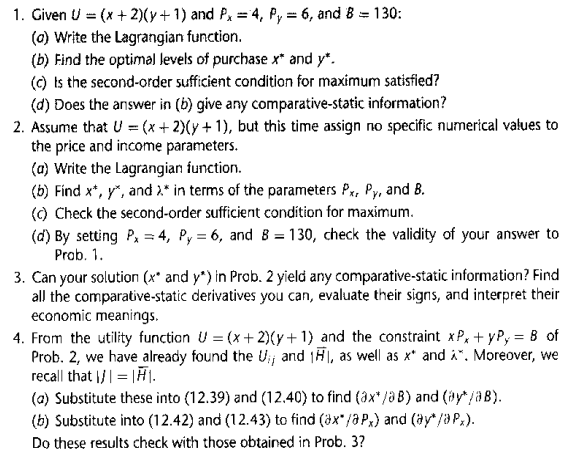
1. Given U=(x+2)(y+1) and Px=4,Py=6, and B=130 : (a) Write the Lagrangian function. (b) Find the optimal levels of purchase x and y. (c) is the second-order sufficient condition for maximum satisfied? (d) Does the answer in (b) give any comparative-static information? 2. Assume that U=(x+2)(y+1), but this time assign no specific numerical values to the price and income parameters. (a) Write the Lagrangian function. (b) Find x,y, and in terms of the parameters PxrPy, and B. (c) Check the second-order sufficient condition for maximum. (d) By setting Px=4,Py=6, and B=130, check the validity of your answer to Prob. 1. 3. Can your solution (x and y) in Prob. 2 yield any comparative-static information? Find all the comparative-static derivatives you can, evaluate their signs, and interpret their economic meanings. 4. From the utility function U=(x+2)(y+1) and the constraint xPx+yPy=B of Prob. 2, we have already found the Uij and h, as well as x and . Moreover, we recall that /=H. (a) Substitute these into (12.39) and (12.40) to find (x/B) and (y/B). (b) Substitute into (12.42) and (12.43) to find (x/Px) and (y/Px). Do these results check with those obtained in Prob. 3
Step by Step Solution
There are 3 Steps involved in it

Get step-by-step solutions from verified subject matter experts
 Study Help