Question: GM Google Case Analysis When G.M. Was Google - New Yorker, The - December 1, 2014 - page 76 December 1, 2014 | New Yorker,
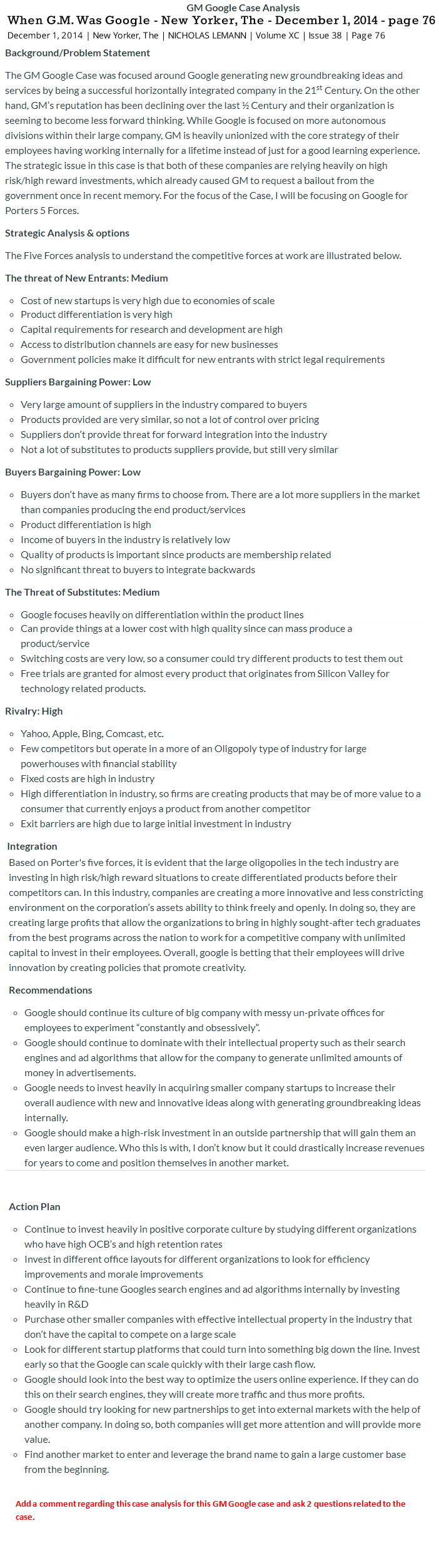
GM Google Case Analysis When G.M. Was Google - New Yorker, The - December 1, 2014 - page 76 December 1, 2014 | New Yorker, The NICHOLAS LEMANN | Volume XC | Issue 38 | Page 76 Background/Problem Statement The GM Google Case was focused around Google generating new groundbreaking ideas and services by being a successful horizontally integrated company in the 21st Century. On the other hand, GM's reputation has been declining over the last 12 Century and their organization is seeming to become less forward thinking. While Google is focused on more autonomous divisions within their large company, GM is heavily unionized with the core strategy of their employees having working internally for a lifetime instead of just for a good learning experience. The strategic issue in this case is that both of these companies are relying heavily on high risk/high reward investments, which already caused GM to request a bailout from the government once in recent memory. For the focus of the Case, I will be focusing on Google for Porters 5 Forces. Strategic Analysis & options The Five Forces analysis to understand the competitive forces at work are illustrated below. The threat of New Entrants: Medium o Cost of new startups is very high due to economies of scale o Product differentiation is very high o Capital requirements for research and development are high o Access to distribution channels are easy for new businesses o Government policies make it difficult for new entrants with strict legal requirements Suppliers Bargaining Power: Low o Very large amount of suppliers in the industry compared to buyers o Products provided are very similar, so not a lot of control over pricing o Suppliers don't provide threat for forward integration into the industry Not a lot of substitutes to products suppliers provide, but still very similar Buyers Bargaining Power: Low Buyers don't have as many firms to choose from. There are a lot more suppliers in the market than companies producing the end product/services Product differentiation is high o Income of buyers in the industry is relatively low o Quality of products is important since products are membership related No significant threat to buyers to integrate backwards The Threat of Substitutes: Medium o Google focuses heavily on differentiation within the product lines Can provide things at a lower cost with high quality since can mass produce a product/service o Switching costs are very low, so a consumer could try different products to test them out Free trials are granted for almost every product that originates from Silicon Valley for technology related products. Rivalry: High o Yahoo, Apple, Bing, Comcast, etc. o Few competitors but operate in a more of an Oligopoly type of industry for large powerhouses with financial stability o Fixed costs are high in industry o High differentiation in industry, so firms are creating products that may be of more value to a consumer that currently enjoys a product from another competitor Exit barriers are high due to large initial investment in industry Integration Based on Porter's five forces, it is evident that the large oligopolies in the tech industry are investing in high risk/high reward situations to create differentiated products before their competitors can. In this industry, companies are creating a more innovative and less constricting environment on the corporation's assets ability to think freely and openly. In doing so, they are creating large profits that allow the organizations to bring in highly sought-after tech graduates from the best programs across the nation to work for a competitive company with unlimited capital to invest in their employees. Overall, google is betting that their employees will drive innovation by creating policies that promote creativity. Recommendations o Google should continue its culture of big company with messy un-private offices for employees to experiment "constantly and obsessively". o Google should continue to dominate with their intellectual property such as their search engines and ad algorithms that allow for the company to generate unlimited amounts of money in advertisements. o Google needs to invest heavily in acquiring smaller company startups to increase their overall audience with new and innovative ideas along with generating groundbreaking ideas internally. o Google should make a high-risk investment in an outside partnership that will gain them an even larger audience. Who this is with, I don't know but it could drastically increase revenues for years to come and position themselves in another market. Action Plan o Continue to invest heavily in positive corporate culture by studying different organizations who have high OCB's and high retention rates o Invest in different office layouts for different organizations to look for efficiency improvements and morale improvements o Continue to fine-tune Googles search engines and ad algorithms internally by investing heavily in R&D o Purchase other smaller companies with effective intellectual property in the industry that don't have the capital to compete on a large scale o Look for different startup platforms that could turn into something big down the line. Invest early so that the Google can scale quickly with their large cash flow. o Google should look into the best way to optimize the users online experience. If they can do this on their search engines, they will create more traffic and thus more profits. o Google should try looking for new partnerships to get into external markets with the help of another company. In doing so, both companies will get more attention and will provide more value. Find another market to enter and leverage the brand name to gain a large customer base from the beginning. Add a comment regarding this case analysis for this GM Google case and ask 2 questions related to the case









 Study Help