







Question: Goal: For an n-bit Carry Completion Adder, write a C program to determine the relationship between the average delay and operand size (n) Guidelines Operand
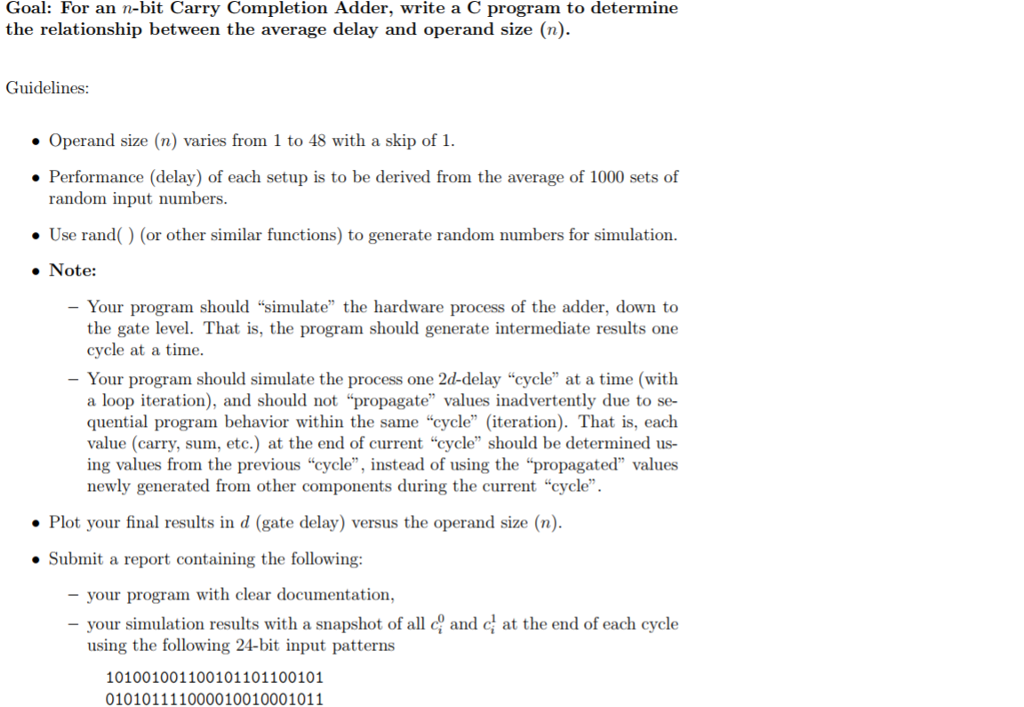
Goal: For an n-bit Carry Completion Adder, write a C program to determine the relationship between the average delay and operand size (n) Guidelines Operand size (n) varies from 1 to 48 with a skip of 1. Performance (delay) of each setup is to be derived from the average of 1000 sets of random input numbers . Use rand) (or other similar functions) to generate random numbers for simulation. e Note: Your program should "simulate the hardware process of the adder, down to the gate level. That is, the program should generate intermediate results one cycle at a time Your program should simulate the process one 2d-delay "cycle" at a time (with a loop iteration), and should not "propagate" values inadvertently due to se- quential program behavior within the same "cycle (iteration). That is, each value (carry, sum, etc.) at the end of current "cycle" should be determined us- ing values from the previous "cycle", instead of using the "propagated" values newly generated from other components during the current "cycle". Plot your final results in d (gate delay) versus the operand size (n) . Submit a report containing the following your program with clear documentation - your simulation results with a snapshot of all cand c at the end of each cycle using the following 24-bit input patterns 101001001100101101100101 010101111000010010001011 Goal: For an n-bit Carry Completion Adder, write a C program to determine the relationship between the average delay and operand size (n) Guidelines Operand size (n) varies from 1 to 48 with a skip of 1. Performance (delay) of each setup is to be derived from the average of 1000 sets of random input numbers . Use rand) (or other similar functions) to generate random numbers for simulation. e Note: Your program should "simulate the hardware process of the adder, down to the gate level. That is, the program should generate intermediate results one cycle at a time Your program should simulate the process one 2d-delay "cycle" at a time (with a loop iteration), and should not "propagate" values inadvertently due to se- quential program behavior within the same "cycle (iteration). That is, each value (carry, sum, etc.) at the end of current "cycle" should be determined us- ing values from the previous "cycle", instead of using the "propagated" values newly generated from other components during the current "cycle". Plot your final results in d (gate delay) versus the operand size (n) . Submit a report containing the following your program with clear documentation - your simulation results with a snapshot of all cand c at the end of each cycle using the following 24-bit input patterns 101001001100101101100101 010101111000010010001011
Step by Step Solution
There are 3 Steps involved in it

Get step-by-step solutions from verified subject matter experts
 Study Help