







Question: Google From smart phones to maps to e - mail to search, today Google is everywhere. This ubiquity makes it easy to forget that the
Google
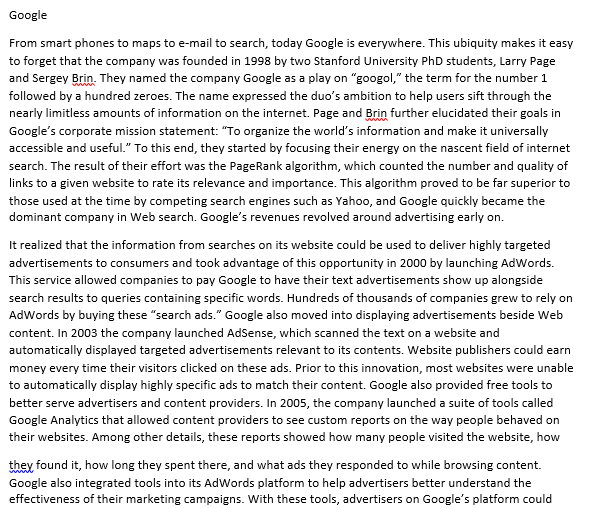
From smart phones to maps to email to search, today Google is everywhere. This ubiquity makes it easy
to forget that the company was founded in by two Stanford University PhD students, Larry Page
and Sergey Brin. They named the company Google as a play on "googol," the term for the number
followed by a hundred zeroes. The name expressed the duo's ambition to help users sift through the
nearly limitless amounts of information on the internet. Page and Brin further elucidated their goals in
Google's corporate mission statement: To organize the world's information and make it universally
accessible and useful." To this end, they started by focusing their energy on the nascent field of internet
search. The result of their effort was the PageRank algorithm, which counted the number and quality of
links to a given website to rate its relevance and importance. This algorithm proved to be far superior to
those used at the time by competing search engines such as Yahoo, and Google quickly became the
dominant company in Web search. Google's revenues revolved around advertising early on
It realized that the information from searches on its website could be used to deliver highly targeted
advertisements to consumers and took advantage of this opportunity in by launching AdWords.
This service allowed companies to pay Google to have their text advertisements show up alongside
search results to queries containing specific words. Hundreds of thousands of companies grew to rely on
AdWords by buying these "search ads." Google also moved into displaying advertisements beside Web
content. In the company launched AdSense, which scanned the text on a website and
automatically displayed targeted advertisements relevant to its contents. Website publishers could earn
money every time their visitors clicked on these ads. Prior to this innovation, most websites were unable
to automatically display highly specific ads to match their content. Google also provided free tools to
better serve advertisers and content providers. In the company launched a suite of tools called
Google Analytics that allowed content providers to see custom reports on the way people behaved on
their websites. Among other details, these reports showed how many people visited the website, how
they found it how long they spent there, and what ads they responded to while browsing content.
Google also integrated tools into its AdWords platform to help advertisers better understand the
effectiveness of their marketing campaigns. With these tools, advertisers on Google's platform could constantly monitor and optimize their advertisements. Google called this approach "marketing asset
management," implying that advertisements should be managed like assets in a portfolio depending on
market conditions. Companies could use the realtime data that Google collected to adjust their
campaigns to market conditions, instead of following marketing plans developed months in advance.
Google came to dominate search and online advertising thanks to its ability to collect and process
enormous amounts of data from the internet and make them useful. It used this capability to provide
consumers and businesses alike with the information they needed. Despite its early successes,
Google never stopped innovating. It continued to expend significant energy to develop and refine
algorithms that could be used to squeeze more information out of the internet and keep Google ahead
of the competition. In addition to refining existing products, Google developed a series of free online
services for consumers. By applying its computer science and design skills to new problems, Google
helped users get things done more efficiently and effectively. In many cases, rather than coming up with
novel products, Google applied its expertise to existing categories to create a superior product offering. By entering a slew of new categories, Google gave advertisers access to consumers in an increasing
number of contexts. Furthermore, the company gained access to increasing amounts of information on
consumers that it could further monetize in the future.
Through continuous internal development and a series of acquisitions, Google rapidly expanded its
product offerings. In Google launched Gmail, an advertisingsupported email service that by
numbered over a billion active users every month. In the company launched Google
Maps to compete with existing online mapping services. The company repeatedly impressed consumers
as it upgraded its map service with features such as Street View, which gave users degree views of
map locations. In Google branched into streaming video when it acquired YouTube and grew it
into a service that generated billions of dollars in advertising revenues. That same year the company
also launched Google Docs, Sheets, and Slidesfree online alternatives to elements of the Microsoft
Office suite. Google continues to expand its online
Step by Step Solution
There are 3 Steps involved in it
1 Expert Approved Answer
Step: 1 Unlock

Question Has Been Solved by an Expert!
Get step-by-step solutions from verified subject matter experts
Step: 2 Unlock
Step: 3 Unlock
 Study Help