







Question: = Google X Summarise the four basic steps of CPU performs: Fetch: Each instruction is stored in memory and has its own address. The processor
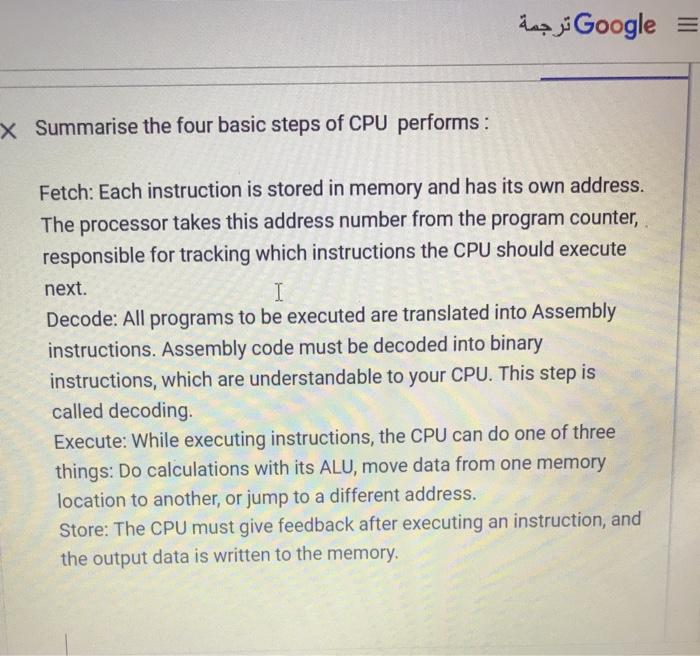
= Google X Summarise the four basic steps of CPU performs: Fetch: Each instruction is stored in memory and has its own address. The processor takes this address number from the program counter, responsible for tracking which instructions the CPU should execute next. I Decode: All programs to be executed are translated into Assembly instructions. Assembly code must be decoded into binary instructions, which are understandable to your CPU. This step is called decoding Execute: While executing instructions, the CPU can do one of three things: Do calculations with its ALU, move data from one memory location to another, or jump to a different address. Store: The CPU must give feedback after executing an instruction, and the output data is written to the memory. = Google X Summarise the four basic steps of CPU performs: Fetch: Each instruction is stored in memory and has its own address. The processor takes this address number from the program counter, responsible for tracking which instructions the CPU should execute next. I Decode: All programs to be executed are translated into Assembly instructions. Assembly code must be decoded into binary instructions, which are understandable to your CPU. This step is called decoding. Execute: While executing instructions, the CPU can do one of three things: Do calculations with its ALU, move data from one memory location to another, or jump to a different address. Store: The CPU must give feedback after executing an instruction, and the output data is written to the memory
Step by Step Solution
There are 3 Steps involved in it

Get step-by-step solutions from verified subject matter experts
 Study Help