







Question: Grant, a young Newfoundlander, has just graduated from high school and is deciding what to do with the rest of his life, which lasts
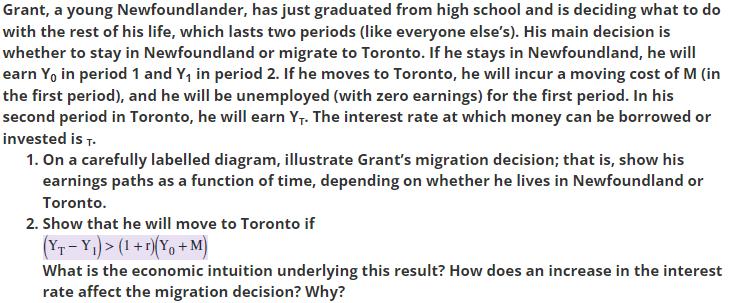
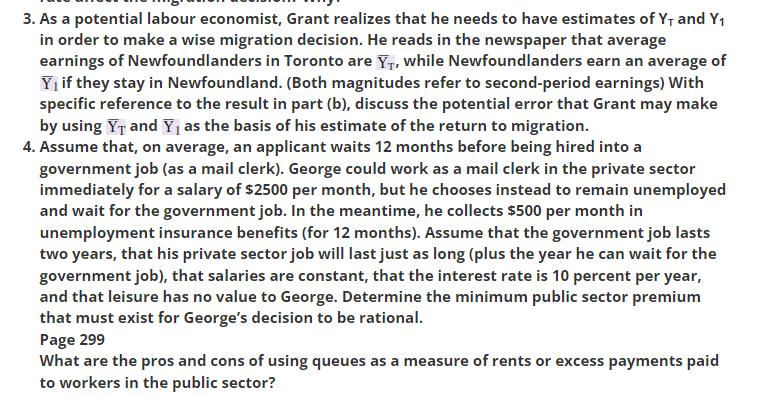
Grant, a young Newfoundlander, has just graduated from high school and is deciding what to do with the rest of his life, which lasts two periods (like everyone else's). His main decision is whether to stay in Newfoundland or migrate to Toronto. If he stays in Newfoundland, he will earn Yo in period 1 and Y, in period 2. If he moves to Toronto, he will incur a moving cost of M (in the first period), and he will be unemployed (with zero earnings) for the first period. In his second period in Toronto, he will earn Yr. The interest rate at which money can be borrowed or invested is T. 1. On a carefully labelled diagram, illustrate Grant's migration decision; that is, show his earnings paths as a function of time, depending on whether he lives in Newfoundland or Toronto. 2. Show that he will move to Toronto if (Yr - Y,)> (1 +*{Y, + M) What is the economic intuition underlying this result? How does an increase in the interest rate affect the migration decision? Why? 3. As a potential labour economist, Grant realizes that he needs to have estimates of Y, and Y1 in order to make a wise migration decision. He reads in the newspaper that average earnings of Newfoundlanders in Toronto are Y, while Newfoundlanders earn an average of Y if they stay in Newfoundland. (Both magnitudes refer to second-period earnings) With specific reference to the result in part (b), discuss the potential error that Grant may make by using YT and Y as the basis of his estimate of the return to migration. 4. Assume that, on average, an applicant waits 12 months before being hired into a government job (as a mail clerk). George could work as a mail clerk in the private sector immediately for a salary of $2500 per month, but he chooses instead to remain unemployed and wait for the government job. In the meantime, he collects $500 per month in unemployment insurance benefits (for 12 months). Assume that the government job lasts two years, that his private sector job will last just as long (plus the year he can wait for the government job), that salaries are constant, that the interest rate is 10 percent per year, and that leisure has no value to George. Determine the minimum public sector premium that must exist for George's decision to be rational. Page 299 What are the pros and cons of using queues as a measure of rents or excess payments paid to workers in the public sector?
Step by Step Solution
3.50 Rating (140 Votes )
There are 3 Steps involved in it
Lets go through the questions stepbystep 1 Diagram of Grants Migration Decision To create a labelled diagram Horizontal Axis Time Periods 1 and 2 Vert... View full answer

Get step-by-step solutions from verified subject matter experts
 Study Help