Question: Graphing Rational Function (2 ACTIVITIES) Please present a full solution/explanation. Note: A rational function may or may not cross its horizontal asymptote. If the function
Graphing Rational Function (2 ACTIVITIES)
Please present a full solution/explanation.
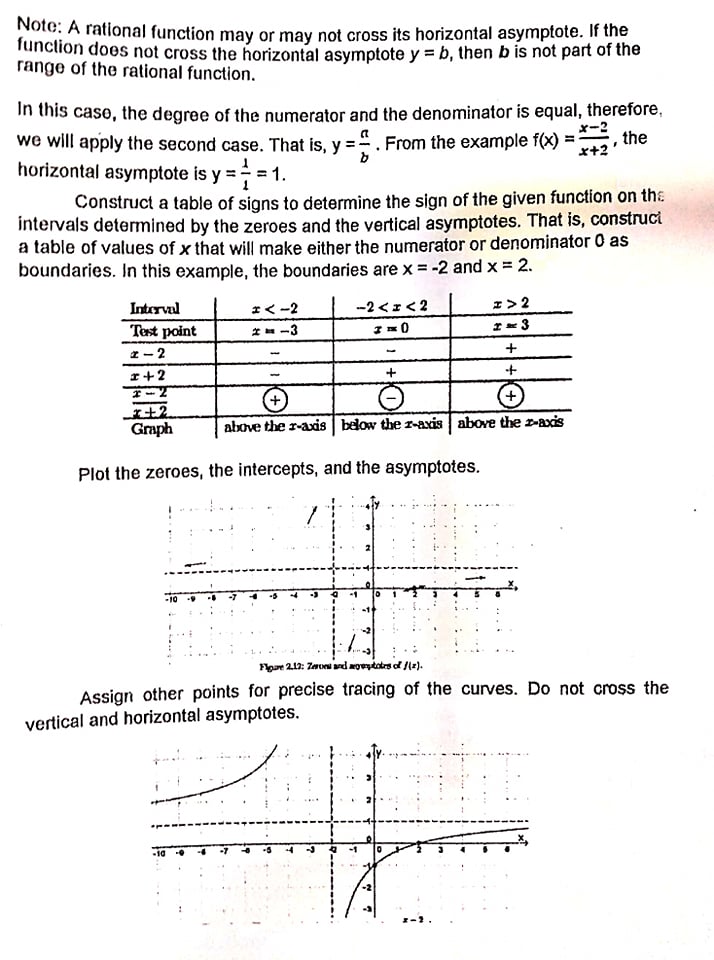
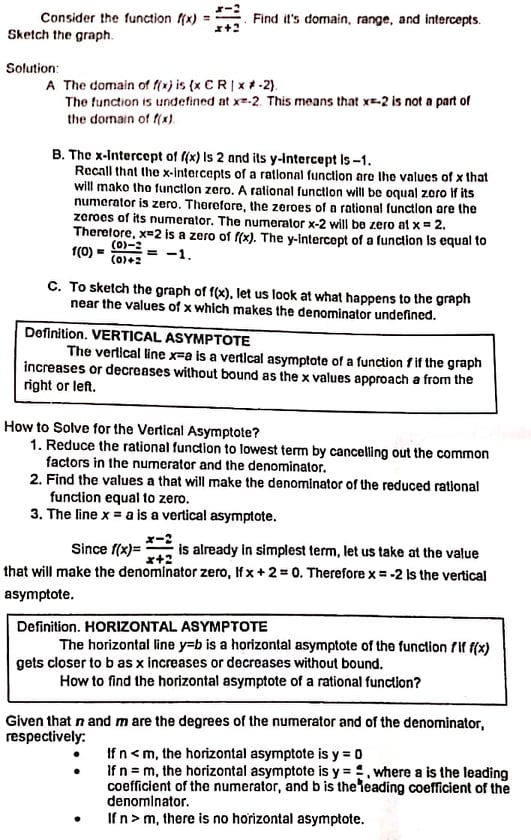
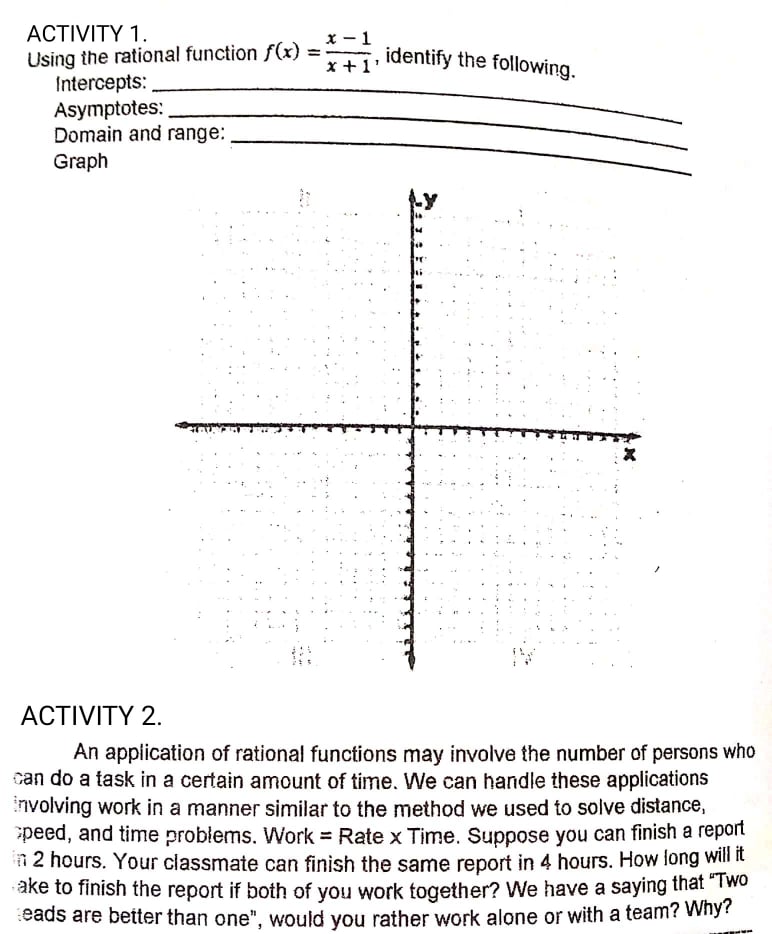
Note: A rational function may or may not cross its horizontal asymptote. If the function does not cross the horizontal asymptote y = b, then b is not part of the range of the rational function. In this case, the degree of the numerator and the denominator is equal, therefore, we will apply the second case. That is, y = = . From the example f(x) = =", the x+2 horizontal asymptote is y = = = 1. Construct a table of signs to determine the sign of the given function on the intervals determined by the zeroes and the vertical asymptotes. That is, construct a table of values of x that will make either the numerator or denominator 0 as boundaries. In this example, the boundaries are x = -2 and x = 2. Interval x- 2 r+2 + 2 Graph Plot the zeroes, the intercepts, and the asymptotes. Float 212: 7moni wed agestars of /(z). Assign other points for precise tracing of the curves. Do not cross the vertical and horizontal asymptotes.Consider the function me Find it's domain, range, and intercepts. Sketch the graph. Solution: A The domain of /(>) is {x C R | x # -2). The function is undefined at x=-2. This means that x=-2 Is not a part of the domain of f(x). B. The x-Intercept of ((x) Is 2 and its y-Intercept Is -1. Recall that the x-intercepts of a rational function are the values of x that will make the function zero. A rational function will be oqual zero If its numerator is zero. Therefore, the zeroes of a rational function are the zeroes of its numerator. The numerator x-2 will be zero al x = 2. Therefore, x=2 is a zero of ((x). The y-intercept of a function Is equal to f(0) = (0)+2 =-1. C. To sketch the graph of f(x). let us look at what happens to the graph near the values of x which makes the denominator undefined. Definition. VERTICAL ASYMPTOTE The vertical line x=a is a vertical asymptote of a function f if the graph increases or decreases without bound as the x values approach a from the right or left. How to Solve for the Vertical Asymptote? 1. Reduce the rational function to lowest term by cancelling out the common factors in the numerator and the denominator. 2. Find the values a that will make the denominator of the reduced rational function equal to zero. 3. The line x = a is a vertical asymptote. Since /(x)= = is already in simplest term, let us take at the value x+2 that will make the denominator zero, If x + 2 = 0. Therefore x = -2 Is the vertical asymptote. Definition. HORIZONTAL ASYMPTOTE The horizontal line y=b is a horizontal asymptote of the function fif f(x) gets closer to b as x increases or decreases without bound. How to find the horizontal asymptote of a rational function? Given that n and m are the degrees of the numerator and of the denominator, respectively: If n m, there is no horizontal asymptote.ACTIVITY 1. x-1 Using the rational function f(x) = Intercepts: x + 1: identify the following. Asymptotes: Domain and range: Graph ACTIVITY 2. An application of rational functions may involve the number of persons who can do a task in a certain amount of time. We can handle these applications involving work in a manner similar to the method we used to solve distance, speed, and time problems. Work = Rate x Time. Suppose you can finish a report in 2 hours. Your classmate can finish the same report in 4 hours. How long will it wake to finish the report if both of you work together? We have a saying that "Two :eads are better than one", would you rather work alone or with a team? Why
Step by Step Solution
There are 3 Steps involved in it
1 Expert Approved Answer
Step: 1 Unlock
Question Has Been Solved by an Expert!
Get step-by-step solutions from verified subject matter experts
Step: 2 Unlock
Step: 3 Unlock
Students Have Also Explored These Related Mathematics Questions!









 Study Help