







Question: Greetings! May I please have your help with this? Your expertise is needed and appreciated. Thank you. 1. Most systems use the queue discipline known
Greetings!
May I please have your help with this? Your expertise is needed and appreciated.
Thank you.
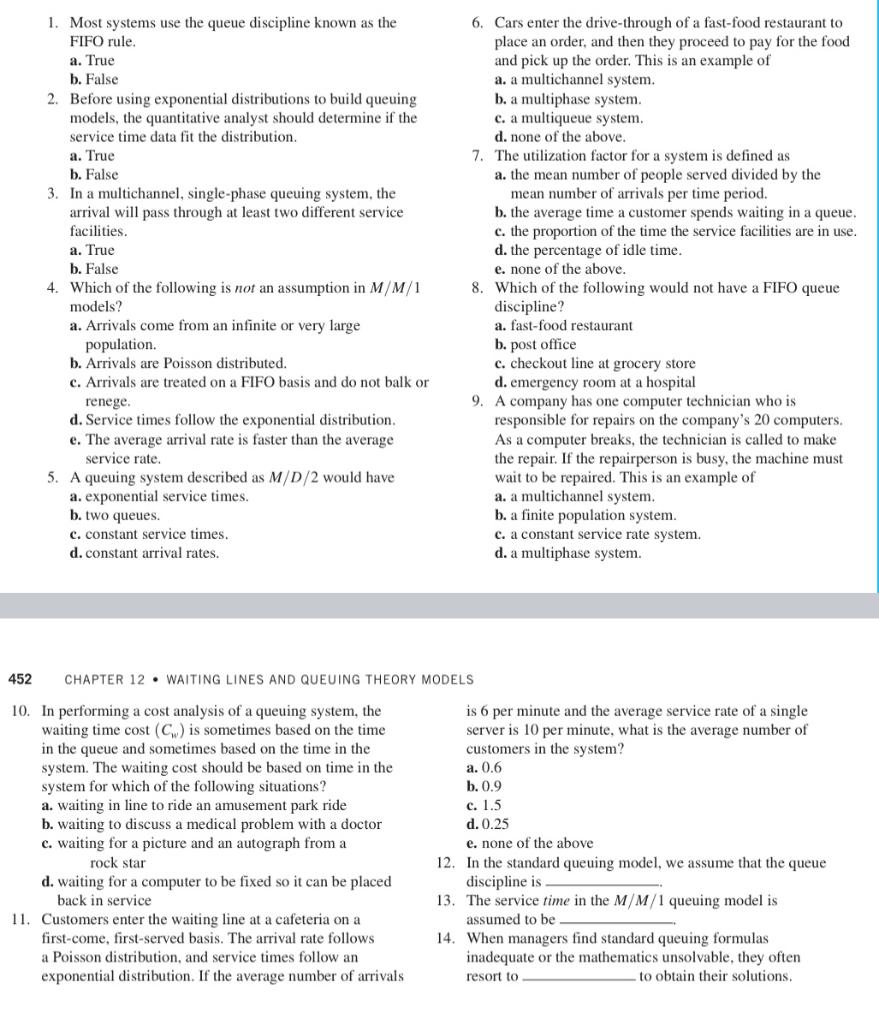
1. Most systems use the queue discipline known as the FIFO rule. a. True b. False 2. Before using exponential distributions to build queuing models, the quantitative analyst should determine if the service time data fit the distribution. a. True b. False 3. In a multichannel,single-phase queuing system, the arrival will pass through at least two different service facilities. a. True b. False 4. Which of the following is not an assumption in M/M/1 models? a. Arrivals come from an infinite or very large population b. Arrivals are Poisson distributed. c. Arrivals are treated on a FIFO basis and do not balk or renege. d. Service times follow the exponential distribution. e. The average arrival rate is faster than the average service rate. 5. A queuing system described as M/D/2 would have a. exponential service times. b. two queues. c. constant service times. d. constant arrival rates. 6. Cars enter the drive-through of a fast-food restaurant to place an order, and then they proceed to pay for the food and pick up the order. This is an example of a. a multichannel system. b. a multiphase system. c. a multiqueue system, d. none of the above. 7. The utilization factor for a system is defined as a. the mean number of people served divided by the mean number of arrivals per time period. b. the average time a customer spends waiting in a queue, c. the proportion of the time the service facilities are in use. d. the percentage of idle time. e. none of the above. 8. Which of the following would not have a FIFO queue discipline? a. fast-food restaurant b. post office c. checkout line at grocery store d. emergency room at a hospital 9. A company has one computer technician who is responsible for repairs on the company's 20 computers. As a computer breaks, the technician is called to make the repair. If the repairperson is busy, the machine must wait to be repaired. This is an example of a. a multichannel system. b. a finite population system. c. a constant service rate system. d. a multiphase system. 452 CHAPTER 12 WAITING LINES AND QUEUING THEORY MODELS 10. In performing a cost analysis of a queuing system, the waiting time cost (C) is sometimes based on the time in the queue and sometimes based on the time in the system. The waiting cost should be based on time in the system for which of the following situations? a. waiting in line to ride an amusement park ride b. waiting to discuss a medical problem with a doctor c. waiting for a picture and an autograph from a rock star d. waiting for a computer to be fixed so it can be placed back in service 11. Customers enter the waiting line at a cafeteria on a first-come, first-served basis. The arrival rate follows a Poisson distribution, and service times follow an exponential distribution. If the average number of arrivals is 6 per minute and the average service rate of a single server is 10 per minute, what is the average number of customers in the system? a. 0.6 b. 0.9 c. 1.5 d. 0.25 e. none of the above 12. In the standard queuing model, we assume that the queue discipline is 13. The service time in the M/M/1 queuing model is assumed to be 14. When managers find standard queuing formulas inadequate or the mathematics unsolvable, they often resort to to obtain their solutionsStep by Step Solution
There are 3 Steps involved in it
1 Expert Approved Answer
Step: 1 Unlock

Question Has Been Solved by an Expert!
Get step-by-step solutions from verified subject matter experts
Step: 2 Unlock
Step: 3 Unlock
 Study Help