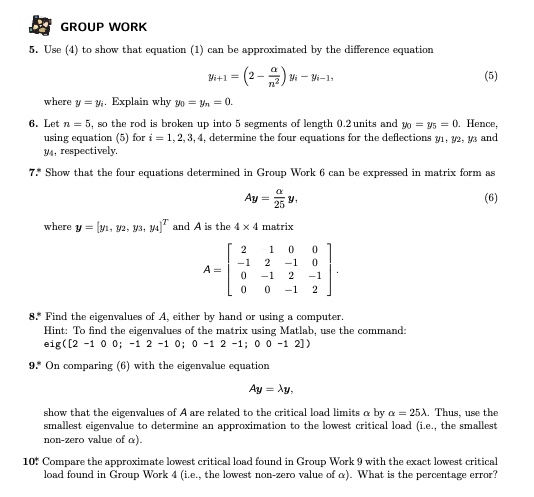
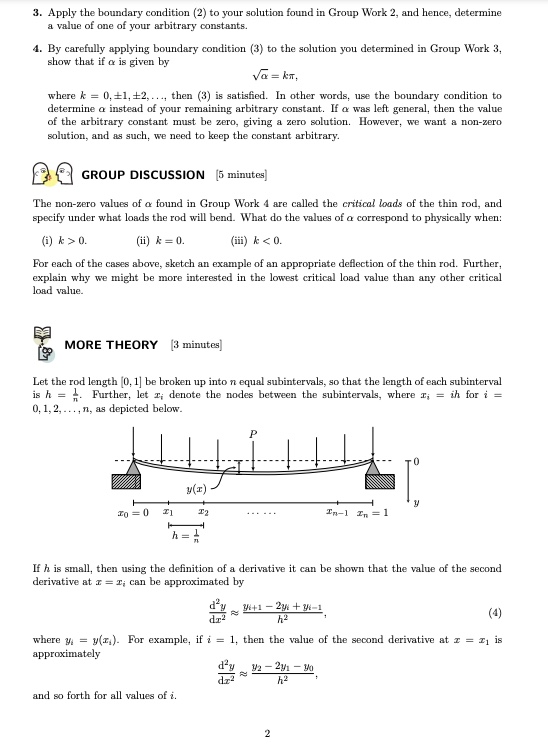
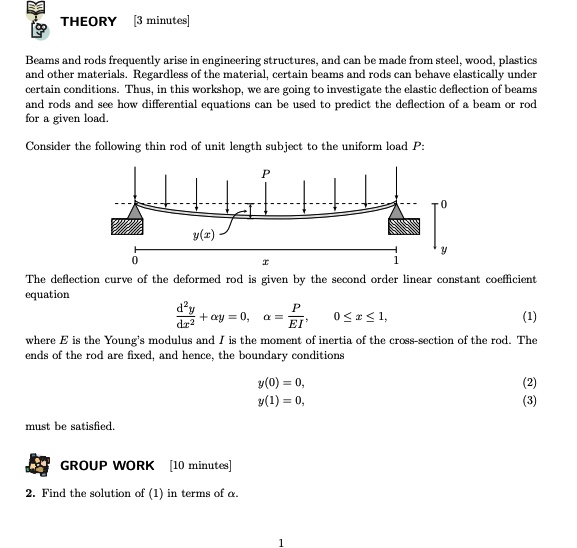
GROUP WORK 5. Use (4) to show that equation (1) can be approximated by the difference equation With = (2 - -2) mi - Bi-1, (5) where y = wi. Explain why yo = y. = 0. 6. Let n = 5, so the rod is broken up into 5 segments of length 0.2 units and yo = y5 = 0. Hence, using equation (5) for i = 1, 2,3, 4, determine the four equations for the deflections y1, 32, ya and 14, respectively. 7: Show that the four equations determined in Group Work 6 can be expressed in matrix form as Ay = E V. (6) where y = [i, 32, ya, w]' and A is the 4 x 4 matrix 0 0 2 0 A = 2 8." Find the eigenvalues of A, either by hand or using a computer. Hint: To find the eigenvalues of the matrix using Matlab, use the command: eig( [2 -1 0 0; -1 2 -1 0; 0 -1 2 -1; 0 0 -1 2]) 9. On comparing (6) with the eigenvalue equation Ay = Xy. show that the eigenvalues of A are related to the critical load limits a by a = 25). Thus, use the smallest eigenvalue to determine an approximation to the lowest critical load (i.e., the smallest non-zero value of o). 10# Compare the approximate lowest critical load found in Group Work 9 with the exact lowest critical load found in Group Work 4 (i.e., the lowest non-zero value of o). What is the percentage error?3. Apply the boundary condition (2) to your solution found in Group Work 2, and hence, determine a value of one of your arbitrary constants. 4. By carefully applying boundary condition (3) to the solution you determined in Group Work 3, show that if a is given by Va = kx. where k = 0, +1, +2, ..., then (3) is satisfied. In other words, use the boundary condition to determine a instead of your remaining arbitrary constant. If a was left general, then the value of the arbitrary constant must be zero, giving a zero solution. However, we want a non-zero solution, and as such, we need to keep the constant arbitrary. GROUP DISCUSSION [5 minutes] The non-zero values of o found in Group Work 4 are called the critical loads of the thin rod, and specify under what loads the rod will bend. What do the values of a correspond to physically when: (i) k >0. (ii) k = 0. (iii) k