







Question: H: Hypotheses Fill in the correct null and alternative hypotheses: Ho : Select an answer v ? v ? = HA : Select an answer
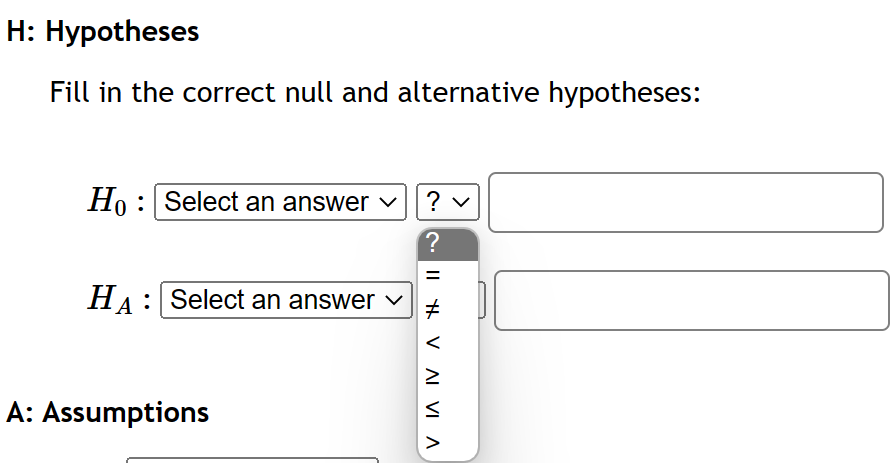
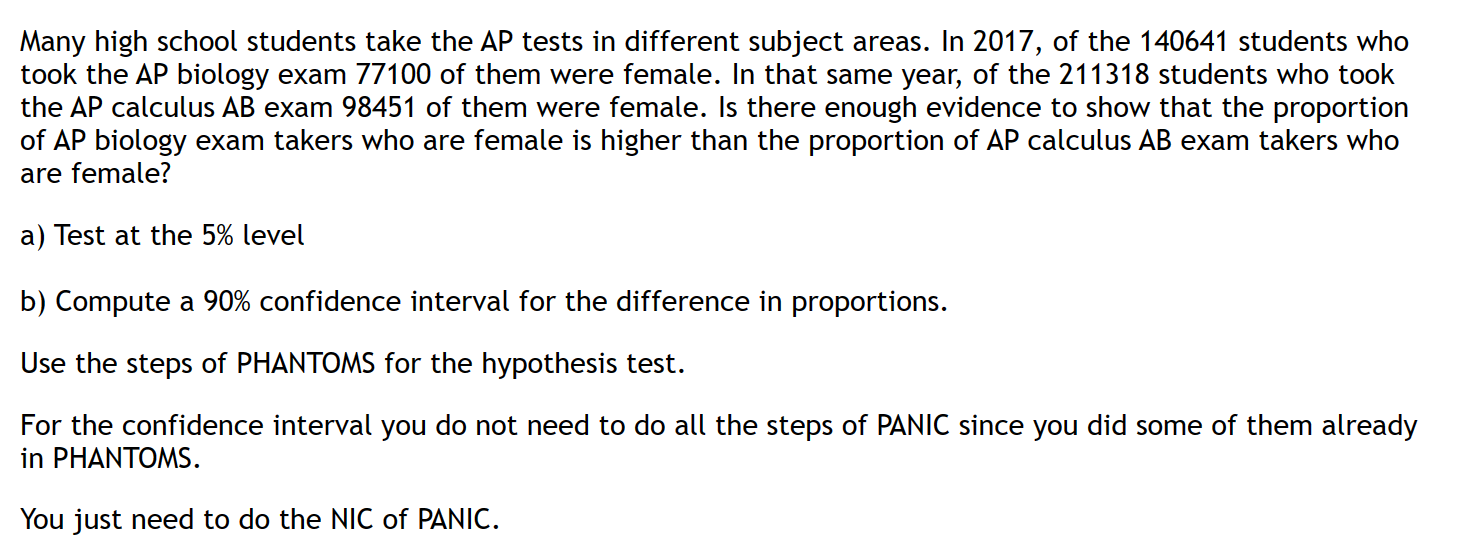
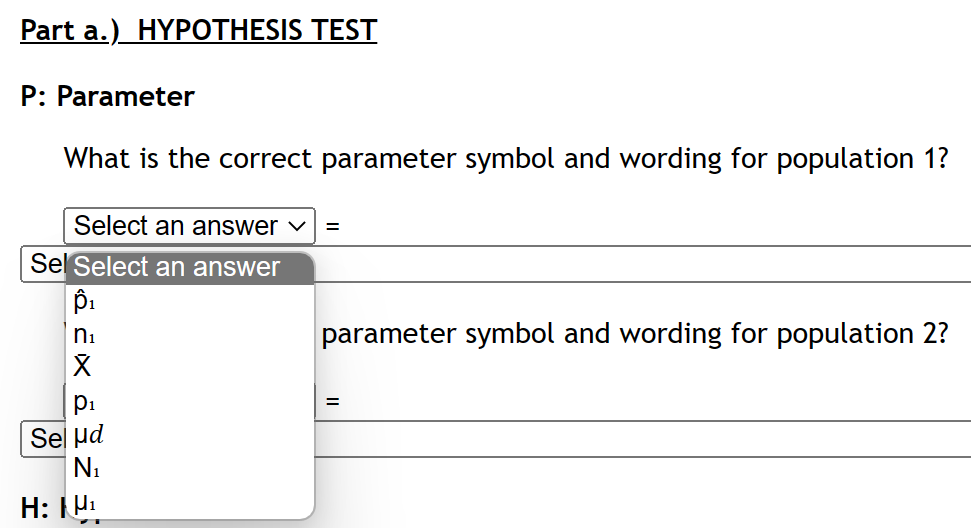
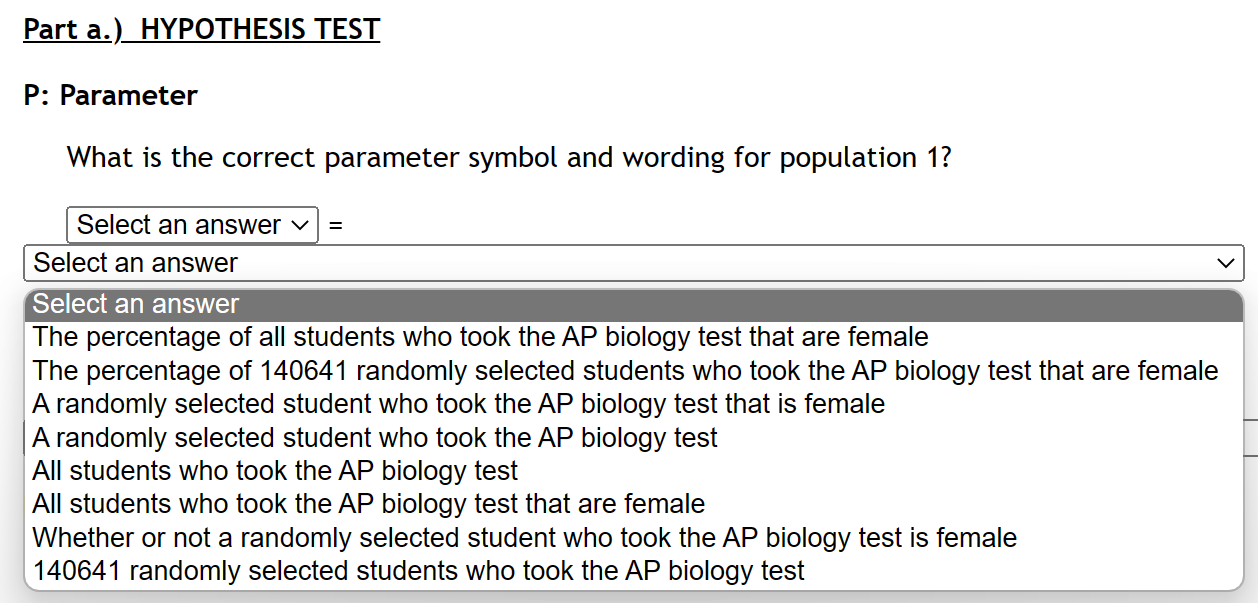
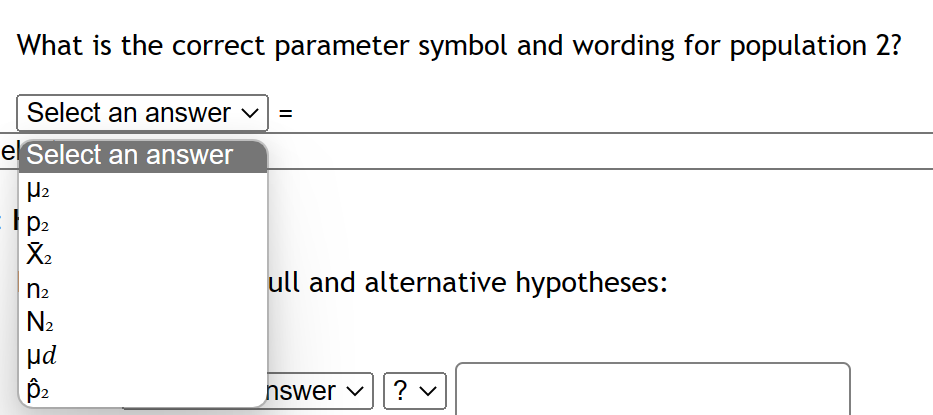
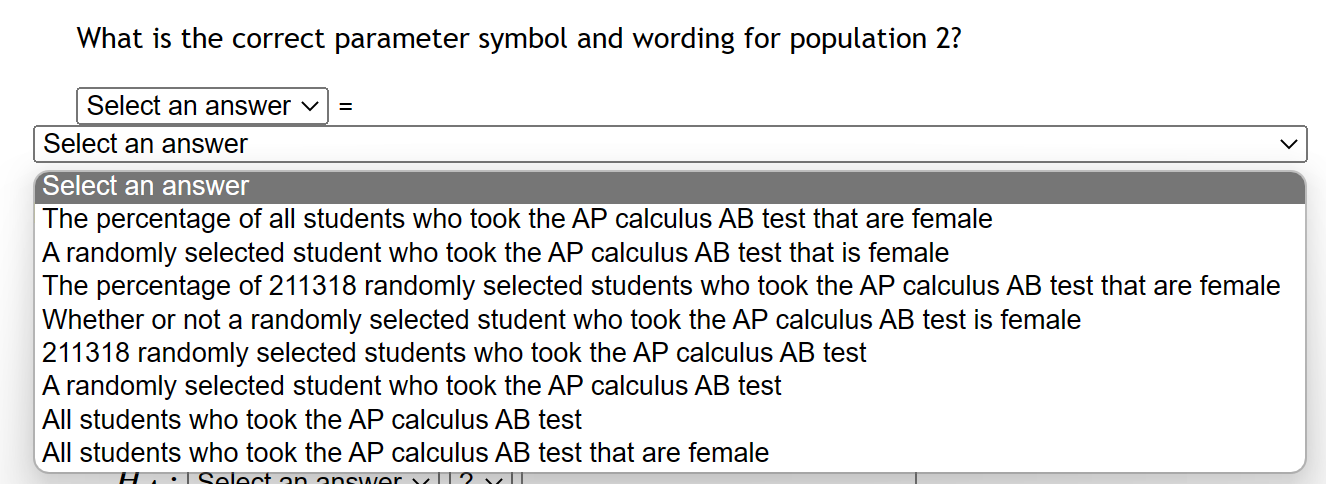
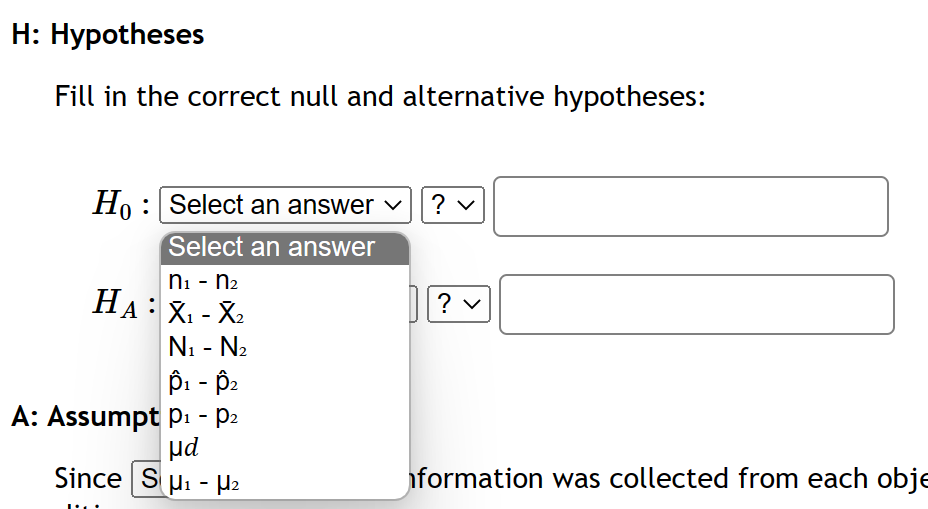
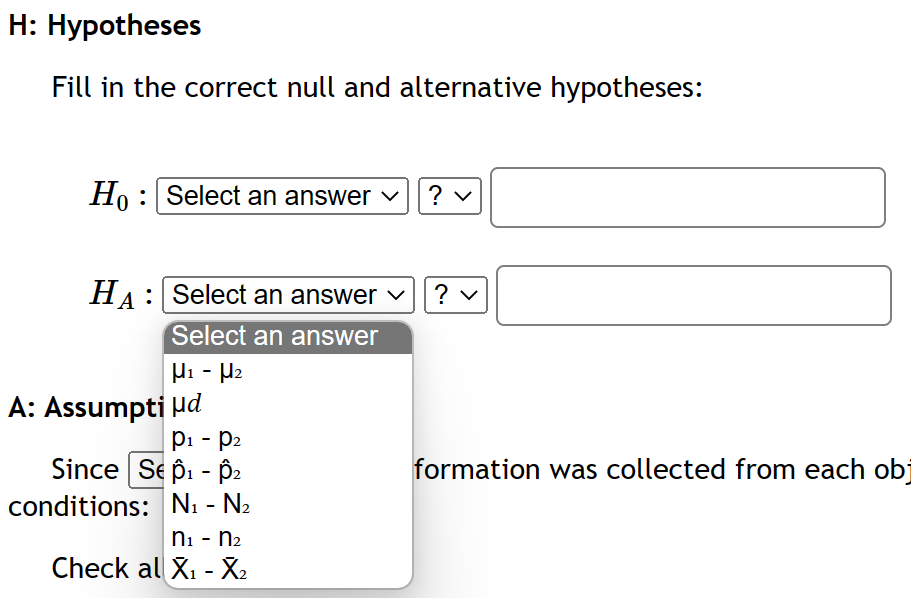
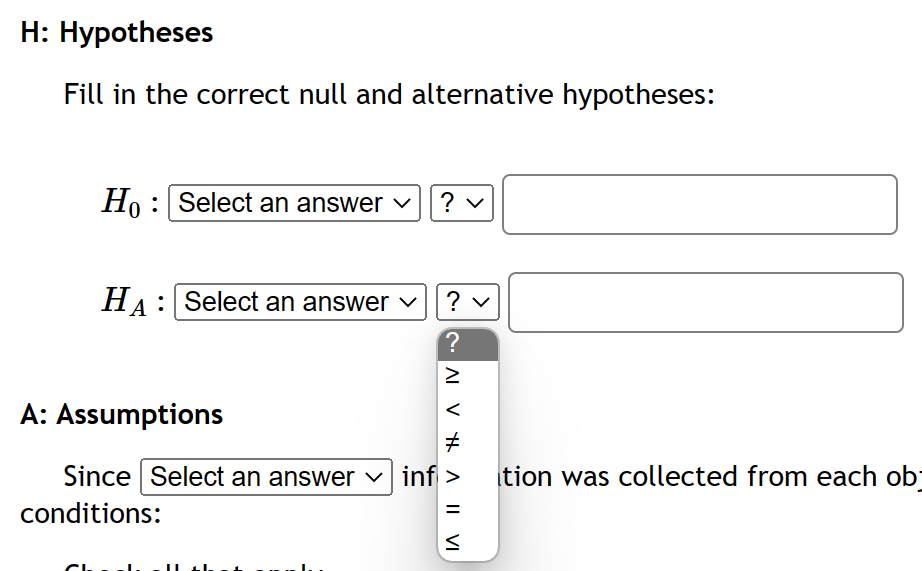
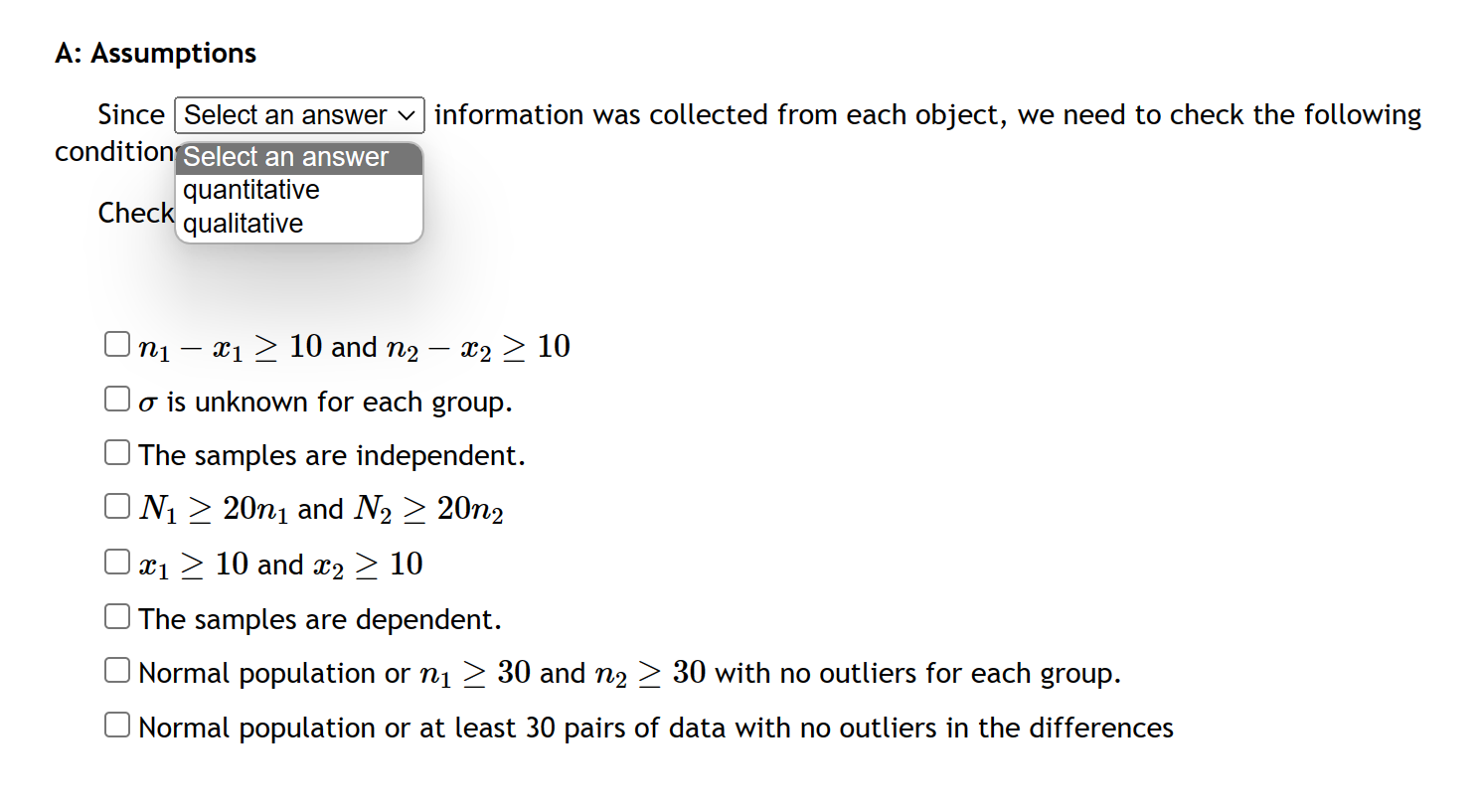
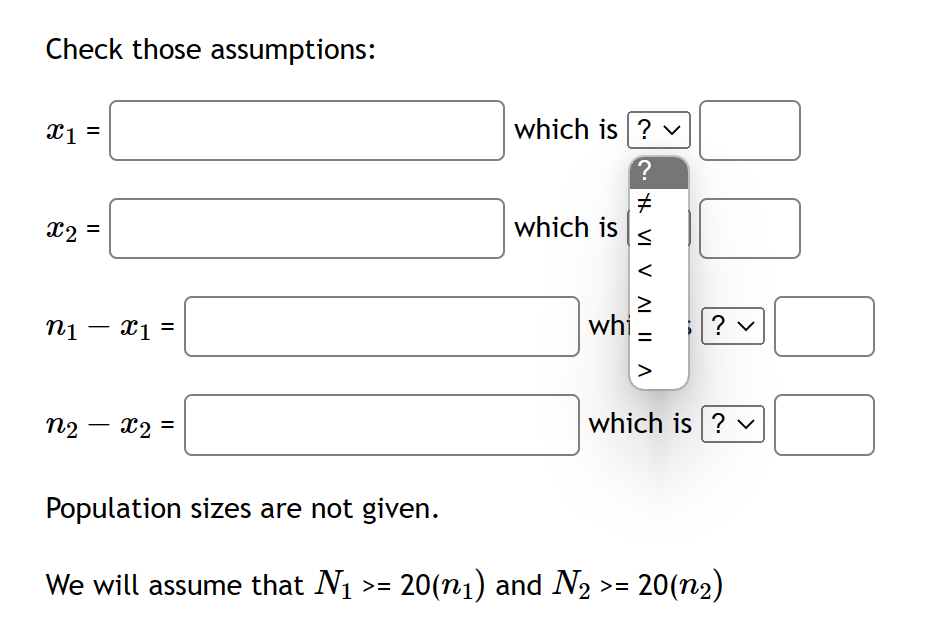
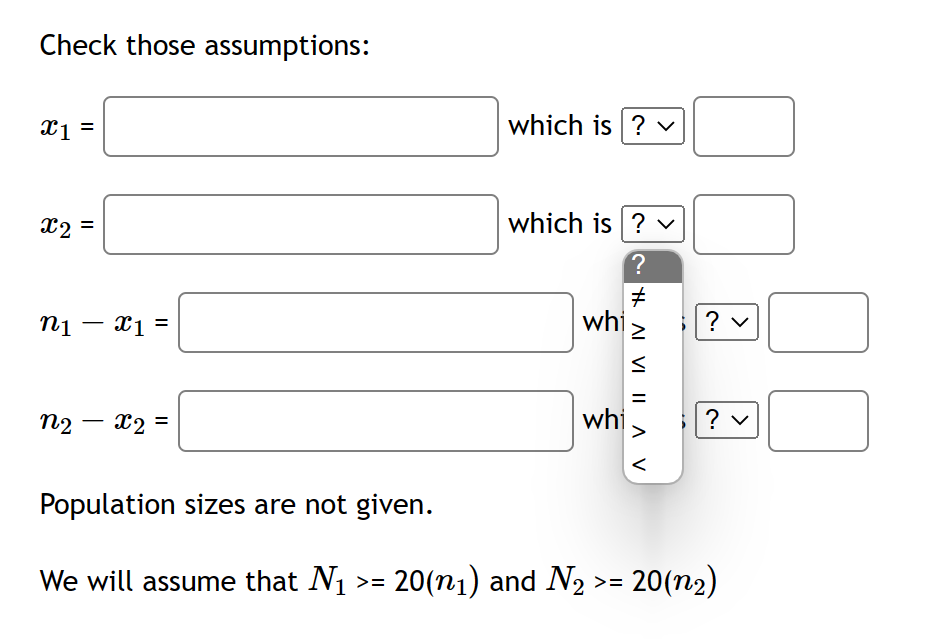
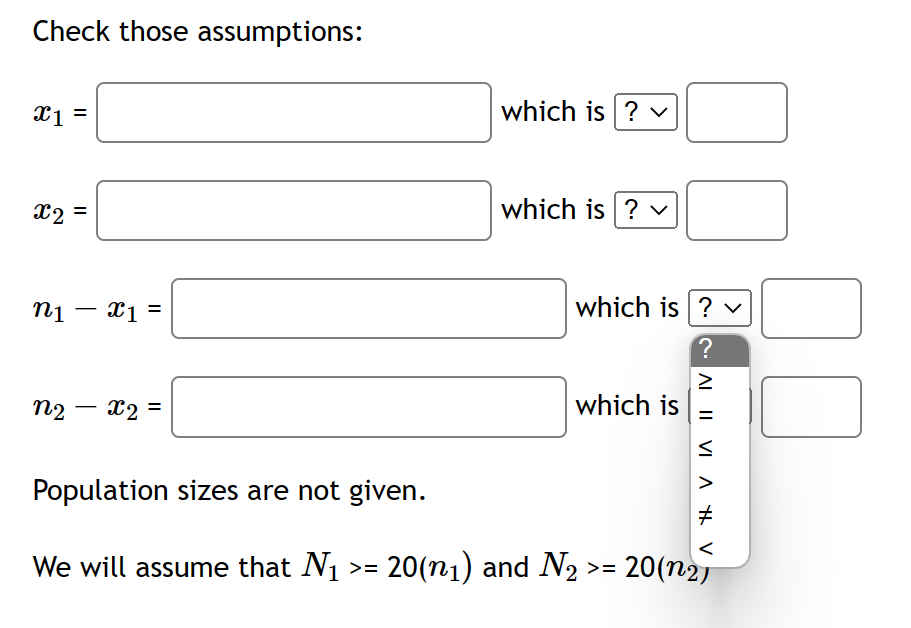
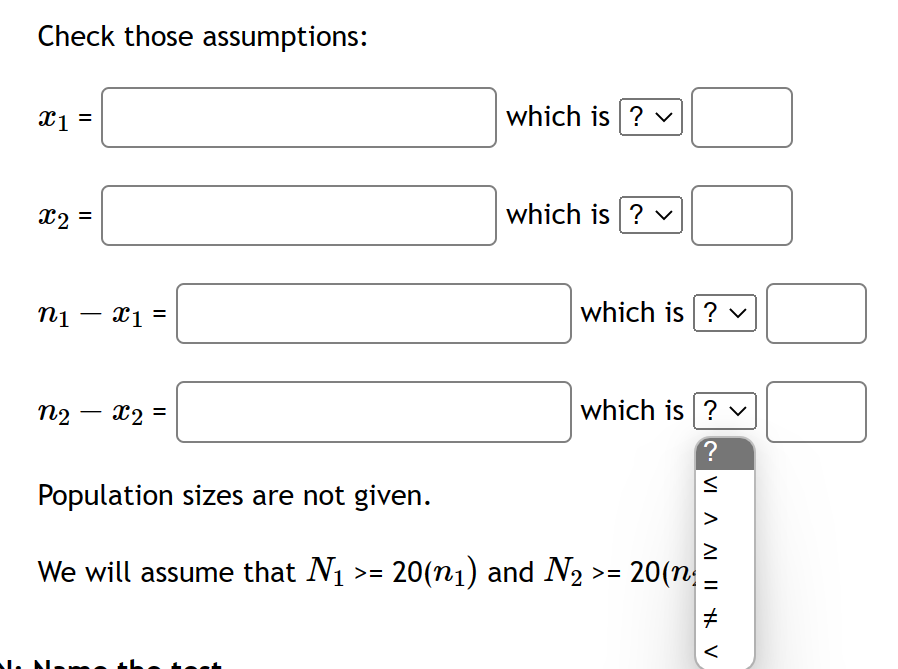
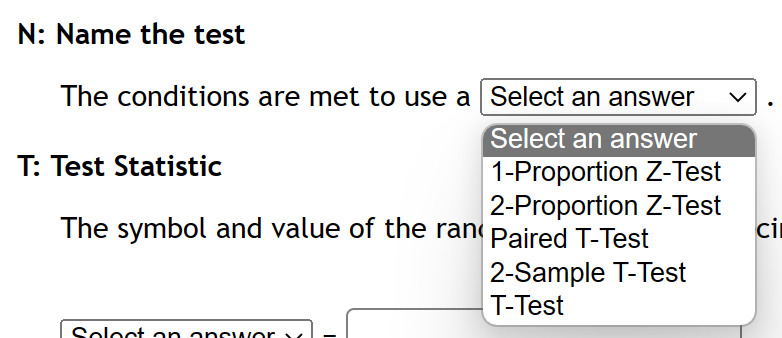
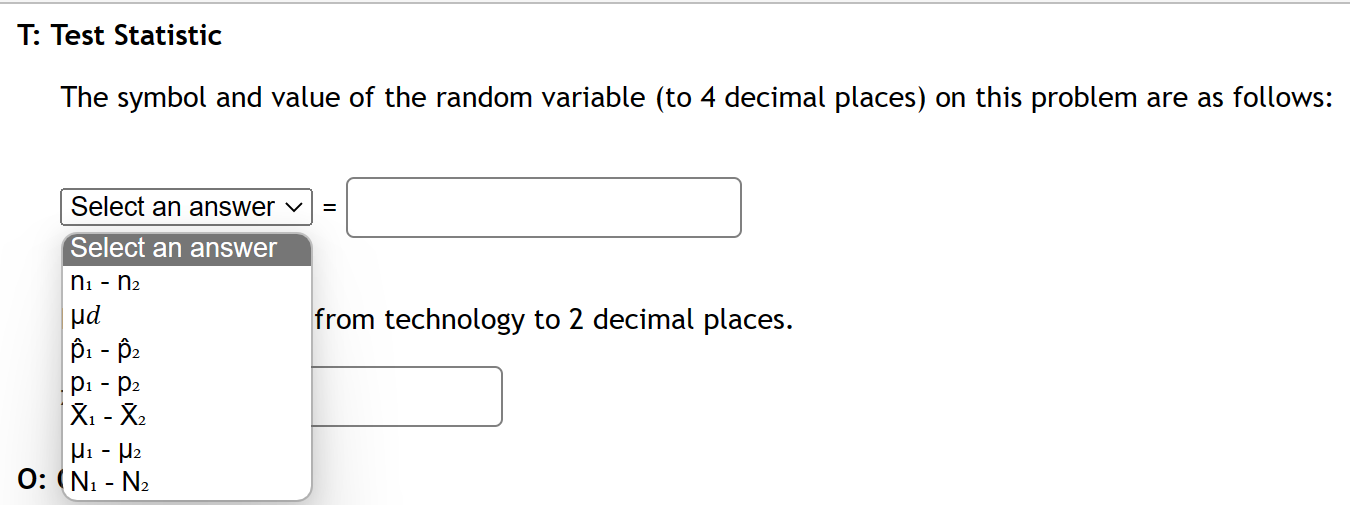
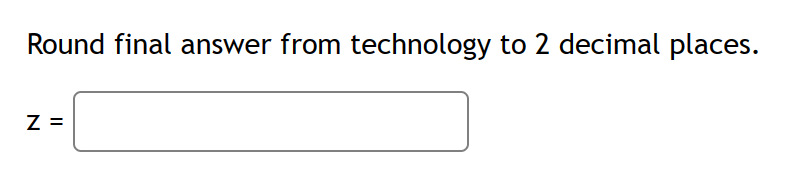

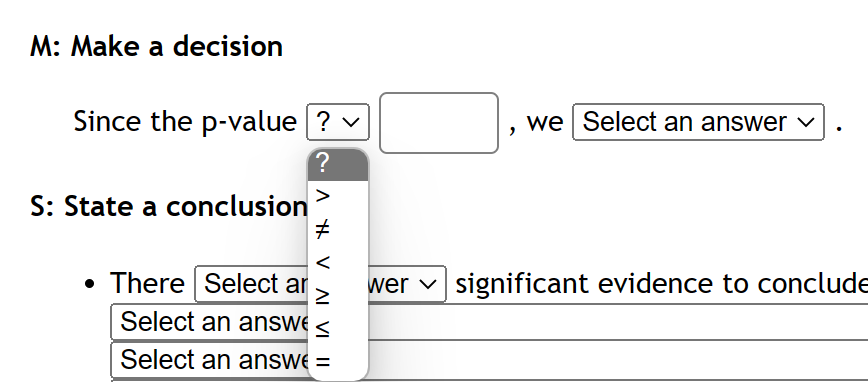
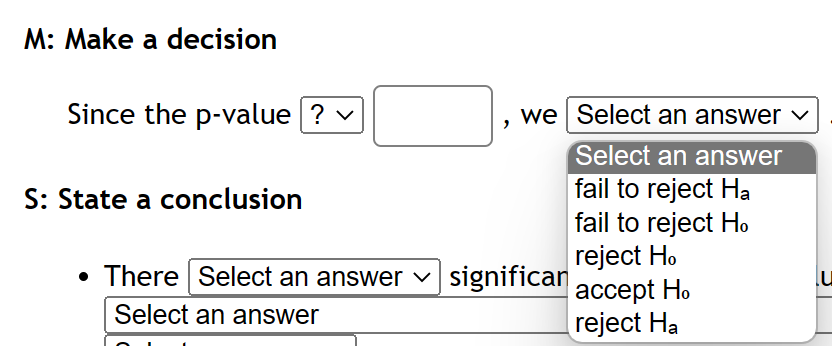
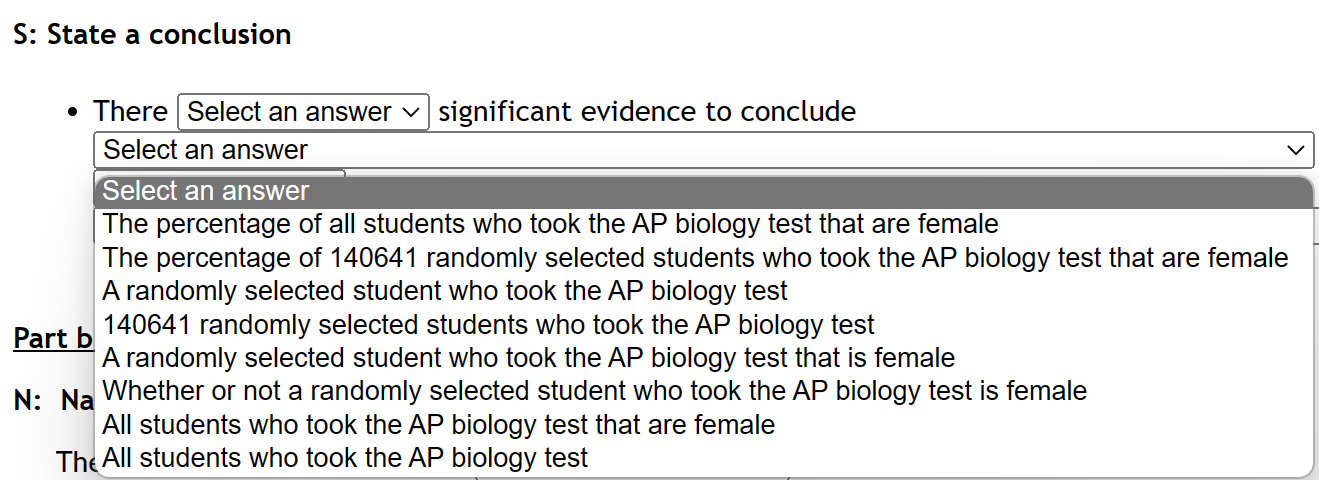
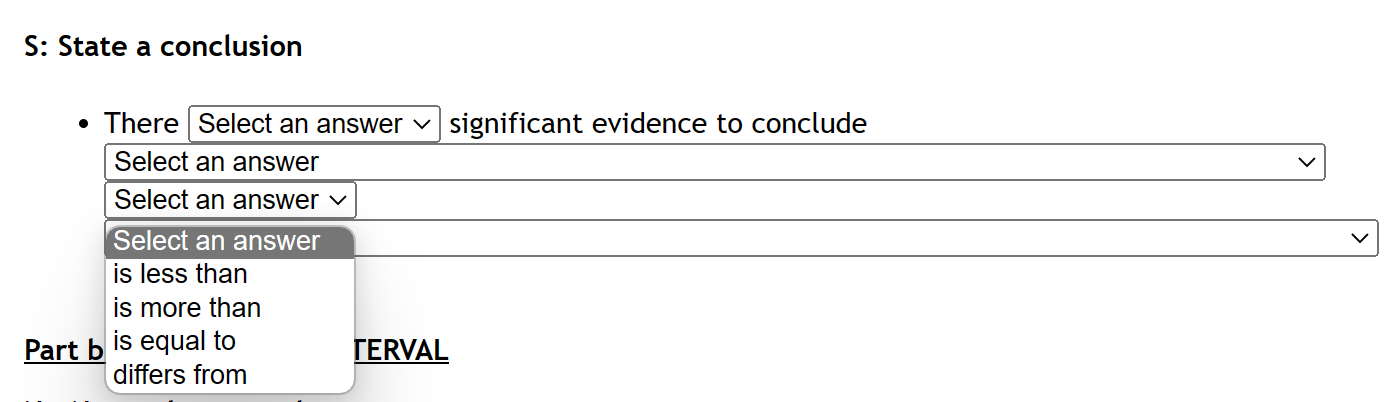
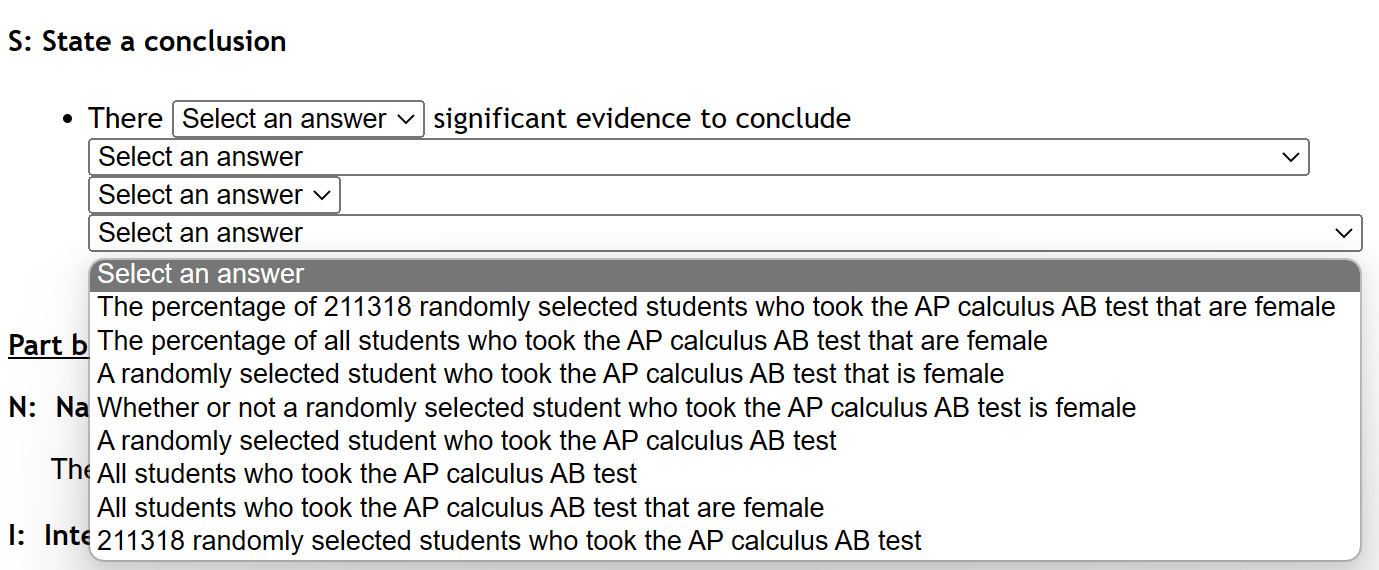
H: Hypotheses Fill in the correct null and alternative hypotheses: Ho : Select an answer v ? v ? = HA : Select an answer V VIAIVA A: AssumptionsMany high school students take the AP tests in different subject areas. In 2017, of the 140641 students who took the AP biology exam 77100 of them were female. In that same year, of the 211318 students who took the AP calculus AB exam 98451 of them were female. Is there enough evidence to show that the proportion of AP biology exam takers who are female is higher than the proportion of AP calculus AB exam takers who are female? a) Test at the 5% level b) Compute a 90% confidence interval for the difference in proportions. Use the steps of PHANTOMS for the hypothesis test. For the confidence interval you do not need to do all the steps of PANIC since you did some of them already in PHANTOMS. You just need to do the MIC of PANIC. Part a.) HYPOTHESIS TEST P: Parameter What is the correct parameter symbol and wording for population 1? Select an answer v = Se Select an answer n1 parameter symbol and wording for population 2? In! |= Part a.) HYPOTHESIS TEST P: Parameter What is the correct parameter symbol and wording for population 1? Select an answer v = Select an answer v Select an answer The percentage of all students who took the AP biology test that are female The percentage of 140641 randomly selected students who took the AP biology test that are female A randomly selected student who took the AP biology test that is female IA randomly selected student who took the AP biology test All students who took the AP biology test All students who took the AP biology test that are female Whether or not a randomly selected student who took the AP biology test is female 140641 randomly selected students who took the AP biology test What is the correct parameter symbol and wording for population 2? _Select an answer v = e_elect an answer In2 ull and alternative hypotheses: p; nswer v What is the correct parameter symbol and wording for population 2? Select an answer v = Select an answer v Select an answer The percentage of all students who took the AP calculus AB test that are female A randomly selected student who took the AP calculus AB test that is female The percentage of 211318 randomly selected students who took the AP calculus AB test that are female Whether or not a randomly selected student who took the AP calculus AB test is female 211318 randomly selected students who took the AP calculus AB test A randomly selected student who took the AP calculus AB test All students who took the AP calculus AB test All students who took the AP calculus AB test that are female H . - I Qolan'l' an annular \\l I I 'J \\I II I H: Hypotheses Fill in the correct null and alternative hypotheses: Ho : Select an answer v ? v Select an answer n1 - n2 HA : X1 - X2 ? v N1 - N2 p1 - p2 A: Assumptip2 ud Since S M1 - 2 formation was collected from each objH: Hypotheses Fill in the correct null and alternative hypotheses: Ho : Select an answer v v HA : Select an answer v ? V Select an answer M1 - 2 A: Assumptid P1 - P2 Since Sep1 - p2 formation was collected from each ob conditions: N1 - N2 n1 - n2 Check al X1 - XzH: Hypotheses Fill in the correct null and alternative hypotheses: Ho : Select an answer ? v HA : Select an answer V ? v 2 A: Assumptions Since Select an answer v inf > Ition was collected from each ob conditions: SA: Assumptions Since information was collected from each object, we need to check the following condition quantitative Check qualitative [371175312 10andn27$22 10 D or is unknown for each group. D The samples are independent. DNl 2 20111 and N2 2 20112 C1351 Z 10and $2 2 10 D The samples are dependent. D Normal population or n1 2 30 and n2 2 30 with no outliers for each group. Cl Normal population or at least 30 pairs of data with no outliers in the differences Check those assumptions: ml D Population sizes are not given. i [3 ._. l E"! ._. I E E V II IV A u \"'3 = 20ml) and N2 >= 20(TL2) Check those assumptions: Population sizes are not given. We will assume that N1 >= 20(n1) and N2 >= 20mg) Check those assumptions: C1= which is ? v 2 = which is ? v n1 - C1 = which is ? v ? 2 n2 - X2 = which is S Population sizes are not given. F = 20(n1) and N2 >= 20(n2)Check those assumptions: 1= which is ? v which is ? v n1 - C1 = which is ? v n2 - X2 = which is ? v Population sizes are not given. S We will assume that N1 >= 20(n1) and N2 >= 20(n A H IIIVN: Name the test The conditions are met to use a Select an answer Select an answer T: Test Statistic 1-Proportion Z-Test 2-Proportion Z-Test The symbol and value of the ran paired T-Test ci 2-Sample T-Test T-Test CalAAtT: Test Statistic The symbol and value of the random variable (to 4 decimal places) on this problem are as follows: Select an answer Select an answer n1 - n2 from technology to 2 decimal places. p1 - p2 P1 - P2 X1 - X2 M1 - 2 O: (N1 - N2Round final answer from technology to 2 decimal places. Z =0: Obtain the P-value Report the final answer to 4 decimal places. It is possible when rounded that a p-value is 0.0000 M: Make a decision Since the p-value V V , we Select an answer V ? S: State a conclusion >
Step by Step Solution
There are 3 Steps involved in it

Get step-by-step solutions from verified subject matter experts
 Study Help