







Question: H s a Hyperbolc half-plane geometry HP s the hyperbolc parallel postulate (given a line l and a point P not on l there are
H s a Hyperbolc half-plane geometry
HP s the hyperbolc parallel postulate (given a line l and a point P not on l there are lines l' and l'' thru P that are parallel to l, l' not equal to l'')
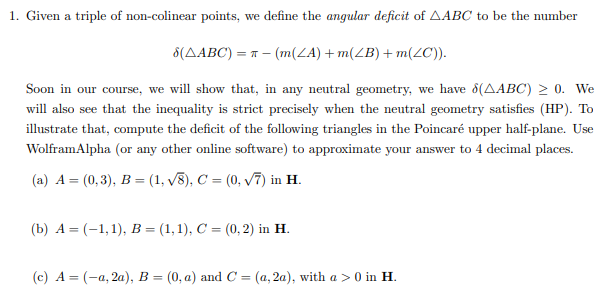
1. Given a triple of non-colinear points, we define the angular deficit of AABC to be the number 8(AABC) = 1 -(m(ZA) +m(ZB) +m(ZC)). Soon in our course, we will show that, in any neutral geometry, we have (AABC) > 0. We will also see that the inequality is strict precisely when the neutral geometry satisfies (HP). To illustrate that, compute the deficit of the following triangles in the Poincar upper half-plane. Use Wolfram Alpha (or any other online software) to approximate your answer to 4 decimal places. (a) A = (0,3), B = (1, V8), C = (0,7) in H. (b) A=(-1,1), B = (1,1), C = (0,2) in H. (c) A=(-a, 2a), B = (0, a) and C = (a, 2a), with a > 0 in H. 1. Given a triple of non-colinear points, we define the angular deficit of AABC to be the number 8(AABC) = 1 -(m(ZA) +m(ZB) +m(ZC)). Soon in our course, we will show that, in any neutral geometry, we have (AABC) > 0. We will also see that the inequality is strict precisely when the neutral geometry satisfies (HP). To illustrate that, compute the deficit of the following triangles in the Poincar upper half-plane. Use Wolfram Alpha (or any other online software) to approximate your answer to 4 decimal places. (a) A = (0,3), B = (1, V8), C = (0,7) in H. (b) A=(-1,1), B = (1,1), C = (0,2) in H. (c) A=(-a, 2a), B = (0, a) and C = (a, 2a), with a > 0 in H
Step by Step Solution
There are 3 Steps involved in it

Get step-by-step solutions from verified subject matter experts
 Study Help