







Question: Handwrit.e and show all work and steps On #5 and #7, please include the directions of these values. They are vector quantities, and the directions
Handwrit.e and show all work and steps
On #5 and #7, please include the directions of these values. They are vector quantities, and the directions should be noted in the context of the problem. (-10)
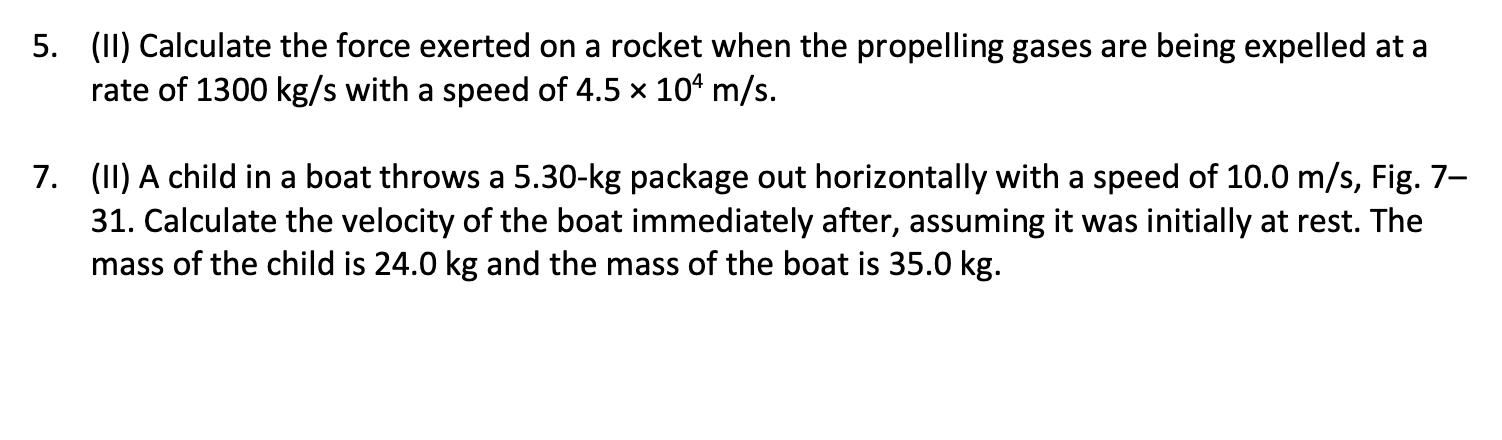




5. (II) Calculate the force exerted on a rocket when the propelling gases are being expelled at a rate of 1300 kg/s with a speed of 4.5 x 10⁴ m/s. 7. (II) A child in a boat throws a 5.30kg package out horizontally with a speed of 10.0 m/s, Fig. 7 31. Calculate the velocity of the boat immediately after, assuming it was initially at rest. The mass of the child is 24.0 kg and the mass of the boat is 35.0 kg. 15. (I) A 0.145-kg baseball pitched at 31.0 m/s is hit on a horizontal line drive straight back at the pitcher at 46.0 m/s. If the contact time between bat and ball is 5.00 x 10'3 s, calculate the force (assumed to be constant) between the ball and bat. 21. (II) A 95-kg fullback is running at 3.0 m/s to the east and is stopped in 0.85 s by a head-on tackle by a tackler running due west. Calculate (a) the original momentum of the fullback, (b) the impulse exerted on the fullback, (c) the impulse exerted on the tackler, and (d) the average force exerted on the tackler. 13. (II) A 1.65-kg mass stretches a vertical spring 0.215 m. If the spring is stretched an additional 0.130 m and released, how long does it take to reach the (new) equilibrium position again? 21. (II) At t = 0, an 885-g mass at rest on the end of a horizontal spring (k = 184 Mm) is struck by a hammer which gives it an initial speed of 2.26 m/s. Determine (a) the period and frequency of the motion, (b) the amplitude, (c) the maximum acceleration, (d) the total energy, and (e) the kinetic energy when x = 0.40A where A is the amplitude
Step by Step Solution
There are 3 Steps involved in it

Get step-by-step solutions from verified subject matter experts
 Study Help