







Question: Hard Rock case study: Describe three data elements you would reasonably find in Hard Rocks CRM ( read Special note on metadata) Ward and Little's
Hard Rock case study: Describe three data elements you would reasonably find in Hard Rocks CRM (read Special note on metadata)
Ward and Little's turnaround strategy for the Hard Rock Caf is straightforward: First, fix the infrastructure and the existing corporate systems, and then invest in customer-facing programs and technologies that will drive traffic to Hard Rock's website (www.hardrock.com) and from there to the restaurants. Will this strategy work for Hard Rock? Alan Hickok, a senior researcher who covers restaurants for Minneapolis-based investment company U.S. Bancorp Piper Jaffray, says that the Internet and food haven't made beautiful music together in the past. He points to the several hundred million dollars of venture money lost in online food-service applications. But the Hard Rock is hoping that the extent of its commitment to this strategy will make it succeed. That commitment entails over 500 exclusive-rights concerts a year that will be shown in the Cafs and via webcasts, a Hard Rock memorabilia section on online auction site eBay and perhaps most pivotally, an ambitious CRM system that aims to strengthen the relationship between restaurant and customer by building an online community. The Hard Rock is using the Internet as a tool both for capturing information about its restaurant patrons and pushing customized information (such as upcoming concert information) to those patrons in an effort to bring them back for repeat dining business. "We're using music as a platform," says Little. "And we're using technology to reach the customer. We're looking for technology to get the company to the next level."
Shortly before Ward arrived, the IT department had tried but failed to install a data warehousethe disparate data standards had proven too complicated to overcome. One of the reasons that Ward left Disney for Hard Rock at the end of 1998 was the leeway he was promised in overhauling the IT department. Using this mandate, Ward galvanized the IT troops and spent the last quarter of 1998 and the first half of 1999 putting in place a million-dollar data warehouse system from Vienna, Va.-based MicroStrategy. The data warehouse now stores all restaurant point-of-sales customer data, such as merchandise sales, as well as customer demographic and preference data now captured on the Weblinking the two together when possible. The completed data warehouse project laid the foundation for two other important fixes.
Because merchandise sales account for hundreds of millions of dollars every yearhalf of the Hard Rock's revenuesthe next step was to install a much-needed chainwide merchandise system. The lack of such a system lead to embarrassing gaffes like the summer the Cleveland Hard Rock opened and had no T-shirts to sell for the first three weeks. Ward's group chose the Radius inventory management system from Transatlantic Software, with a price tag of $1.5 million, because it was built on the MicroStrategy platform.
Next up was the financial system. "There were three sets of books when I started," says Little. "You had the people in the field saying these are the numbers, you had finance saying these were the numbers, and you had the CEO saying these were the numbers." And most of the time their totals weren't even close. As late as the end of 1998, the finance system required restaurant managers to e-mail a copy of the financial statement in Lotus Notes, a dedicated staffer in corporate to reproduce the numbers in Microsoft Excel spreadsheets and another to key it in to a Lawson Software financial module.
According to Ward, the Lawson system had 50 different ledgersone for each of the U.S. restaurantsand needed to be completely reengineered to produce a common ledger for all the Cafs. One year and $5 million later, the system now automatically reconciles the numbers for every Caf and reports them on a daily basis. The workload has been so reduced that the finance staff has been trimmed from 90 to 30 people. "Now we have one set of booksours," jokes Little.
While the restaurants were opposed to changes that required them to spend time learning new systemsit was a fairly painful process for them, Ward concedesthe benefits are now apparent. The new systems and data warehouses are now accessible through a companywide intranet. All the records are updated and reported daily, ensuring that disasters like the New York City misplaced money bag and the Cleveland T-shirt debacle won't happen again. With just a click of the mouse, corporate executives can call up the Memphis Caf's beer sales for the previous day$4,641 worthor see how many fries were served in Houston.
Obviously, hungry patrons aren't going to flock to the Hard Rock just because the Caf has gotten its financial systems together. In fact, Technomic's Paul suggests that the casual dining field has never been more crowded and competitive. Every night the Cheesecake Factory and the Olive Garden, among many others, compete for the same blue-jean-and-sweater-wearing diner as the Hard Rock. "All of these come back to 'how was dinner,'" says Paul. "And what you mean really is how was the whole experience, from the parking lot to the way out." The Hard Rock has the opportunity to distinguish itself with its strong connection to music. After all, says Paul, "it is a little more cool than just going to Chili's."
This is exactly what the Hard Rock is trying to convince its customers in its second wave of IT-based initiatives. Thirty million people visit the Hard Rock every year; 75 percent of them are tourists, often drawn by the opportunity to purchase a Hard Rock Boston T-shirt as proof of their travels. If some of those tourists also became regular diners at their local Hard Rocks back at home, profits chainwide would greatly increase. Central to the mission to attract a more local crowd more consistently is the company's newest outletHard Rock Cyberspace, www.hardrock.com. "Our goal and our desire is that we can capture people coming out of the Caf," says Ward, "and they would go to our website. And the goal with our website is first and foremost to drive traffic back to the Caf." Closing the loop, so to speak.
The key to this two-pronged strategy is a CRM system that tracks users both on the Web and in the restaurants. Hard Rock is implementing Epiphany's CRM product to track users both on the Web and in the restaurants. The system also allows Hard Rock to offer real-time promotional campaigns based on user behaviorfor instance, predicting bands a visitor might like and alerting him when those bands play at the local Hard Rock.
To Bob Chatham, a principal analyst at Forrester Research in Cambridge, Mass., just having a CRM system is only half an answer. While CRM products like Epiphany's allow companies to keep careful tabs on visitors' online behavior and track how they respond to certain promotions, it doesn't actually help develop successful promotions. "There's also this little magic step that you have to take," says Chatham. "Identifying people who are your most likely customers is one step, but then there is this black art of what am I going to pitch them. It still hasn't eliminated the need for a great creative effort."
Usually creative efforts are left to marketing people who, equipped with market research and customer data, seize control of a CRM project the moment the CIO completes the integration. But to Ward's surprise, rather than relinquish his customer responsibilities when the system was installed, he was given more customer responsibility. Now he is responsible for CRM, customer service, customer surveys and point-of-sales feedback. And his IT staff now includes writers, artists and even marketing professionals.
After 15 years of traditional IT work, Ward finds the expanded role exciting. Still, in his mind, Hard Rock's goals are relatively simple and straightforward. "If somebody had a phenomenal time in Paris, they go home to Cleveland, and there is a follow-up e-mail from the general manager to come in and experience the local Caf, again increasing the frequency of a customer's visits," says Ward.
The Hard Rock has figured out a few ways to drive traffic to the website, which allows the company to capture more informationsuch as age, address and musical tastesabout their restaurant customers. At the bottom of every restaurant receipt is an identification number, unique for every meal, which can be entered into the website. In exchange for a $5 gift certificate, visitors can then enter some personal information and fill out a survey rating the Hard Rock experience and naming their favorite bands. The Hard Rock then sends notification when that band is in town or when a similar band may be playing at the local Caf.
Also, restaurant diners can have a digital picture taken among the guitars and posters and then find the picture posted for download on Hardrock.com. Through a strategic agreement with eBay, rock 'n' roll fans browsing for memorabilia on the auction site are routed to www.hardrock.com. And the site itself is trying to become a haven for music lovers. It offers streaming playback of concerts, memorabilia trading, music communities, trivia and a customizable My Rock section that keeps fans informed of the latest happenings of their favorite bands.
CFO Little recalls a recent interview in which a reporter, confusing the Hard Rock with Planet Hollywood, asked him how it felt to bring a company out of bankruptcy. "If the media are having a hard time distinguishing us," he says, "then the consumer must also. So everything about this last year has been about separating us from the pack."
CRM isn't easy. But there are three early indicators that the Rock might be on a roll.
First, customers are actually completing the online survey referenced on the receipts. The restaurant won't disclose the exact completion rate, but Little says it is "substantial double digits"which might sound low, but is actually a staggering number compared with the standard 2 percent or 3 percent response rate of direct-mail promotions.
Second, 70 percent of people who get their picture taken at the caf have claimed their photo online. That fact indicates that the drive-diners-to-the-Web leg of the strategy is humming.
Third, and of course most important, is the bottom line. Sales were more than $200 million for the first half of 2000on pace to easily outdistance 1999's $388 million showing and thus reverse the declining sales trend.
Emboldened by these facts, Hard Rock is expanding its website to include pages for each restaurant, celebrating the cool and crazy characters who work in the local Cafs75 percent of whom play in one band or another. Further Web content and promotional deals are in the works with Internet music companies Liquid Audio and CDnow. (Company officials are mum on the details.) And next year the Hard Rock will extend its brand with a series of music-themed hotels and casinos.
And the current offerings will be fine-tuned as well. While the Hard Rock doesn't sell city-specific merchandise on the Webto preserve the clothing's travel-trophy value, they saythe CRM system will allow, for example, customers to purchase merchandise from a Caf they have been to in the past. Plus Ward is confident he can use it to increase the flow of customers to the restaurants. "We are trying to build a community around the Cafs," he says. "Not just an online community but a real live community where you're going to find out what band is playing at the Hard Rock, and say, 'Hey, we're going.'" And if he can do his job, the Cafs can focus on what they do best. Serving cold beer, hot burgers and fajitas, and music. Lots of music.
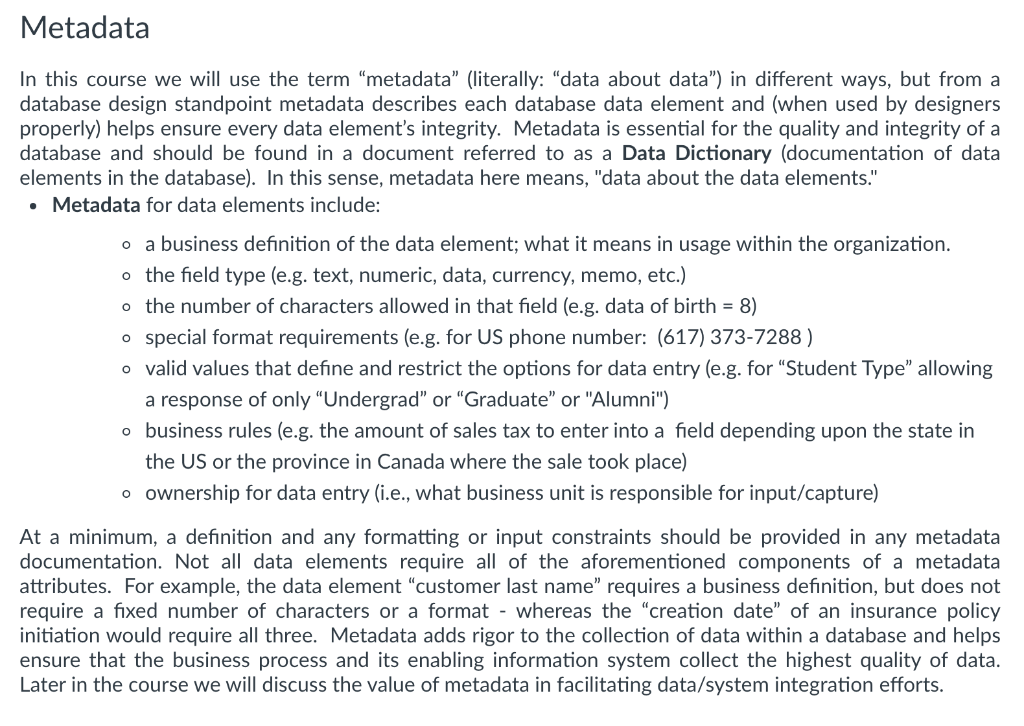
Metadata In this course we will use the term "metadata" (literally: "data about data) in different ways, but from a database design standpoint metadata describes each database data element and (when used by designers properly) helps ensure every data element's integrity. Metadata is essential for the quality and integrity of a database and should be found in a document referred to as a Data Dictionary (documentation of data elements in the database). In this sense, metadata here means, "data about the data elements." Metadata for data elements include: o a business definition of the data element; what it means in usage within the organization. o the field type (e.g. text, numeric, data, currency, memo, etc.) o the number of characters allowed in that field (e.g. data of birth = 8) o special format requirements (e.g. for US phone number: (617) 373-7288) o valid values that define and restrict the options for data entry (e.g. for Student Type" allowing a response of only Undergrad" or "Graduate" or "Alumni") o business rules (e.g. the amount of sales tax to enter into a field depending upon the state in the US or the province in Canada where the sale took place) o ownership for data entry (i.e., what business unit is responsible for input/capture) At a minimum, a definition and any formatting or input constraints should be provided in any metadata documentation. Not all data elements require all of the aforementioned components of a metadata attributes. For example, the data element "customer last name" requires a business definition, but does not require a fixed number of characters or a format - whereas the creation date of an insurance policy initiation would require all three. Metadata adds rigor to the collection of data within a database and helps ensure that the business process and its enabling information system collect the highest quality of data. Later in the course we will discuss the value of metadata in facilitating data/system integration effortsStep by Step Solution
There are 3 Steps involved in it

Get step-by-step solutions from verified subject matter experts
 Study Help