







Question: heat and mass transfer please answer for a like 2) Reducing evaporation from a pond (based on Cussler 2.2) Learning Objective: Know the relationships between
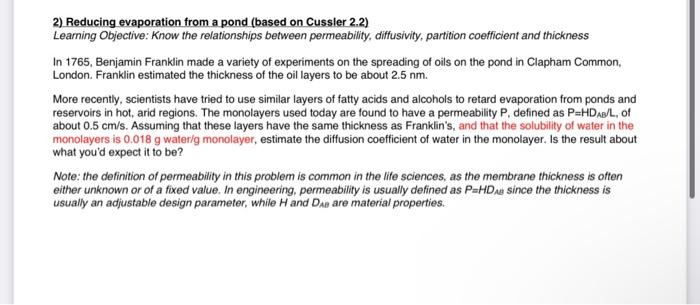
2) Reducing evaporation from a pond (based on Cussler 2.2) Learning Objective: Know the relationships between permeability, diffusivity, partition coefficient and thickness In 1765, Benjamin Franklin made a variety of experiments on the spreading of oils on the pond in Clapham Common London. Franklin estimated the thickness of the oil layers to be about 2.5 nm. More recently, scientists have tried to use similar layers of fatty acids and alcohols to retard evaporation from ponds and reservoirs in hot, arid regions. The monolayers used today are found to have a permeability P. defined as P=HDA/L, of about 0.5 cm/s. Assuming that these layers have the same thickness as Franklin's, and that the solubility of water in the monolayers is 0.018 g waterig monolayer, estimate the diffusion coefficient of water in the monolayer. Is the result about what you'd expect it to be? Note: the definition of permeability in this problem is common in the life sciences, as the membrane thickness is often either unknown or of a fixed value in engineering, permeability is usually defined as P-HD since the thickness is usually an adjustable design parameter, while H and Dae are material properties
Step by Step Solution
There are 3 Steps involved in it

Get step-by-step solutions from verified subject matter experts
 Study Help