







Question: Heat equation Problem 3. Consider the 1-dimensional heat equation + 37 ) (2 ,1 ) = 1 on the domain ? = [0, 1] with
Heat equation
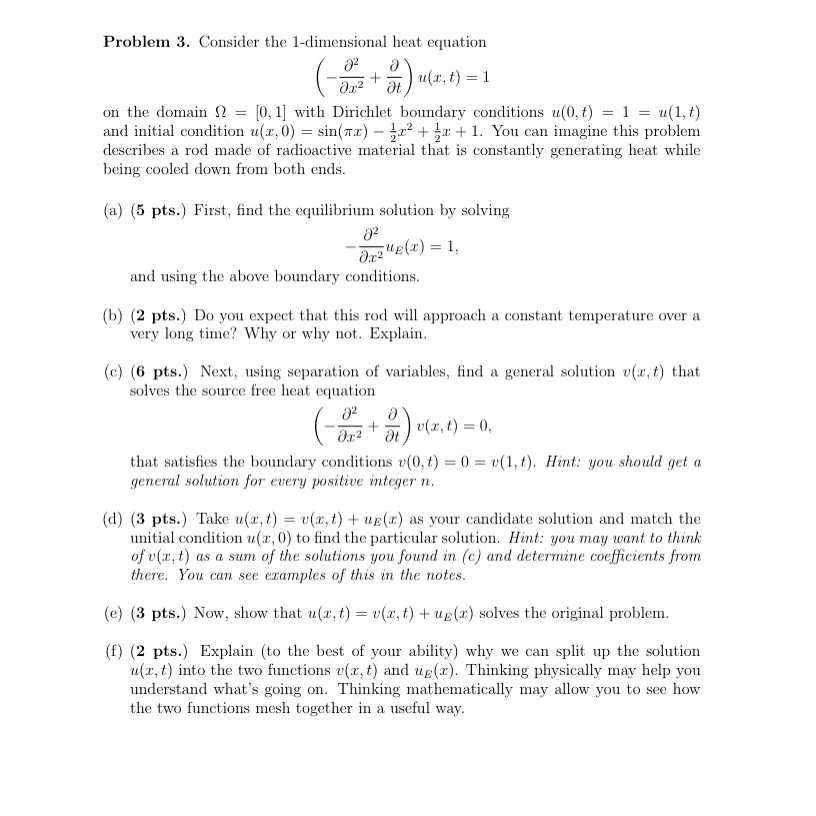
Problem 3. Consider the 1-dimensional heat equation + 37 ) "(2 ,1 ) = 1 on the domain ? = [0, 1] with Dirichlet boundary conditions u(0, () = 1 = u(1, t) and initial condition u(r, 0) = sin(me) - $2 + x +1. You can imagine this problem describes a rod made of radioactive material that is constantly generating heat while being cooled down from both ends. (a) (5 pts.) First, find the equilibrium solution by solving 02 dri "E(T) = 1, and using the above boundary conditions. (b) (2 pts.) Do you expect that this rod will approach a constant temperature over a very long time? Why or why not. Explain. (c) (6 pts.) Next, using separation of variables, find a general solution v(x, () that solves the source free heat equation 02 + 27 ) " ( , 1 ) = 0 , that satisfies the boundary conditions v(0, t) = 0 = v(1, (). Hint: you should get a general solution for every positive integer n. (d) (3 pts.) Take u(x, t) = v(r, t) + us() as your candidate solution and match the unitial condition u(x, 0) to find the particular solution. Hint: you may want to think of v(x, t) as a sum of the solutions you found in (c) and determine coefficients from there. You can see examples of this in the notes. (e) (3 pts.) Now, show that u(x, t) = v(r, t) + up(x) solves the original problem. (f) (2 pts.) Explain (to the best of your ability) why we can split up the solution u(r, t) into the two functions v(x, t) and up(x). Thinking physically may help you understand what's going on. Thinking mathematically may allow you to see how the two functions mesh together in a useful way
Step by Step Solution
There are 3 Steps involved in it

Get step-by-step solutions from verified subject matter experts
 Study Help