







Question: I-d wave equation Problem 2. Consider the 1-dimensional wave equation Or2 + of ) u(x, t) = 0, with domain ? = [0, 1]. Without
I-d wave equation
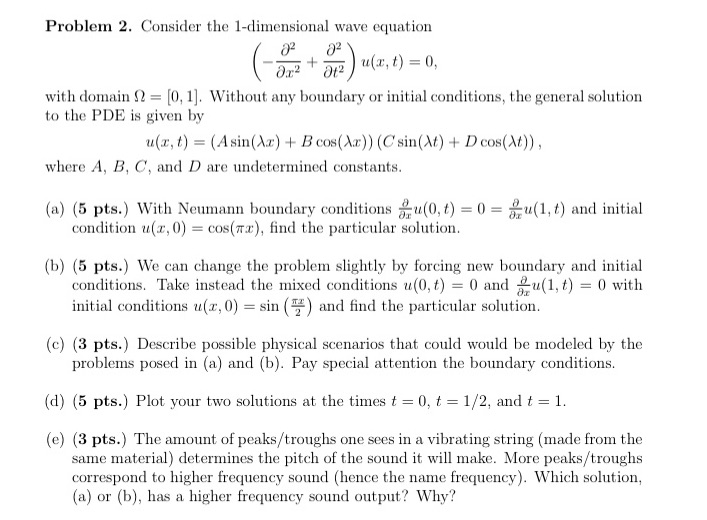
Problem 2. Consider the 1-dimensional wave equation Or2 + of ) u(x, t) = 0, with domain ? = [0, 1]. Without any boundary or initial conditions, the general solution to the PDE is given by u(x, t) = (Asin(Ar) + Bcos(Xx)) (C sin(At) + D cos(At) ), where A, B, C, and D are undetermined constants. (a) (5 pts.) With Neumann boundary conditions mu(0,() =0 = Pu(1, t) and initial condition u(z, 0) = cos(#x), find the particular solution. (b) (5 pts.) We can change the problem slightly by forcing new boundary and initial conditions. Take instead the mixed conditions u(0, f) = 0 and Bu(1, t) = 0 with initial conditions u(z, 0) = sin (# ) and find the particular solution. (c) (3 pts. ) Describe possible physical scenarios that could would be modeled by the problems posed in (a) and (b). Pay special attention the boundary conditions. (d) (5 pts.) Plot your two solutions at the times t = 0, t = 1/2, and t = 1. (e) (3 pts.) The amount of peaks/troughs one sees in a vibrating string ( made from the same material) determines the pitch of the sound it will make. More peaks/troughs correspond to higher frequency sound (hence the name frequency). Which solution, (a) or (b), has a higher frequency sound output? Why
Step by Step Solution
There are 3 Steps involved in it

Get step-by-step solutions from verified subject matter experts
 Study Help