







Question: Hello, Any solution for this case study Ruaha Farm LTD: Engaging Local Beekeeping communities in Tanzania, 2021. Ivey Publishing. Question : What is the
 Hello,
Any solution for this case study " Ruaha Farm LTD: Engaging Local Beekeeping communities in Tanzania, 2021. Ivey Publishing."
- Question : What is the market failure in this case? How is he providing sustainable solutions to a neglected problem with positive externalities?
I NEED TO ATTACH THE CASE STUDY ITS LONG.
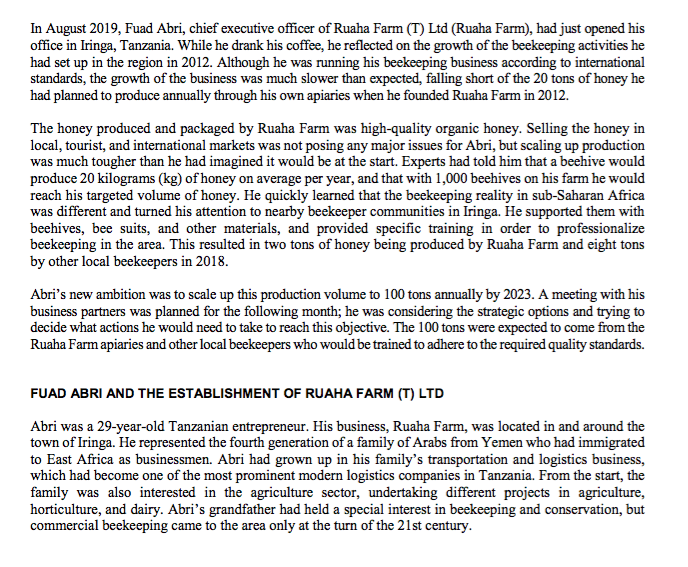
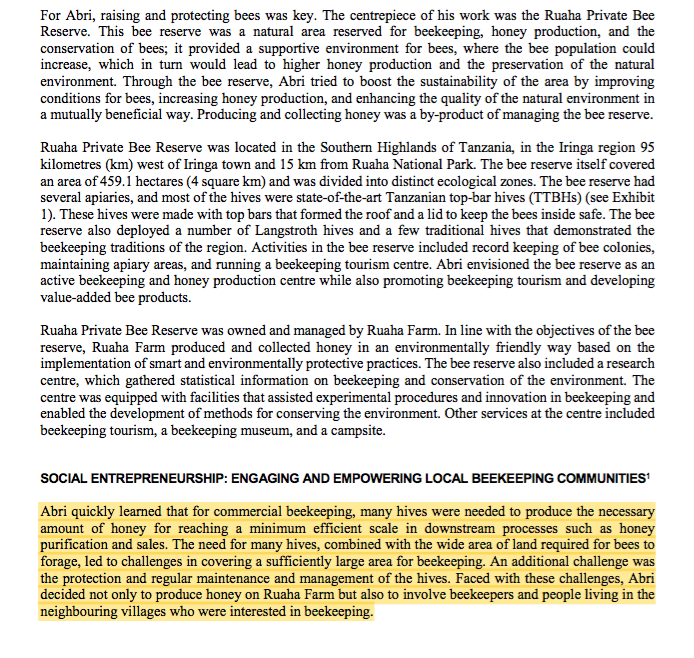
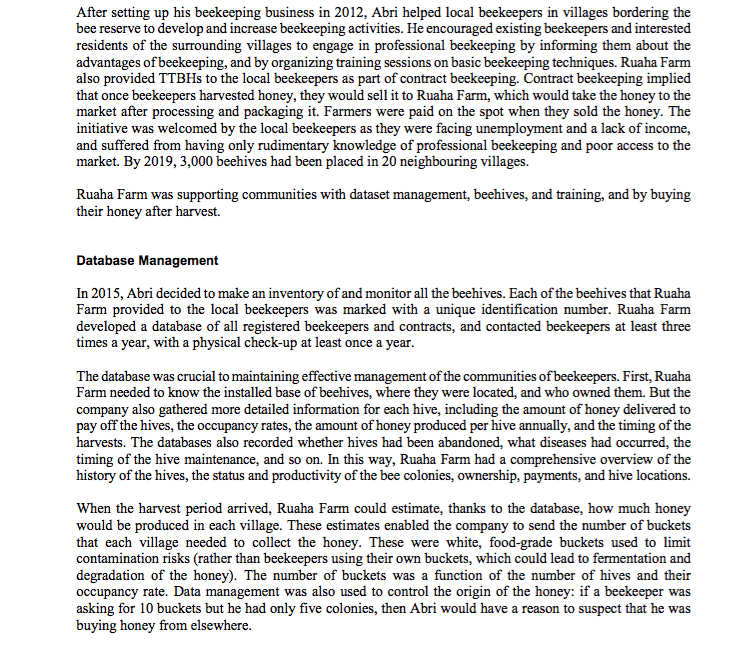
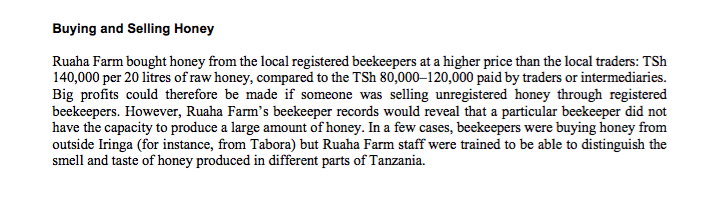
In August 2019, Fuad Abri, chief executive officer of Ruaha Farm (T) Ltd (Ruaha Farm), had just opened his office in Iringa, Tanzania. While he drank his coffee, he reflected on the growth of the beekeeping activities he had set up in the region in 2012. Although he was running his beekeeping business according to international standards, the growth of the business was much slower than expected, falling short of the 20 tons of honey he had planned to produce annually through his own apiaries when he founded Ruaha Farm in 2012. The honey produced and packaged by Ruaha Farm was high-quality organic honey. Selling the honey in local, tourist , and international markets was not posing any major issues for Abri, but scaling up production was much tougher than he had imagined it would be at the start. Experts had told him that a beehive would produce 20 kilograms (kg) of honey on average per year, and that with 1,000 beehives on his farm he would reach his targeted volume of honey. He quickly learned that the beekeeping reality in sub-Saharan Africa was different and turned his attention to nearby beekeeper communities in Iringa. He supported them with beehives, bee suits, and other materials, and provided specific training in order to professionalize beekeeping in the area. This resulted in two tons of honey being produced by Ruaha Farm and eight tons by other local beekeepers in 2018. Abri's new ambition was to scale up this production volume to 100 tons annually by 2023. A meeting with his business partners was planned for the following month; he was considering the strategic options and trying to decide what actions he would need to take to reach this objective. The 100 tons were expected to come from the Ruaha Farm apiaries and other local beekeepers who would be trained to adhere to the required quality standards. FUAD ABRI AND THE ESTABLISHMENT OF RUAHA FARM (T) LTD Abri was a 29-year-old Tanzanian entrepreneur. His business, Ruaha Farm, was located in and around the town of Iringa. He represented the fourth generation of a family of Arabs from Yemen who had immigrated to East Africa as businessmen. Abri had grown up in his family's transportation and logistics business, which had become one of the most prominent modern logistics companies in Tanzania. From the start, the family was also interested in the agriculture sector, undertaking different projects in agriculture, horticulture, and dairy. Abri's grandfather had held a special interest in beekeeping and conservation, but commercial beekeeping came to the area only at the turn of the 21st century. For Abri, raising and protecting bees was key. The centrepiece of his work was the Ruaha Private Bee Reserve. This bee reserve was a natural area reserved for beekeeping, honey production, and the conservation of bees; it provided a supportive environment for bees, where the bee population could increase, which in turn would lead to higher honey production and the preservation of the natural environment. Through the bee reserve, Abri tried to boost the sustainability of the area by improving conditions for bees, increasing honey production, and enhancing the quality of the natural environment in a mutually beneficial way. Producing and collecting honey was a by-product of managing the bee reserve. Ruaha Private Bee Reserve was located in the Southern Highlands of Tanzania, in the Iringa region 95 kilometres (km) west of Iringa town and 15 km from Ruaha National Park. The bee reserve itself covered an area of 459.1 hectares (4 square km) and was divided into distinct ecological zones. The bee reserve had several apiaries, and most of the hives were state-of-the-art Tanzanian top-bar hives (TTBHs) (see Exhibit 1). These hives were made with top bars that formed the roof and a lid to keep the bees inside safe. The bee reserve also deployed a number of Langstroth hives and a few traditional hives that demonstrated the beekeeping traditions of the region. Activities in the bee reserve included record keeping of bee colonies, maintaining apiary areas, and running a beekeeping tourism centre. Abri envisioned the bee reserve as an active beekeeping and honey production centre while also promoting beekeeping tourism and developing value-added bee products. Ruaha Private Bee Reserve was owned and managed by Ruaha Farm. In line with the objectives of the bee reserve, Ruaha Farm produced and collected honey in an environmentally friendly way based on the implementation of smart and environmentally protective practices. The bee reserve also included a research centre, which gathered statistical information on beekeeping and conservation of the environment. The centre was equipped with facilities that assisted experimental procedures and innovation in beekeeping and enabled the development of methods for conserving the environment. Other services at the centre included beekeeping tourism, a beekeeping museum, and a campsite. SOCIAL ENTREPRENEURSHIP: ENGAGING AND EMPOWERING LOCAL BEEKEEPING COMMUNITIES Abri quickly learned that for commercial beekeeping, many hives were needed to produce the necessary amount of honey for reaching a minimum efficient scale in downstream processes such as honey purification and sales. The need for many hives, combined with the wide area of land required for bees to forage, led to challenges in covering a sufficiently large area for beekeeping. An additional challenge was the protection and regular maintenance and management of the hives. Faced with these challenges, Abri decided not only to produce honey on Ruaha Farm but also to involve beekeepers and people living in the neighbouring villages who were interested in beekeeping. After setting up his beekeeping business in 2012, Abri helped local beekeepers in villages bordering the bee reserve to develop and increase beekeeping activities. He encouraged existing beekeepers and interested residents of the surrounding villages to engage in professional beekeeping by informing them about the advantages of beekeeping, and by organizing training sessions on basic beekeeping techniques. Ruaha Farm also provided TTBHs to the local beekeepers as part of contract beekeeping. Contract beekeeping implied that once beekeepers harvested honey, they would sell it to Ruaha Farm, which would take the honey to the market after processing and packaging it. Farmers were paid on the spot when they sold the honey. The initiative was welcomed by the local beekeepers as they were facing unemployment and a lack of income, and suffered from having only rudimentary knowledge of professional beekeeping and poor access to the market. By 2019, 3,000 beehives had been placed in 20 neighbouring villages. Ruaha Farm was supporting communities with dataset management, beehives, and training, and by buying their honey after harvest. Database Management In 2015, Abri decided to make an inventory of and monitor all the beehives. Each of the beehives that Ruaha Farm provided to the local beekeepers was marked with a unique identification number. Ruaha Farm developed a database of all registered beekeepers and contracts, and contacted beekeepers at least three times a year, with a physical check-up at least once a year. The database was crucial to maintaining effective management of the communities of beekeepers. First, Ruaha Farm needed to know the installed base of beehives, where they were located, and who owned them. But the company also gathered more detailed information for each hive, including the amount of honey delivered to pay off the hives, the occupancy rates, the amount of honey produced per hive annually, and the timing of the harvests. The databases also recorded whether hives had been abandoned, what diseases had occurred, the timing of the hive maintenance, and so on. In this way, Ruaha Farm had a comprehensive overview of the history of the hives, the status and productivity of the bee colonies, ownership, payments, and hive locations. When the harvest period arrived, Ruaha Farm could estimate, thanks to the database, how much honey would be produced in each village. These estimates enabled the company to send the number of buckets that each village needed to collect the honey. These were white, food-grade buckets used to limit contamination risks (rather than beekeepers using their own buckets, which could lead to fermentation and degradation of the honey). The number of buckets was a function of the number of hives and their occupancy rate. Data management was also used to control the origin of the honey: if a beekeeper was asking for 10 buckets but he had only five colonies, then Abri would have a reason to suspect that he was buying honey from elsewhere. Buying and Selling Honey Ruaha Farm bought honey from the local registered beekeepers at a higher price than the local traders: TSh 140,000 per 20 litres of raw honey, compared to the TSh 80,000120,000 paid by traders or intermediaries. Big profits could therefore be made if someone was selling unregistered honey through registered beekeepers. However, Ruaha Farm's beekeeper records would reveal that a particular beekeeper did not have the capacity to produce a large amount of honey. In a few cases, beekeepers were buying honey from outside Iringa (for instance, from Tabora) but Ruaha Farm staff were trained to be able to distinguish the smell and taste of honey produced in different parts of Tanzania. Ruaha Farm was willing to buy honey that had been produced elsewhere as long as local beekeepers reported that different prices applied to locally produced honey and honey brought in from outside the area. If beekeepers were not honest about the origin of the honey, Abri rejected it. This was a way of discouraging beekeepers from becoming involved in honey trading and to encourage them to sell only locally produced honey. Rejection was always done on the spot: testing the honey happened with the beekeeper witnessing the whole process. Abri explained, "If you tell him (the beekeeper] that the quality of the honey is not good, he should be able to see it himself on the refractometer." Ruaha Farm also rejected honey that was adulterated, over-smoked, or had a high water content (22 per cent or more). However, the company looked at beekeepers individually: inexperienced beekeepers sometimes had honey containing slightly higher water content due to negligence or harvesting too early, and in such cases Abri might then still accept the honey because he did not want to discourage them. Instead, he offered these beekeepers extra training to avoid such problems in the future. Honey was always rejected when experienced beekeepers were offering over-smoked or high-water-content honey, or when their honey came mixed with wax or pollen. Through data management, the company had a track record for each beekeeper. As such, it could identify big swings in the honey production volume (e.g., from 80 litres to 200 litres)an indicator that something unusual was going on. Ruaha Farm processed and purified the honey and sold it in two markets: the local market and the tourist market. Honey was sold in the local market at TSh 12,000 for a package of 1,000 grams, TSh 6,000 for 500 grams, and TSh 3,500 for a package of 300 grams (see Exhibit 2). In the tourist market, prices were twice as high. The local market generated only small margins. Ruaha Farm tried to sell honey at higher prices and therefore aimed for high-end markets. Abri commented, You can't sell in high-end markets without a story behind your product: customers want information about the product based on facts and research, or they want the story of your company and the bee reserve, or you can focus on the exceptional quality of the honey." Ruaha Farm mainly focused on the tourist market. Honey in Iringa could have a variety of colours and tastes depending on the flowering plants and trees. This variety in honey was easy to sell to tourists, as they could see the differences at the bee reserve, and they were informed about the story behind it. Abri intended to reach the international market quickly, as wholesalers in the Middle East, for instance, were paying high prices for well-branded organic honey. However, taking the business international would require high sales volumes. Moreover, in international markets, the consistency of the honey was key, and that could only be achieved by consistently blending different types. The Iringa honey crystallized easily (sometimes only one or two weeks after the harvest). This was a considerable problem because consumers perceived crystallization as an indication of poor honey quality. One possible solution was to cream the honey, but customers in the local market and some in the tourist market tended to believe that organic honey should be in liquid form. Most consumers thought that crystallization was not a natural phenomenon. Abri explained, HOW TO GROW THE BUSINESS IN THE NEXT FOUR YEARS Abri was delighted to observe that local beekeepers had benefited economically from his efforts to engage the neighbouring communities in honey production. He strongly believed that continuous education and innovation were the key to improving the beekeeping practice. Improving beekeeping activities was always combined with care for and protection of the environment in collaboration with the local communities. By 2019, Ruaha Farm had distributed 3,000 hives to 498 households in 20 villages in the Iringa district. Yet with 3,000 hives distributed in the villages, Abri was still far short of his initial target of 10,000 beehives. Abri was considering how he could extend and accelerate the growth of honey production in the Iringa region. Should he increase the number of beehives? Should he focus on increasing occupancy rates and look for possibilities to increase the honey production per hive? Should he stick to the existing approach and optimize the processes, or should he develop additional approaches to reach his target? To reach the yearly target of 100 tons of honey annually from the farm and from villagers' hives under contract would require not only a further extension of the installed base but also novel approaches to reduce costs and increase productivity, as well as further professionalization of beekeeping in the villages. Several ideas could be considered. As many beekeepers had faced problems in attracting wild bee colonies, Abri considered sending colonies to the villages. Beekeepers would thus buy hives already populated. But this approach would not be easy as bees tended to abscond once they were transferred over longer distances. Nevertheless, selling colonies had a possible advantage as it could accelerate the selection and dissemination of African bees that produced more honey and were less aggressive. "Queen rearing" was another possibility: with this technique, queen honeybees were raised to head additional colonies or to replace ageing (and less productive) queens or colonies with poor honey production. Another method to colonialize hives was "colony division," a technique of dividing a strong colony into two smaller colonies in two hives. Dividing colonies was a way of increasing the colonization of hives without having to wait for swarms to colonize the hives naturally. Both techniques required advanced understanding of beekeeping, which would imply intensified training. Training itself had proved to be expensive for Ruaha Farm; therefore, new approaches needed to be found to reach more beekeepers and in a more cost-effective way. Ruaha Farm was already connected with various experts and institutes overseas; the more advanced the professionalization of beekeeping activities, the stronger the need for collaboration with universities and institutions specializing in beekeeping. Abri was also thinking about the role of communication and online technologies to facilitate communication with local beekeepers in Tanzania. In 2019, Ruaha Farm developed its own website, www.ruahabeereserve.com. This provided a platform to advertise the honey locally and in various other countries. The company was exploring the use of social media to facilitate communication between beekeepers, to disseminate best practice more quickly, and to train beekeepers remotely. Abri also intended to establish a beekeeping museum in the bee reserve to preserve the history of beekeeping. For example, the museum would compare the use of log hives with modern TBHs. The bee museum would also showcase the future development plans of Ruaha Farm. Along with the museum, the company also planned to introduce bee tourism and integrate it with tourism at Ruaha National Park, focusing on African beekeeping and Ruaha honey harvesting. Abri also intended to strengthen collaboration with the government to ensure that beekeeping was recognized as one of the most interesting tourist attractions in Tanzania's Southern Highlands. Furthermore, Abri wanted to introduce apitherapy. Honey was a natural remedy and could be used in beauty and medicinal products. Also, other bee products such as beeswax, bee glue, bee milk, and pollen had many advantages in people's daily lives, and there was a growing market for these products. Abri was exploring whether diversification into offering these products would pay offStep by Step Solution
There are 3 Steps involved in it
1 Expert Approved Answer
Step: 1 Unlock

Question Has Been Solved by an Expert!
Get step-by-step solutions from verified subject matter experts
Step: 2 Unlock
Step: 3 Unlock
 Study Help