Question: Hello could you please look at this (FIve forces model of Fiat Chrysler) and draw a reasonable conclusion accordingly, please? 1) Threat of New Entrants:
Hello could you please look at this (FIve forces model of Fiat Chrysler) and draw a reasonable conclusion accordingly, please?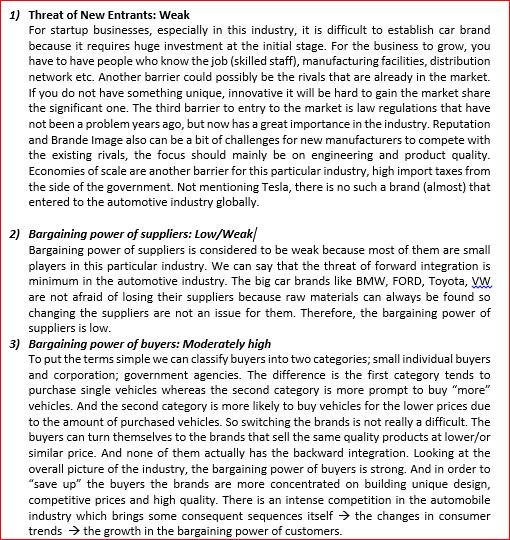
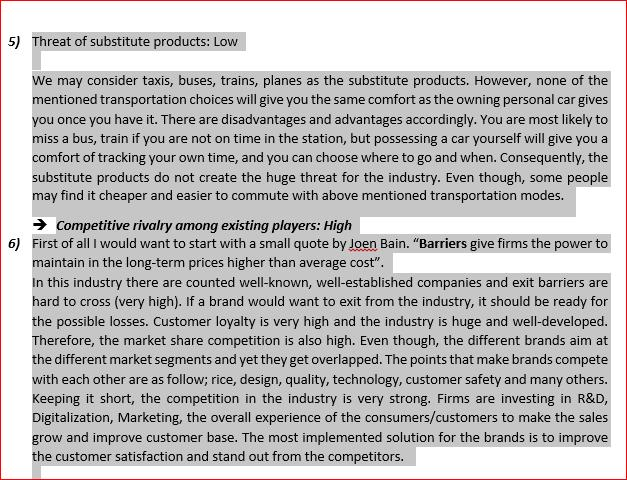
1) Threat of New Entrants: Weak For startup businesses, especially in this industry, it is difficult to establish car brand because it requires huge investment at the initial stage. For the business to grow, you have to have people who know the job (skilled staff), manufacturing facilities, distribution network etc. Another barrier could possibly be the rivals that are already in the market. If you do not have something unique, innovative it will be hard to gain the market share the significant one. The third barrier to entry to the market is law regulations that have not been a problem years ago, but now has a great importance in the industry. Reputation and Brande Image also can be a bit of challenges for new manufacturers to compete with the existing rivals, the focus should mainly be on engineering and product quality. Economies of scale are another barrier for this particular industry, high import taxes from the side of the government. Not mentioning Tesla, there is no such a brand (almost) that entered to the automotive industry globally. 2) Bargaining power of suppliers: Low/Weak/ Bargaining power of suppliers is considered to be weak because most of them are small players in this particular industry. We can say that the threat of forward integration is minimum in the automotive industry. The big car brands like BMW, FORD, Toyota, VW are not afraid of losing their suppliers because raw materials can always be found so changing the suppliers are not an issue for them. Therefore, the bargaining power of suppliers is low. 3) Bargaining power of buyers: Moderately high To put the terms simple we can classify buyers into two categories; small individual buyers and corporation; government agencies. The difference is the first category tends to purchase single vehicles whereas the second category is more prompt to buy "more" vehicles. And the second category is more likely to buy vehicles for the lower prices due to the amount of purchased vehicles. So switching the brands is not really a difficult. The buyers can turn themselves to the brands that sell the same quality products at lower/or similar price. And none of them actually has the backward integration. Looking at the overall picture of the industry, the bargaining power of buyers is strong. And in order to "save up the buyers the brands are more concentrated on building unique design, competitive prices and high quality. There is an intense competition in the automobile industry which brings some consequent sequences itself the changes in consumer trends the growth in the bargaining power of customers. 5) Threat of substitute products: Low We may consider taxis, buses, trains, planes as the substitute products. However, none of the mentioned transportation choices will give you the same comfort as the owning personal car gives you once you have it. There are disadvantages and advantages accordingly. You are most likely to miss a bus, train if you are not on time in the station, but possessing a car yourself will give you a comfort of tracking your own time, and you can choose where to go and when. Consequently, the substitute products do not create the huge threat for the industry. Even though, some people may find it cheaper and easier to commute with above mentioned transportation modes. Competitive rivalry among existing players: High 6) First of all I would want to start with a small quote by Joen Bain. "Barriers give firms the power to maintain in the long-term prices higher than average cost". In this industry there are counted well-known, well-established companies and exit barriers are hard to cross (very high). If a brand would want to exit from the industry, it should be ready for the possible losses. Customer loyalty is very high and the industry is huge and well-developed. Therefore, the market share competition is also high. Even though, the different brands aim at the different market segments and yet they get overlapped. The points that make brands compete with each other are as follow; rice, design, quality, technology, customer safety and many others. Keeping it short, the competition in the industry is very strong. Firms are investing in R&D, Digitalization, Marketing, the overall experience of the consumers/customers to make the sales grow and improve customer base. The most implemented solution for the brands is to improve the customer satisfaction and stand out from the competitors









 Study Help