







Question: Hello, i am not really agree with the answer in the red, please may you elaborate, thanks ! Q15. A rational, selfish consumer lives for
Hello, i am not really agree with the answer in the red, please may you elaborate, thanks !
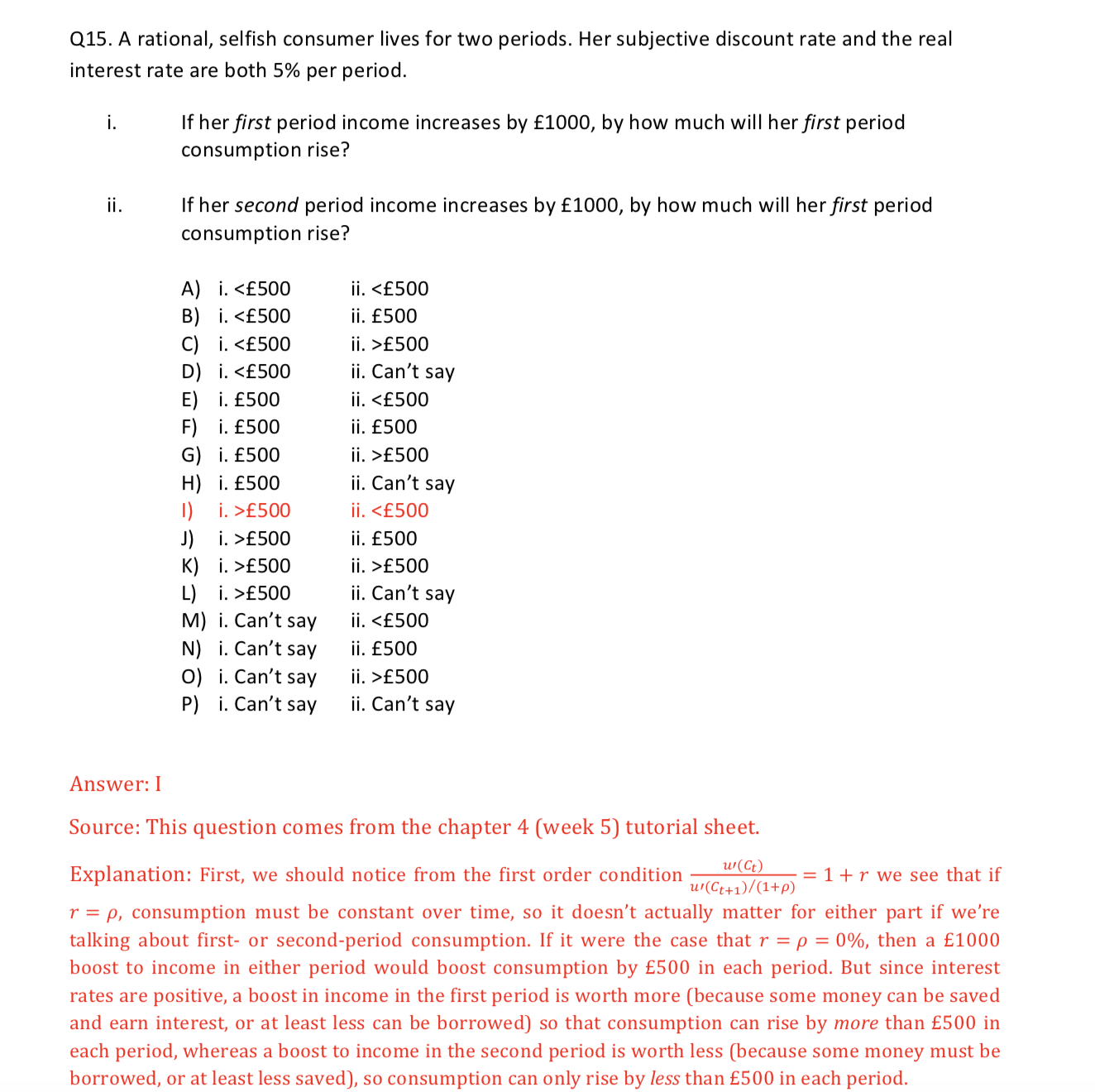
Q15. A rational, selfish consumer lives for two periods. Her subjective discount rate and the real interest rate are both 5% per period. If herrst period income increases by 1000, by how much will herrst period consumption rise? ii. If her second period income increases by 1000, by how much will herrst period consumption rise? A} i. 500 D) i. 500 H) i. 500 ii. Can't say I) i. >500 ii. 500 ll. 500 K} i. >500 ii. >500 L} i. >500 ii. Can't say M} i. Can't say ii. 500 P} i. Can't say ii. Can't say Answer: I Source: This question comes from the chapter 4 (week 5) tutorial sheet. \"'(Cz) \"'(Cc+1)/(1+P) r = p, consumption must be constant over time, so it doesn't actually matter for either part if we're Explanation: First, we should notice from the first order condition = 1 + r we see that if talking about first- or second-period consumption. If it were the case that r = p = 0%, then a 1000 boost to income in either period would boost consumption by 500 in each period. But since interest rates are positive, a boost in income in the first period is worth more [because some money can be saved and earn interest, or at least less can be borrowed] so that consumption can rise by more than 500 in each period, whereas a boost to income in the second period is worth less [because some money must be borrowed, or at least less saved], so consumption can only rise by less than 500 in each period
Step by Step Solution
There are 3 Steps involved in it

Get step-by-step solutions from verified subject matter experts
 Study Help