Question: Hello, I have a case study on this reading we have to do a case analysis My question is what are the Recommendation in this
Hello, I have a case study on this reading we have to do a case analysis My question is what are the Recommendation in this case analysiS
I only want an answer for a recommendation
thanks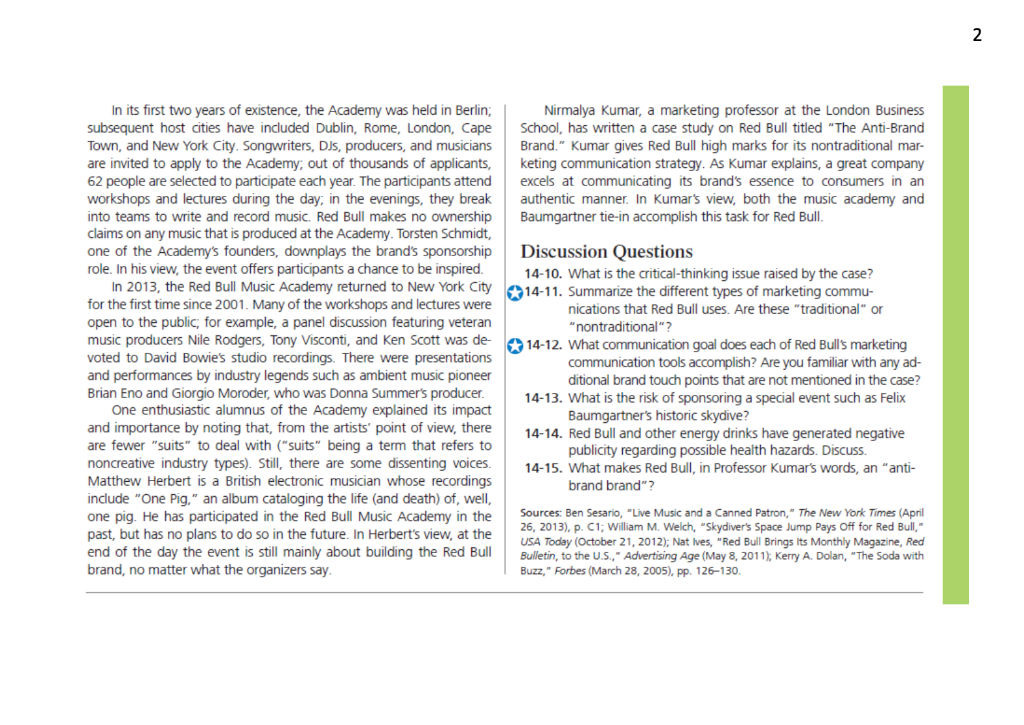
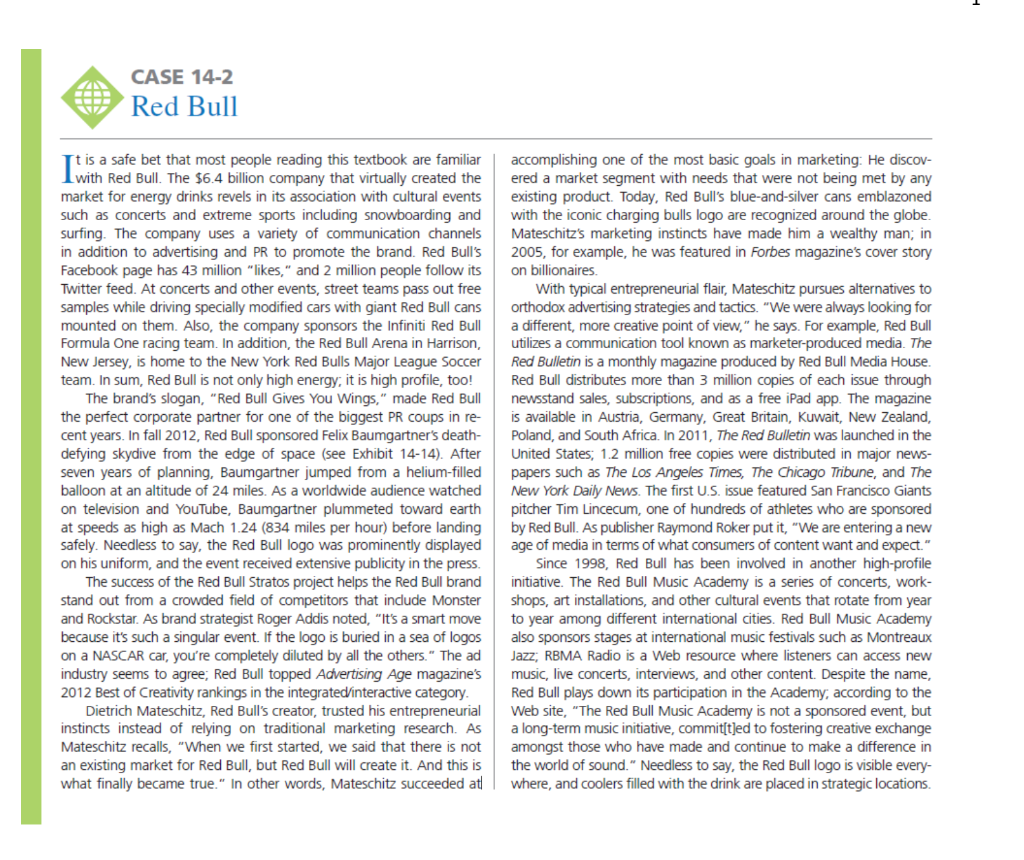
2 In its first two years of existence, the Academy was held in Berlin, Nirmalya Kumar, a marketing professor at the London Business subsequent host cities have included Dublin, Rome, London, Cape School, has written a case study on Red Bull titled "The Anti-Brand Town, and New York City. Songwriters, DJs, producers, and musicians Brand." Kumar gives Red Bull high marks for its nontraditional mar- are invited to apply to the Academy, out of thousands of applicants, keting communication strategy. As Kumar explains, a great company 62 people are selected to participate each year. The participants attend excels at communicating its brand's essence to consumers in an workshops and lectures during the day, in the evenings, they break authentic manner. In Kumar's view, both the music academy and into teams to write and record music. Red Bull makes no ownership Baumgartner tie-in accomplish this task for Red Bull. claims on any music that is produced at the Academy. Torsten Schmidt, one of the Academy's founders, downplays the brand's sponsorship Discussion Questions role. In his view, the event offers participants a chance to be inspired. 14-10. What is the critical thinking issue raised by the case? In 2013, the Red Bull Music Academy returned to New York City 14-11. Summarize the different types of marketing commu- for the first time since 2001. Many of the workshops and lectures were nications that Red Bull uses. Are these "traditional" or open to the public, for example, a panel discussion featuring veteran "nontraditional"? music producers Nile Rodgers, Tony Visconti, and Ken Scott was de voted to David Bowie's studio recordings. There were presentations 14-12. What communication goal does each of Red Bulls marketing communication tools accomplish? Are you familiar with any ad- and performances by industry legends such as ambient music pioneer ditional brand touch points that are not mentioned in the case? Brian Eno and Giorgio Moroder, who was Donna Summer's producer. 14-13. What is the risk of sponsoring a special event such as Felix One enthusiastic alumnus of the Academy explained its impact Baumgartner's historic skydive? and importance by noting that, from the artists' point of view, there 14-14. Red Bull and other energy drinks have generated negative are fewer "suits" to deal with ("suits" being a term that refers to publicity regarding possible health hazards. Discuss noncreative industry types). Still, there are some dissenting voices. 14-15. What makes Red Bull, in Professor Kumar's words, an "anti- Matthew Herbert is a British electronic musician whose recordings brand brand"? include "One Pig," an album cataloging the life and death) of, well, one pig. He has participated in the Red Bull Music Academy in the Sources: Ben Sesario, "Live Music and a Canned Patron, The New York Times (April past, but has no plans to do so in the future. In Herbert's view, at the 26, 2013), p. C1; William M. Welch, "Skydiver's Space Jump Pays off for Red Bull," USA Today (October 21, 2012); Nat Ives, "Red Bull Brings Its Monthly Magazine, Red end of the day the event is still mainly about building the Red Bull Bulletin, to the U.S.," Advertising Age (May 8, 2011); Kerry A. Dolan, "The Soda with brand, no matter what the organizers say. Buzz," Forbes (March 28, 2005), pp. 126-130. CASE 14-2 Red Bull It is a safe bet that most people reading this textbook are familiar I with Red Bull. The $6.4 billion company that virtually created the market for energy drinks revels in its association with cultural events such as concerts and extreme sports including snowboarding and surfing. The company uses a variety of communication channels in addition to advertising and PR to promote the brand. Red Bull's Facebook page has 43 million "likes," and 2 million people follow its Twitter feed. At concerts and other events, street teams pass out free samples while driving specially modified cars with giant Red Bull cans mounted on them. Also, the company sponsors the Infiniti Red Bull Formula One racing team. In addition, the Red Bull Arena in Harrison, New Jersey, is home to the New York Red Bulls Major League Soccer team. In sum, Red Bull is not only high energy, it is high profile, too! The brand's slogan, "Red Bull Gives You Wings," made Red Bull the perfect corporate partner for one of the biggest PR coups in re- cent years. In fall 2012, Red Bull sponsored Felix Baumgartner's death- defying skydive from the edge of space (see Exhibit 14-14). After seven years of planning, Baumgartner jumped from a helium-filled balloon at an altitude of 24 miles. As a worldwide audience watched on television and YouTube, Baumgartner plummeted toward earth at speeds as high as Mach 1.24 (834 miles per hour) before landing safely. Needless to say, the Red Bull logo was prominently displayed on his uniform, and the event received extensive publicity in the press The success of the Red Bull Stratos project helps the Red Bull brand stand out from a crowded field of competitors that include Monster and Rockstar. As brand strategist Roger Addis noted, "It's a smart move because it's such a singular event. If the logo is buried in a sea of logos on a NASCAR car, you're completely diluted by all the others." The ad industry seems to agree, Red Bull topped Advertising Age magazine's 2012 Best of Creativity rankings in the integrated interactive category. Dietrich Mateschitz, Red Bull's creator, trusted his entrepreneurial instincts instead of relying on traditional marketing research. As Mateschitz recalls, "When we first started, we said that there is not an existing market for Red Bull, but Red Bull will create it. And this is what finally became true." In other words, Mateschitz succeeded at accomplishing one of the most basic goals in marketing: He discov- ered a market segment with needs that were not being met by any existing product. Today, Red Bull's blue-and-silver cans emblazoned with the iconic charging bulls logo are recognized around the globe. Mateschitz's marketing instincts have made him a wealthy man; in 2005, for example, he was featured in Forbes magazine's cover story on billionaires With typical entrepreneurial flair, Mateschitz pursues alternatives to orthodox advertising strategies and tactics. "We were always looking for a different, more creative point of view," he says. For example, Red Bull utilizes a communication tool known as marketer-produced media. The Red Bulletin is a monthly magazine produced by Red Bull Media House. Red Bull distributes more than 3 million copies of each issue through newsstand sales, subscriptions, and as a free iPad app. The magazine is available in Austria, Germany, Great Britain, Kuwait, New Zealand, Poland, and South Africa. In 2011, The Red Bulletin was launched in the United States, 1.2 million free copies were distributed in major news- papers such as The Los Angeles Times, The Chicago Tribune, and The New York Daily News. The first U.S. issue featured San Francisco Giants pitcher Tim Lincecum, one of hundreds of athletes who are sponsored by Red Bull. As publisher Raymond Roker put it, "We are entering a new age of media in terms of what consumers of content want and expect." Since 1998, Red Bull has been involved in another high-profile initiative. The Red Bull Music Academy is a series of concerts, work- shops, art installations, and other cultural events that rotate from year to year among different international cities. Red Bull Music Academy also sponsors stages at international music festivals such as Montreaux Jazz, RBMA Radio is a Web resource where listeners can access new music, live concerts, interviews, and other content. Despite the name, Red Bull plays down its participation in the Academy, according to the Web site, "The Red Bull Music Academy is not a sponsored event, but a long-term music initiative, commit[t]ed to fostering creative exchange amongst those who have made and continue to make a difference in the world of sound." Needless to say, the Red Bull logo is visible every- where, and coolers filled with the drink are placed in strategic locations









 Study Help