Question: hello i need an answer for this case study as soon as possible. thank you. ill give likes. Case Study: Talent Management Lessons from Apple
hello i need an answer for this case study as soon as possible.
thank you.
ill give likes.
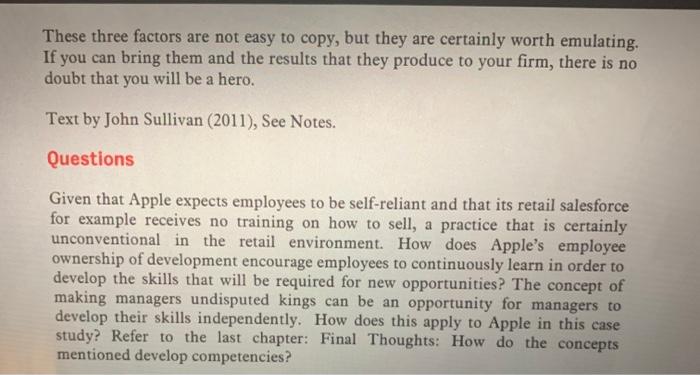
Case Study: Talent Management Lessons from Apple - A Case Study of the World's Most Valuable Firm The purpose of this case study was not to say that you should copy everything Apple does, but rather to point out that with relentless execution and focus on key factors even a firm near bankruptcy can fight its way back to the top. In 13 years Apple has transformed itself from an organisation of the verge of collapse to the world's most valuable firm, amassing a phenomenal innovation record in the process. While Apple's approach wouldn't work for every firm, there are lessons to be learned that can influence program design regardless of industry, firm size, or location. Make your employees "own" their learning, training and development because Apple frequently produces new products requiring expertise in completely different industries (i.e. computers, music devices, media sales, and telephony), its employee skill set requirements change faster than at almost any other tech firm. While there is plenty of training available, there is no formal attempt to give every employee a learning plan. Just as with career progression, employee training and learning are primarily "owned" by employees. The firm expects employees to be self-reliant. Its retail salesforce for example receives no training on how to sell, a practice that is certainly unconventional in the retail environment. The lesson is simple: providing target competencies and prescribing training can weaken employee self-reliance, an attribute problematic in a fast-changing environment. Employee ownership of development encourages employees to continuously learn in order to develop the skills that will be required for new opportunities. Make managers undisputed kings - Apple is not a democracy. Most direction and major decisions are made by senior management. "Twenty percent time" like that found at Google doesn't exist. While in some organisations HR is powerful when it comes to people management issues, at Apple, Steve Jobs has a well- carned reputation for deemphasising the power of HR. Although Apple was the first firm to develop an HR 411 line, I have concluded that most of the talent management innovations at Apple emanate from outside of the HR function. Make managers undisputed kings - Apple is not a democracy. Most direction and major decisions are made by senior management. "Twenty percent time" like that found at Google doesn't exist. While in some organisations HR is powerful when it comes to people management issues, at Apple, Steve Jobs has a well- carned reputation for deemphasising the power of HR. Although Apple was the first firm to develop an HR 411 line, I have concluded that most of the talent management innovations at Apple emanate from outside of the HR function. There is a concerted effort to avoid having decisions made by "committees." Putting the above factors together, it is clear that at Apple, managers are the undisputed kings. The resulting decrease in overhead function interference, coupled with the increased authority and accountability, helps to attract and retain managers that prefer control. Unfortunately, concentrating the authority 38 People and Talent Management-A concise approach has resulted in having some managers being accused of micromanagement and abusing team members. Having a product focus drives focus, cooperation, and integration - Apple is notably famous in the business press for its "product-focused" approach (versus a functional or regional focus). Everything from strategy to budgets to organisational design and talent management functions are designed around the product." One of the primary goals of talent management is to ensure that the workforce is focused on the strategic elements that drive company success. That focus can be distracted with selfish or self-serving behaviour that instead shifts the emphasis to the individual, a business function, a particular business unit or even a region. Although deciding to have a product focus is normally a business decision, it turns out that Apple's strong product focus also has significant nositive impacts contient management has resulted in having some managers being accused of micromanagement and abusing team members. Having a product focus drives focus, cooperation, and integration - Apple is notably famous in the business press for its "product-focused" approach (versus a functional or regional focus). Everything from strategy to budgets to organisational design and talent management functions are designed around the product." One of the primary goals of talent management is to ensure that the workforce is focused on the strategic elements that drive company success. That focus can be distracted with selfish or self-serving behaviour that instead shifts the emphasis to the individual, a business function, a particular business unit or even a region. Although deciding to have a product focus is normally a business decision, it turns out that Apple's strong product focus also has significant positive impacts on talent management. Apple purposely offers only a relative handful of products, so employee focus isn't dispersed among hundreds of products as it is at other firms. By releasing products only when it can have a major market impact, Apple essentially guarantees that every employee can brag that they contributed to an industry- dominating product that everyone is aware of. This focus on product helps to contribute to employees feeling that they are "changing the world." This focus may also reduce the chance that employees will notice that the day-to-day work environment with its politics and the required secrecy may be less than perfect. And because Apple is no longer a small firm, with nearly 50,000 employees, a unifying and inspiring theme is required to maintain cohesion and a single sense of purpose. Final Thoughts Although Apple clearly produces extraordinary results, its approach to talent management is totally different than that of Google and Facebook, which also produce industry-dominating results. As Apple has grown larger, its rigour around sustainable innovation has grown as well, a feat that proves impossible for most organisations including the likes of HP, Microsoft, and Yahoo. The three "big picture" learnings I hope you walk away from this case study with include: Final Thoughts Although Apple clearly produces extraordinary results, its approach to talent management is totally different than that of Google and Facebook, which also produce industry-dominating results. As Apple has grown larger, its rigour around sustainable innovation has grown as well, a feat that proves impossible for most organisations including the likes of HP, Microsoft, and Yahoo. The three "big picture" learnings I hope you walk away from this case study with include: 1. Focus on the work it is management's responsibility to do whatever is necessary to keep work exciting and compelling. 2. Strive for continuous innovation - Apple's emphasis on being "different" is so strong that it can't be overlooked by any employee or applicant. It delivers industry-dominating innovation levels because everyone is expected to 3. Deliver on your brand - Apple works hard to make sure that potential applicants, employees, and even competitors admire its products, the firm, and how it operates. People and Talent Management-A concise approach/39 These three factors are not easy to copy, but they are certainly worth emulating. If you can bring them and the results that they produce to your firm, there is no doubt that you will be a hero. These three factors are not easy to copy, but they are certainly worth emulating. If you can bring them and the results that they produce to your firm, there is no doubt that you will be a hero. Text by John Sullivan (2011), See Notes. Questions Given that Apple expects employees to be self-reliant and that its retail salesforce for example receives no training on how to sell, a practice that is certainly unconventional in the retail environment. How does Apple's employee ownership of development encourage employees to continuously learn in order to develop the skills that will be required for new opportunities? The concept of making managers undisputed kings can be an opportunity for managers to develop their skills independently. How does this apply to Apple in this case study? Refer to the last chapter: Final Thoughts: How do the concepts mentioned develop competencies









 Study Help