Question: Hello I need help with problem 3a. terminology, his result is essentially our above table of the ssible finite groups of rotations (proper and improper)

Hello I need help with problem 3a.
Hello I need help with problem 3a. terminology,Hello I need help with problem 3a. terminology,
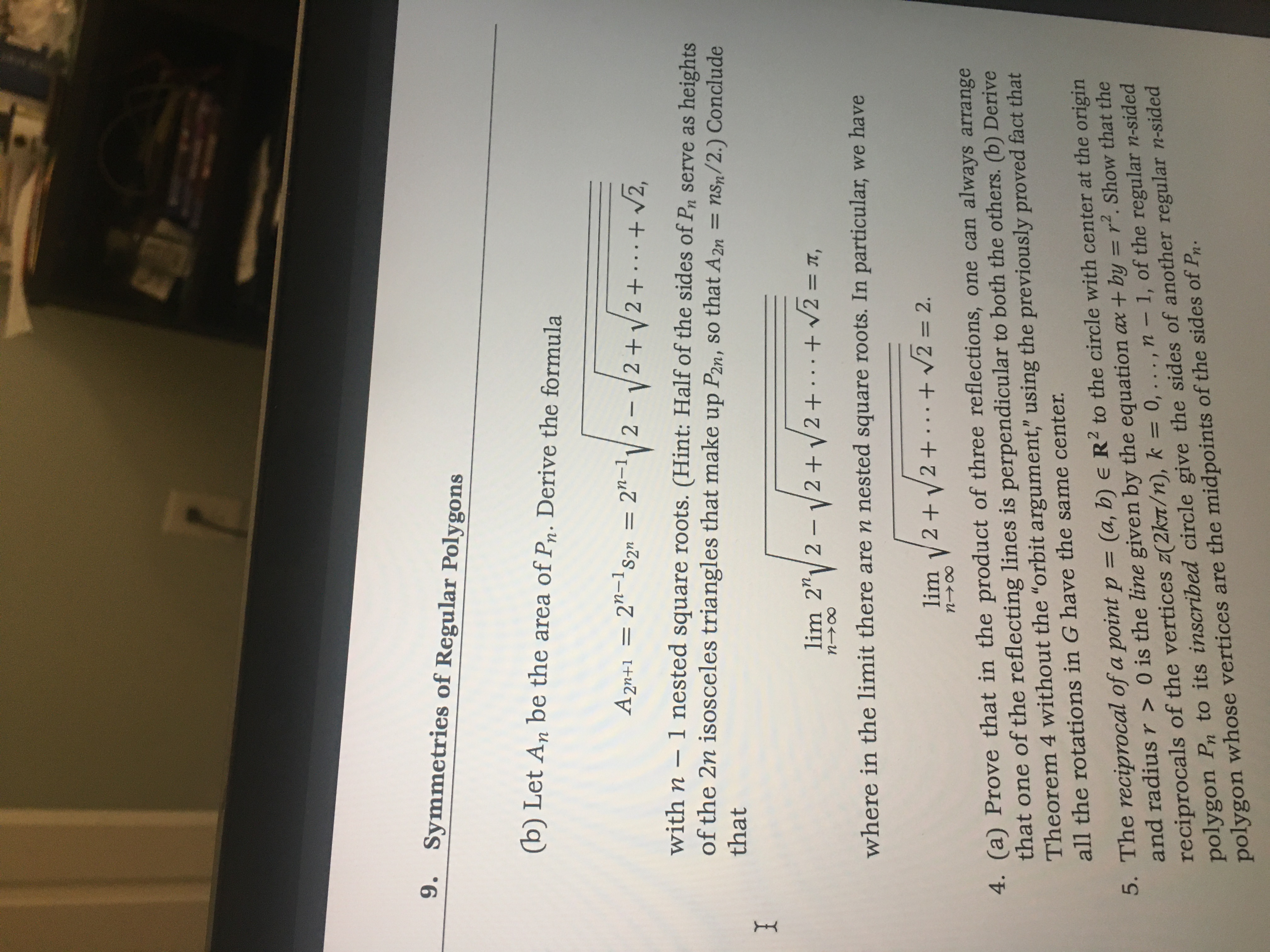
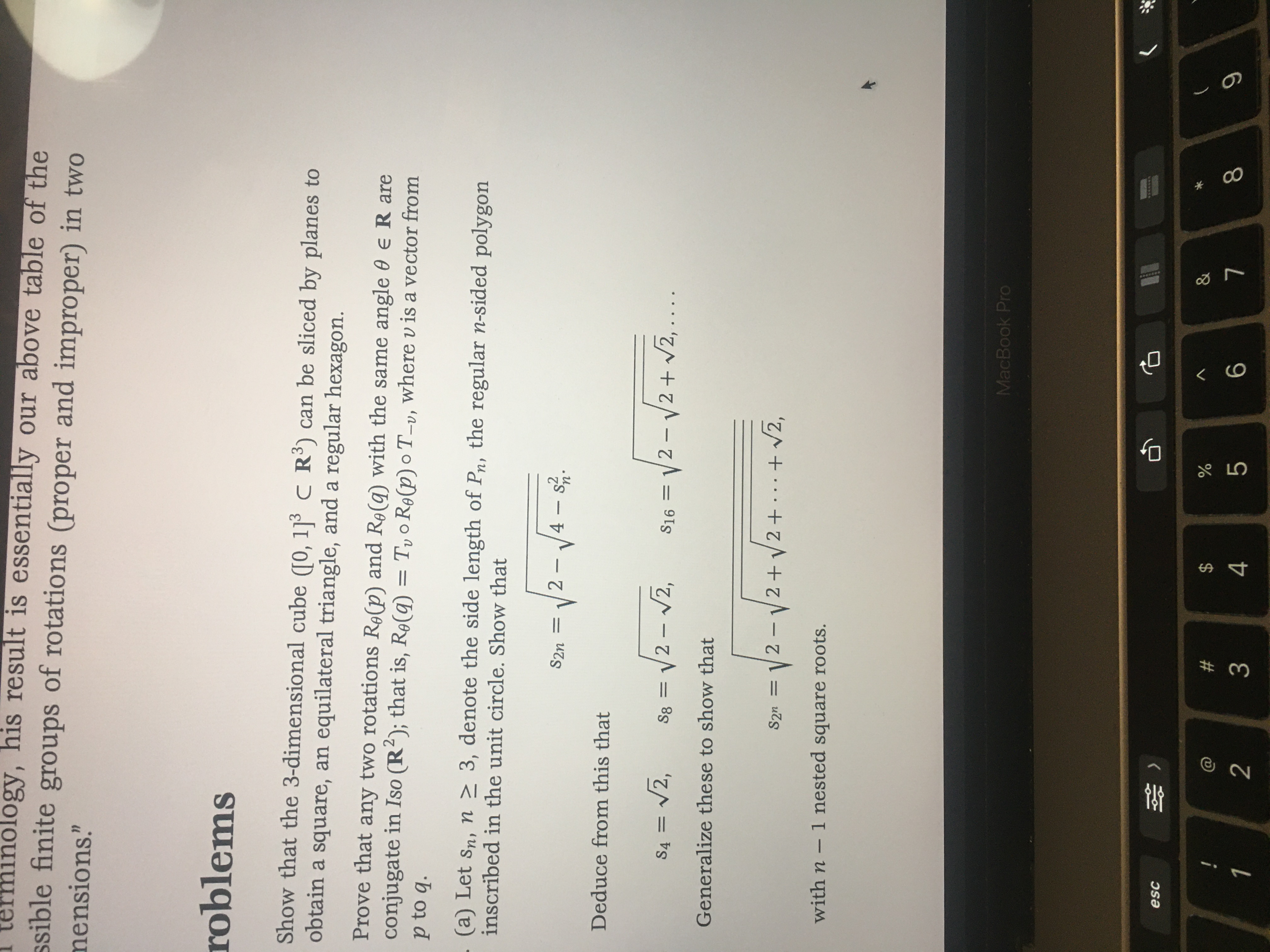
terminology, his result is essentially our above table of the ssible finite groups of rotations (proper and improper) in two nensions." roblems Show that the 3-dimensional cube ([0, 1]3 C R3) can be sliced by planes to obtain a square, an equilateral triangle, and a regular hexagon. Prove that any two rotations Re(p) and Re(q) with the same angle 0 E R are conjugate in Iso (R2); that is, Re(q) = Tvo Re(p) . T-v, where u is a vector from p to q. (a) Let Sn, n 2 3, denote the side length of Pn, the regular n-sided polygon inscribed in the unit circle. Show that San 12 - 14 - Sm. Deduce from this that $4 = V2, S8 = V2 - V2, $16 = V2 - V2 + 12,.... Generalize these to show that S2n = 12 - V2 + V 2+ ... + V2 , with n - 1 nested square roots. MacBook Pro esc # $ % & @ 4 5 6 8 9 2 39. Symmetries of Regular Polygons (b) Let An be the area of Pn. Derive the formula Anti = 20-1s2n = 2n-1\\/2 -V2+V2+...+ v2, with n - 1 nested square roots. (Hint: Half of the sides of Pn serve as heights that of the 2n isosceles triangles that make up Pan, so that Azn = nsn/2.) Conclude I lim 2\\/ 2 - V2 + V2+ ... + V2= 1, where in the limit there are n nested square roots. In particular, we have lim V2 + V 2+ ... + V2 = 2. n -+ 0o 4. (a) Prove that in the product of three reflections, one can always arrange that one of the reflecting lines is perpendicular to both the others. (b) Derive Theorem 4 without the "orbit argument," using the previously proved fact that all the rotations in G have the same center. 5. The reciprocal of a point p = (a, b) E R2 to the circle with center at the origin and radius r > 0 is the line given by the equation ax + by = r2. Show that the reciprocals of the vertices z(2kx), k = 0, ..., n - 1, of the regular n-sided polygon Pn to its inscribed circle give the sides of another regular n-sided polygon whose vertices are the midpoints of the sides of Pn

Step by Step Solution

There are 3 Steps involved in it

1 Expert Approved Answer
Step: 1 Unlock blur-text-image

Question Has Been Solved by an Expert!

Get step-by-step solutions from verified subject matter experts

Step: 2 Unlock
Step: 3 Unlock

Students Have Also Explored These Related Mathematics Questions!