



Question: Hello I need help with this IRAC I just need the ANALYSIS of the case? Mendez v. Westminster Court United States Court of Appeals for
Hello I need help with this IRAC I just need the ANALYSIS of the case?
| Mendez v. Westminster | |
| Court | United States Court of Appeals for the Ninth Circuit (Links to an external site.) |
| Full case name | Mendez et al. v. Westminster School Dist. of Orange County et al. |
| Argued | February 18, 1946 |
| Decided | April 14, 1947 |
| Citation(s) | 161 F.2d (Links to an external site.) 774 (Links to an external site.) (9th Cir. 1947) |
| Case history | |
| Prior action(s) | 64 F.Supp. (Links to an external site.) 544 (Links to an external site.) (C.D. Cal. (Links to an external site.) 1946) |
| Holding | |
| Separate educational facilities primarily used to segregated pupils are inherently unequal and violate the Equal Protection Clause (Links to an external site.), even if such facilities have the same layout and equal amenities, due to the notion that segregation promotes the creation of biases and hinders the linguistic and cultural commonality between such segregated groups. | |
| Court membership | |
| Judge(s) sitting | Francis Arthur Garrecht (Links to an external site.), William Denman (Links to an external site.), Clifton Mathews (Links to an external site.), Albert Lee Stephens Sr. (Links to an external site.), William Healy (Links to an external site.), William Edwin Orr (Links to an external site.) |
| Laws applied | |
| U.S. Const. amend. XIV (Links to an external site.) Section 1 of Article IX of the Constitution of California (Links to an external site.) Cal. Ed. Code 8002-8004, 8251, 8501, 10051, 16004, 16005 (Links to an external site.) | |
Mendez, et al v. Westminister [sic] School District of Orange County, et al, 64 F.Supp. 544 (S.D. Cal. 1946),[1] (Links to an external site.) aff'd, 161 F.2d 774 (9th Cir. 1947) (en banc),[2] (Links to an external site.) was a 1947 federal court case that challenged Mexican remedial schools in Orange County, California (Links to an external site.). In its ruling, the United States Court of Appeals for the Ninth Circuit (Links to an external site.), in an en banc (Links to an external site.) decision, held that the forced segregation of Mexican American (Links to an external site.) students into separate "Mexican schools" was unconstitutional and unlawful, not because Mexicans were "white," as attorneys for the plaintiffs argued, but because as US District Court Judge Paul J. McCormick ruled, "The equal protection of the laws pertaining to the public school system in California is not provided by furnishing in separate schools the same technical facilities, textbooks and courses of instruction to children of Mexican ancestry that are available to the other public school children regardless of their ancestry. A paramount requisite in the American system of public education is social equality. It must be open to all children by unified school association regardless of lineage."[3] (Links to an external site.) Magistrate McCormick went as far to state that "The evidence clearly shows that Spanish-speaking children are retarded in learning English by lack of exposure to its use because of segregation, and that commingling of the entire student body instills and develops a common cultural attitude among the school children which is imperative for the perpetuation of American institutions and ideals."
Five Mexican-American fathers (Thomas Estrada, William Guzman, Gonzalo Mendez, Frank Palomino, and Lorenzo Ramirez) challenged the practice of Mexican school segregation in the United States District Court for the Central District of California (Links to an external site.), in Los Angeles (Links to an external site.). They claimed that their children, along with 5000 other children of "Mexican" ancestry, were victims of unconstitutional discrimination by being forced to attend separate "schools for Mexicans" in the Westminster (Links to an external site.), Garden Grove (Links to an external site.), Santa Ana (Links to an external site.), and El Modena (Links to an external site.) school districts of Orange County (Links to an external site.).
Mexican American school children in the 1940s
Mexican Americans, who were then considered to be white, were normally unaffected by legal segregation and, in general they always went to segregated white schools. The Mendez family, who previously went to white schools without problems, suddenly found their children forced into separate "Schools for Mexicans" when they came to Westminster - even though that was not the norm and it was not legally sanctioned by the state. In the 1940s, a small minority of school districts began to establish separate language-based "Mexican Schools", arguing that Mexican children had special needs because they were Spanish (Links to an external site.) speakers. The schools existed only for elementary children (K-4) and were intended to prepare them for mainstream schools. But, since many districts began forcing all Mexican elementary school children into "Mexican Schools" irrespective of language ability, it became a form of unlawful discrimination that was superficially similar to legalized race segregation.
Soledad Vidaurri went to the Westminster Elementary School District (Links to an external site.) to enroll her children and those of her brother Gonzalo Mendez: Gonzalo, Geronimo, and Sylvia (Links to an external site.). The Westminster School informed Viduarri that her children could be admitted to the school. However, Gonzalo, Geronimo, and Sylvia could not be admitted on the basis of their skin color. (Viduarri's children had light complexions and Basque (Links to an external site.) surnames and so would not be segregated into a different school.) Upon hearing the news, Viduarri refused to admit her children to the school if her brother's children were not admitted as well. The parents, Gonzalo and Felicitas Mendez (Links to an external site.), tried to arrange for Geronimo, Gonzalo, and Sylvia to attend the school by talking to the school administration, but both parties were not able to reach an agreement.
Gonzalo dedicated the next year to a lawsuit against the Westminster School District of Orange County. The school district offered to compromise by allowing the Mendez children to attend the elementary school without any other student of Mexican-American descent.
The Mendez family declined the offer and continued the lawsuit. The Mendez family believed in helping out the entire Mexican community, instead of a handful of children. The Mendez family covered most of the expenses for the various witnesses that would be present in the case.[4] (Links to an external site.)
The plaintiffs were represented by an established Jewish American civil rights attorney David Marcus. Funding for the lawsuit was primarily paid for initially by the lead plaintiff Gonzalo Mendez, who began the lawsuit when his three children were denied admission to their local Westminster school.[5] (Links to an external site.)
Senior District Judge Paul J. McCormick, sitting in Los Angeles (Links to an external site.), presided at the trial and ruled in favor of Mendez and his co-plaintiffs on February 18, 1946 in finding that separate schools for Mexicans to be an unconstitutional denial of equal protection.[6] (Links to an external site.) The school district appealed to the Ninth Federal Circuit Court of Appeals in San Francisco, which upheld Judge McCormick's decision finding that the segregation practices violated the Fourteenth Amendment. Although the case was a victory for the families affected, it was narrowly focused on the small number of Mexican remedial schools in question and did not challenge legal race segregation in California or elsewhere. After Mendez, racial minorities were still subject to legal segregation in schools and public places.
Aftermath[edit (Links to an external site.)]
Governor Earl Warren (Links to an external site.), who would later become Chief Justice of the United States, where he would preside over the Brown v. Board of Education (Links to an external site.) case, signed a law outlawing segregation only where it was not legal - he did not end legal segregation for non-white minorities in California. Several organizations joined the appellate case as amicus curiae, including the NAACP (Links to an external site.), represented by Thurgood Marshall (Links to an external site.) and Robert L. Carter[7] (Links to an external site.) and the Japanese American Citizens League (Links to an external site.) (JACL). More than a year later, on April 14, 1947, the United States Court of Appeals for the Ninth Circuit affirmed the district court's ruling but not on equal protection grounds. It did not challenge the "separate but equal" interpretation of the Fourteenth Amendment that had been announced by the Supreme Court in Plessy v. Ferguson (Links to an external site.) in 1896. Instead, the Ninth Circuit held that the segregation was not racially based, but it had been implemented by the school districts without being specifically authorized by state law, and it was thus impermissible irrespective of Plessy.
Legacy[edit (Links to an external site.)]
On December 8, 1997, the Santa Ana Unified School District dedicated the Gonzalo and Felicitas Mendez Intermediate Fundamental School in Santa Ana, California.
In 2003, writer/producer Sandra Robbie received an Emmy Award for her documentary Mendez vs. Westminster: For All the Children / Para Todos los Nios.
On September 14, 2007, the US Postal Service (Links to an external site.) honored the 60th anniversary of the ruling with a 41-cent commemorative stamp.[8] (Links to an external site.) On November 15, 2007, it presented the Mendez v. Westminster stamp (Links to an external site.) to the Mendez family, at a press conference at the Rose Center Theater (Links to an external site.) in Westminster (Links to an external site.), California (Links to an external site.).
In September 2009, Felicitas and Gonzalo Mendez High School (Links to an external site.) opened in Boyle Heights. The school was named after Felicitas and Gonzalo Mendez, parents of American civil rights activist Sylvia Mendez (Links to an external site.), who played an instrumental role in the case.
On October 14, 2009, Chapman University (Links to an external site.)'s Leatherby Libraries (Links to an external site.) dedicated the Mendez et al v. Westminster et al Group Study Room and a collection of documents, video and other items relating to the landmark desegregation case. Chapman also owns the last standing Mexican school building from the segregation era in Orange County.
On February 15, 2011, President Barack Obama (Links to an external site.) awarded the Presidential Medal of Freedom (Links to an external site.) to Sylvia Mendez, the daughter of Gonzalo Mendez, the lead plaintiff in the lawsuit. She, along with her two brothers, Gonzalo, Jr. and Jerome, were some of the Mexican-American students who were denied admission to their local Westminster school, which formed the basis for the suit. Sylvia was awarded the honor for her many years of work encouraging students to stay in school and to ensure that the importance of Mendez v. Westminster in American history will not be forgotten.[5] (Links to an external site.)
In September 2011, the Museum of Teaching and Learning (MOTAL) (Links to an external site.), in partnership with a half-dozen government agencies and universities, opened a nine-month exhibition about the case at the Old Orange County Courthouse (Links to an external site.) in Santa Ana, California. The exhibition, for which the team won a 2013 Award of Merit from the American Association for State and Local History (Links to an external site.), continues to travel to other locations to educate the public, both adults and students, about the details around this landmark case
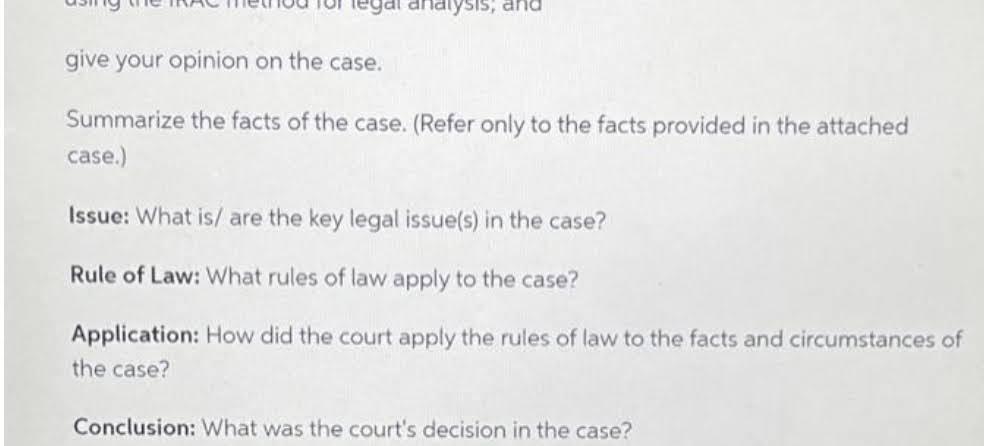
legal analysis, and give your opinion on the case. Summarize the facts of the case. (Refer only to the facts provided in the attached case.) Issue: What is/ are the key legal issue(s) in the case? Rule of Law: What rules of law apply to the case? Application: How did the court apply the rules of law to the facts and circumstances of the case? Conclusion: What was the court's decision in the case
Step by Step Solution
There are 3 Steps involved in it

Get step-by-step solutions from verified subject matter experts